somewhere, there is a mathematical formula that can predict the drag pressure generated by a drag stack based on the size of the washer and the number of washers in the stack. it most certainly involves calculus. um, i had a full year of college calculus. i hated every moment of it, forgot it the day after i finished the class and have never used it since.
drag washers come in stacks of varying heights. the simplest stack is a "1+1" arrangement. you don't get alot of drag out of this arrangement unless the drag washers are particularly large.
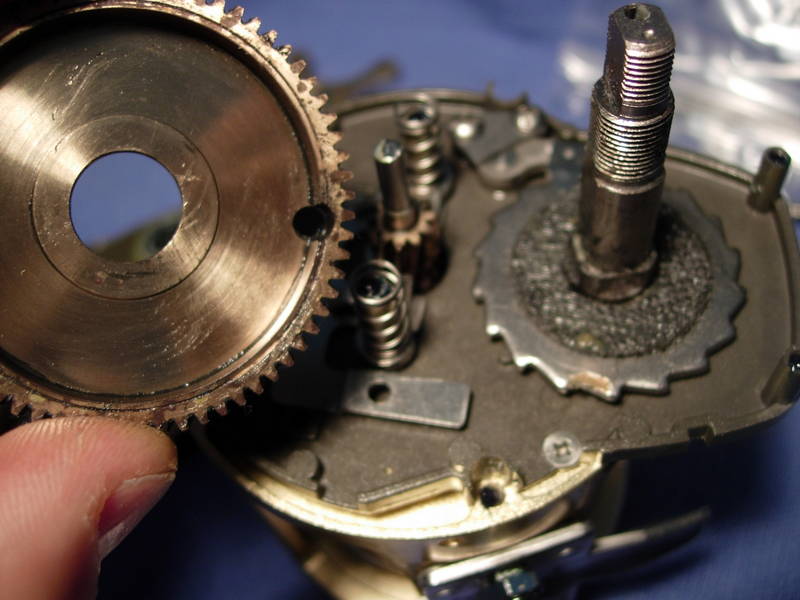
the next arrangement is a "1+3." this is what you find in the smaller trinidads and toriums. you have one drag washer underneath the main gear and three drag washers inside.
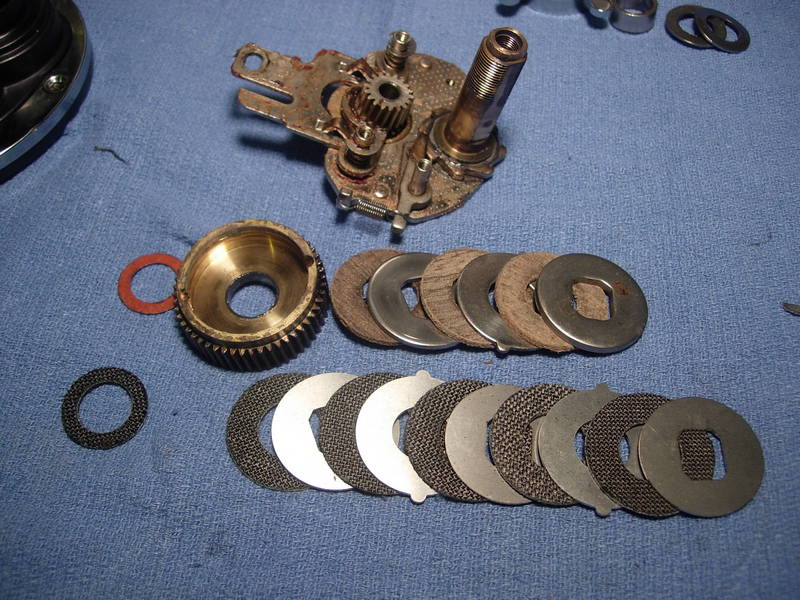
the next most common stack is a "1+5." this photo is missing the last metal drag washer, but that's ok. you see the pattern.
you've seen this stack before. what's this one? is it a "1+3" orientation, or more?
if you guessed "1+5," then you guessed correctly. the drag washers in the photo above most likely have a fiberglass core that behaves like a tabbed metal washer. the carbon fiber is simply "stuck" to those fiberglass "washers."
1. How does each component of the stack function under reeling and fighting pressure?
the most basic "drag" system is a piece of carbon fiber wedged between two metal plates. one of the metal plates will be stationary and one will be in motion. a free-floating double sided carbon fiber washer will "stick" to the metal surface with the higher coeffecient of friction. yup, the carbon fiber will stick to the surface that is stickier and slide against the surface that is not. this also applies to multi-stack drag systems.
there's no telling which metal washer the carbon fiber drag washer will "stick" to, and functionally it does not matter. now for the next question,
2. Does your entire drag stack function based on the load of the last and smallest of the washers?
it does not. here is the modified drag stack for the daiwa 900h. the original "1+3" drag and metal washers were pretty thick so there was no way to easily turn this into a "1+5" stack. it actually required new carbon fiber drag washers AND new thinner metal washers. it is important to note that the "1+3" drag stack delivered a mere 20 pounds of drag which was way too low for this reel. the newer "1+5" drag stack delivered 35 pounds of drag.
the important message here is that each of the carbon fiber drag washers inside the main gear contributed approximately 7 pounds of drag to the total. the small drag washer under the main gear contributed virtually nothing. but most importantly, the small drag washer under the main gear did not appear to limit the drag range.
there is probably a calculus equation that would explain all of this........ alan