
Finnseeker
Senior Member

Circle Fish Hooks versus Octopus Fish Hooks
There is so much hype about the relative efficiency of different fish hooks that it is hard to know which is fish hook best for the fisherman, or the fishery!
In large scale hook efficiency research over the last six years involved in the setting of 60,000 hooks over several research projects to answer just that question.
The the small portion of the extensive work fish hook patterns (J shaped hooks) with Circle fish hooks.
It also tests whether tying or snelling the hook to the fishing line makes any difference to the catch rate and reports the observed incidence of gut hooking where fish have swallowed the hook. Only size 4/0 and 5/0 hooks were trialled.
The sea trials were undertaken in the New Zealand snapper fishery in the Hauraki Gulf (within 15 miles of the Americas Cup course).

This fishery is NZ's biggest inshore fishery for both commercial and recreational fishers.

The sea trials used four 116 hook longlines which were set daily at sunrise.
The lines were left to fish for 1-2 hours.
Longlines were used to avoid any angler bias due to the different abilities and fishing styles of different fishers.
Each set of the longlines had circle hooks on half the traces (snoods). The other half were a combination of Octopus hooks.
The graph above shows the circle hooks seriously out performed the popular J shaped hooks in all size classes of snapper.
The much higher catch of undersized fish on the circle hooks is of some concern.
An article about hook snelling can be found at the following link hook snelling
Tying versus Snelling Fish Hooks
Commercial fishers in NZ use a type of circle hook (Tainawa pattern, Jap Hook) and snell their hooks to the fishing line.
Most recreational fishers tie a knot to the eye of the hook as shown in the diagram on the right.
As one would expect, the commercial fishers had it right.
Snelling improved the observed catch rate on circle hooks by a staggering 30% while gut hooking of the catch was about the same.

[align=left]Circle Hooks Tied[/align]
[align=center]138[/align]
[align=center]10[/align]
[align=center]148[/align]
[align=left]Circle Snelled Hooks[/align]
[align=center]198[/align]
[align=center]12[/align]
[align=center]210[/align]
O'Shaugnessy & Octopus Tied
[align=center]69[/align]
[align=center]5[/align]
[align=center]74[/align]
[align=left]O'Shaugnessy & Octopus Snelled[/align]
[align=center]60[/align]
[align=center]21[/align]
[align=center]81[/align]
Note*
- Lip hooked is a fish caught in the mouth which can be released [/*]
- Gut hooked is a fish which has swallowed the hook and is highly unlikely to survive release
[/*]
[align=center]
The snelled circle hooks caught around 10% more than the tied
NOTE : The results for commercial circle hooks, a Tainawa Pattern, and the circle hooks in the attached diagram are shown later in the report.
The tables below give further details on the gut hooking rates and undersized fish mortality by hook type and compare tying hooks with snelling hooks to the fishing trace.
[/align]
- Lip hooked is a fish caught in the mouth which can be released [/*]
- Gut hooked is a fish which has swallowed the hook and is highly unlikely to survive release
[align=center]
Catch Rates
An equal number of each hook and knot type were fished and a vast difference in the catch rates were observed.
The snelled circle hook caught the most snapper by far (210 fish) followed by the tied circle hook (148 fish).
O'Shaugnessy & Octopus hooks whether tied or snelled caught about the same number of fish each (average 78). The snelled circle hook caught around three times as many snapper as the O'Shaugnessy & Octopus hooks.
Want to find out how to do snell knots, it is one of the strongest fishing knots around. Find out how to snell hooks here
Gut Hooking Rates
The circle hooks gut hooked the lowest proportion of the snapper catch. Circle snelled hooks gut hooked around 4% of the catch while tied circle hooks gut hooked 7% of the catch. However the circle snelled hooks caught around three times as many undersized fish, so will likely gut hook as many fish as O'Shaugnessy & Octopus hooks would for the same amount of fishing effort
The snelled O'Shaugnessy hooks caught around 10% more than the tied version but observed gut hooking of the catch increased from 7% to 26%
Best Hook for the Fisherman
From the observed data Circle hooks are the most efficient hook particularly when snelled to the fishing line. Learn how to tie your own snell knots here

Snelling is a very simple method of fishing hook knot tying and the snell knot is the strongest of all saltwater fishing hook knots.
Tying fishing hooks
- First pass the trace through the eye of the hook from the front of the hook. Only pass it through about half an inch. [/*]
- Hold the shank of the hook and the half inch tab end and wrap the trace around both the shank of the hook and the tab end 7 or 8 turns. [/*]
- Pass the trace back down through the eye of the hook from the back of the hook. [/*]
- Pull the trace tight while holding the hook to set the snell. [/*]
- There should be very little or no tag end protruding when the knot is set.
If the hook curls up towards the trace you have snelled the hook correctly. We believe that snelling a hook like this makes the trace act as a spring and improves the hook up rate and also prevents the fish from throwing the hook.
For Pilchards

When tying a two hook pilchard rig, we have found that keeping the hooks in line further improves both your catch rate and the ability of the rig to hold soft baits or live baits.
NOTE :
If using whole fish baits, put one hook through the head and the other hook through the body behind the gut cavity and make sure the second hook goes around the spine of the bait fish.
The head of the bait should be on the bottom hook

Dead baits are simple and straight forward, just simply mount the hook in the snout of the fish bait as shown below:

Live baits are a mounted with a bit more difficulty. Firstly mount a doubled length of dental floss on the curve of the hook, with a clove-hitch. Then mount the dental floss on a large sewing needle.

Take the needle, and pass it though the eye socket of the live Mackerel to the rear of the eye ball. Without puncturing the eye! This will mount the hook by a very secure part of the bait fish, but preserve a natural presentation

Remove the needle from the dental floss, and hook the doubled end of the floss over the hook point.

Now twist the hook in a clockwise or anti-clockwise direction, to take up the slack in the dental floss.

Now take the hook point and pass it under the point where the dental floss first crosses the Mackerel's head. Pass the hook from front to back.

Finally, move the shank of the hook up under the dental floss, so that the hook is positioned on the top of the bait's head.

The bridle rigging method described above actually takes longer to read, than to carry out, it is just a matter of a little practice and preparation

[align=center]Circle Hooks for Soft Plastics
Many anglers have been asking about circle hooks. The reason for angler interest is that circle hooks are safer for fish due to the fact that the circle hooks very often slide into the jaw corner before penetrating the fish's mouth. There is less chance to deeply hook a fish. Conservation-minded catch-and-release anglers like that! So far, circle hooks are becoming well-accepted for live bait applications. Why? Fish help hook themselves as they try to swim away with a bait, the hook is hard for a fish to throw during the fight, plus fish can be released with less damage to its mouth tissue. All very good! However, artificial lure fishermen are still wondering - can circle hooks be used with lures such as soft plastic baits? [/align]
The answer is a partial YES. I have used a circle style hook - the Yamamoto Crooked hook - with soft stickbaits, floating worms, tubes, and grubs. At least for these baits fished in the manners described below, the Yamamoto Crooked hook does work as desired - hooking fish in the corner of the jaw with only line pressure as they swim away with the bait! Mind you, these are mostly OPEN WATER or LIGHT COVER applications on a slack or semi-slack line where there is either no weight used or else the bait is separated from the weight by a short trace of leader line. I believe that the circle style Split Shot hooks excel in such situations.
In weeds, moderate to heavy cover, or for "dragging" bottom on Carolina rigs, I caution you against using circle style hooks. You are likely to pick up too many weeds or get snagged with exposed circle style hooks. In weedy or snaggy environs, you may want to stick with an offset shank rigging hook hidden in the bait when fishing weeds, snags, and for "dragging" bottom. But in this article, let's keep talking about these incredible little circle style hooks, okay?
[align=right]Gary Yamamoto Crooked hooks. These are a special kind of rounded, short shank hook made exclusively for Gary by Gamakatsu. Very strong steel. In size and shape, Split Shot hooks closely approximate what's more commonly known as a circle hook. However, the bend of the Split Shot hook is much better designed for seating soft plastic baits properly on the bend of the hook. Why is the bend better? Because it is what I can only describe as "squarer" that a true circle hook bend. This allows the bait to poise much more comfortably nestled in the crook of the Split Shot hook as compared to a true circle hook.[/align]
Actually, "Split Shot" is a poor name for this hook because it does much more than just splitshotting. It is also a good hook for "wacky worming" and for nose-hooking trick worms, floating worms and soft plastic stickbaits, plus single tail grubs and other soft plastics. Let me tell you how I've used it...so far!
Yamamoto Ika (solid-bodied tube bait alternative)
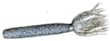
1) Weightless Near Surface. You just insert the Split Shot hook crossways through the nose of the Ika, cast it out and start twitching it under the surface. Let it fall dead too. When a fish takes, you let the fish go down and swim away from you with the Ika. Don't worry, they won't let go. Just start reeling in line and the steady, gentle pressure of a slow sideways sweep of the rod tip causes the circle-style hook to catch in the corner of the jaw, hooking the fish without actually "setting" the hook!
2) Splitshot - Suspended. This is simply adding a light splitshot a few feet up the line from the weightless Ika with the Split Shot circle-style hook. You let it drift down through suspended fish - or engage the reel, thereby holding the bait at the depth that the fish are found. You can deadstick it or shake it.
Yamamoto Senko (soft subsurface stickbait)

1) Wacky Rig. Gary Yamamoto's exclusively-made Gamakatsu "Split Shot" hook excels for this. In shallow water (0 to 6' deep) you can rig it "wacky" with the little Split Shot hook in the middle and unweighted. If you want to get deeper than this, stick a small piece of solder or nail weight right in the middle where you put the hook. Keep in mind that all Yamamoto baits are made of denser plastic which is slightly heavier and sinks faster than other plastics. With or without an embedded weight, just let it settle down to the bottom and shake the rod tip slightly from time to time during its descent. Hooked and weighted properly in the middle, the Senko should sort of flutter back and forth as it falls.
2) Split Shot Rig. You can stick the Split Shot hook straight through the nose about 3-4 ribs back, then pinch a few split shot two feet up the line to sink it quickly about 10 to 20 feet deep...then just deadstick it or start twitching it back through mid-water where your electronics mark suspended fish.
Trick Worms, Floating Worms (soft topwater stickbaits)

1) Nose-piercing. I like to use big, buoyant floater worms about 7" long. I am sure many vendors make good worms to use... Zoom, Gambler Worms...many others. Simply pierce them through the nose! When nose-piercing, you can use an incredibly small size of Split Shot hook! Such a small size lets the worm float better and it avoids weeds/snags better.
2) Cuckoo Bird. To make this rig, simply pass the Split Shot hook through the bait - about 1/4 to 1/3 the body length back from the bait's nose. I use a larger size hook than when nose-piercing. Cast this quivering Cuckoo Bird weightless in open patches around cover for topwater twitching action. Rig it with a light splitshot 2 feet up the line - let it sink to the bottom in shallow water - and twitch it as it sinks, suspends and darts like crazy. My friend Eto invented this rigging as far as I know. Try it, you'll like it!
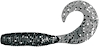
If possible, I always prefer to rig 4" and 5" single tail grubs on an open hook jig whenever possible. Rig with the tail pointing down. But when weeds or underwater obstructions get a little bothersome, I may instead rig with a few splitshots pinched on two feet above Yamamoto's specially-made Gamakatsu "Split Shot" hooks. Just stick the split shot hook through the nose of the grub about 4 "ribs" back. You MUST make sure the hook point comes out on the same side as the grub's curly tail is pointing "up". If that gets hung up too much, I go to a fiberguard jig head for moderately heavy cover, and ultimately to Texas-rigged grubs for the worst possible cover. Mister Twister Exude Fry (zipper style bait)
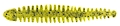
Have I saved the best bait for last? I think so, buddy. This one rules on a Split Shot hook! Use ANY method described above. The head is wide. Hook in the bottom, out the top so it lays flat. It has a central core spine along its length to get Wacky and do the Cuckoo Bird...and some of the biggest, softest protruding ribs of all zipper-style lures hang off this spine. The bigger ribs cause it to drop slowly and erratically. The bait's ridiculously soft. As if that's not enough, the plastic exudes molded-in salt, scent and flavors that create a slippery coat of fish-attracting slime when wet. Just add water! The bass will do the rest. Remember - use a soft-tipped rod and do NOT set the hook! Swivels. In the types of rigging described above, you may very often desire to use a small swivel and trace of leader line to prevent line twist. Personally, I prefer the light, streamlined and smooth-turning Super Crane swivels. Please note that the line twist is NOT caused by the circle hooks or by the specific brands of baits mentioned above. Line twist is a common occurrence with ALL hook styles and soft plastic bait models used with weightless, twitchy, slack line presentations. So, swivels always help!
With any bait, you will need to test FOUR different ways to find which one presents your bait with the best action and the least line twist: 1) in bottom/out top, 2) in top/out bottom, 3) in right/out left, 4) in left/out right. That is all piecing the nose of the bait. In addition, you may want to explore for the best hooking spot to get "wacky" and to do the "cuckoo bird" rigging styles.


