Hey guys. I`m new to kayak fishing. Just bought my son and I each a stealth supalite. Been reading all the forum topics the last few weeks and am pretty clear on all the safety aspects, rod requirements etc etc. Today I was reading all the different ideas the guys have regarding anchor systems and was wondering if there are any other ideas out there that you dont mind sharing. Simple tricks, tips etc that make fishing off a ski easier and more comfortable. Any advice would be appreciated. Cheers

You are using an out of date browser. It may not display this or other websites correctly.
You should upgrade or use an alternative browser.
You should upgrade or use an alternative browser.
Tips, tricks and hints
- Thread starter SLAYD
- Start date
There are many way to set up an anchor system - i use the approach that I don't want pulleys etc and things I can get tangled in. I use a bungy shock chord to absorb the swell and this is set up permanently on the boat- the anchor system is then attached to this. The key is to have a system that is simple and ends up with the point of the departure form the front of the boat or you will flip each time a swell hits.
You will need
1. about 3m of bungy,
2. 1,2m of galvanised chain
3. 2 sring gate clips
4. 2 o-rings
5. 30-50m rope(3mm is ok)
6. 700g anchor
7. cable ties- the smallest you can find
8. short section of pool noodle as a float
9. Plank to act as a reel
10. anchor -bag
Fix one O-ring to boat in front of hatch, the other to the front carry handle. tie the one snpgate clip to the bungy and clip to the o-ring. Thread the rest of the bungy thru the o-ring at the carry handle and thru about 300mm of pool noodle to act as a float, and then back to the hatch, attach second snap gate clip to the free end of the bungy and clip back to the o-ring at the hatch. The bungy should be in tension and you must be able to reach over the hatch on the water and unclip the one side to tie to a loop in your anchor rope. This is the fixed section of the set-up.
You will need
1. about 3m of bungy,
2. 1,2m of galvanised chain
3. 2 sring gate clips
4. 2 o-rings
5. 30-50m rope(3mm is ok)
6. 700g anchor
7. cable ties- the smallest you can find
8. short section of pool noodle as a float
9. Plank to act as a reel
10. anchor -bag
Fix one O-ring to boat in front of hatch, the other to the front carry handle. tie the one snpgate clip to the bungy and clip to the o-ring. Thread the rest of the bungy thru the o-ring at the carry handle and thru about 300mm of pool noodle to act as a float, and then back to the hatch, attach second snap gate clip to the free end of the bungy and clip back to the o-ring at the hatch. The bungy should be in tension and you must be able to reach over the hatch on the water and unclip the one side to tie to a loop in your anchor rope. This is the fixed section of the set-up.
Now for the anchor system
1. attach the galvanised chain to the top of the anchor
2. attach the galvanised chain to the one end of your 30-50m of anchor rope
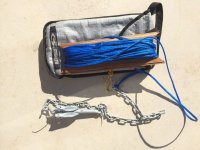
3. Create an anchor trip by fixing a cable tie to the bottom of the anchor to the galvanised chain. (in this way when you want to go you yank the anchor rope and the cable tie trips and the anchor folds and is lifted by the top limk)
4. tie the other end of the rope to your wooden plank reel
5. reel it all up and stow in an anchor bag
see picture
1. attach the galvanised chain to the top of the anchor
2. attach the galvanised chain to the one end of your 30-50m of anchor rope
3. Create an anchor trip by fixing a cable tie to the bottom of the anchor to the galvanised chain. (in this way when you want to go you yank the anchor rope and the cable tie trips and the anchor folds and is lifted by the top limk)
4. tie the other end of the rope to your wooden plank reel
5. reel it all up and stow in an anchor bag
see picture
Attachments

On the water you let paddle into the wind over the spot you want to anchor and drop the anchor, let out enough rope to have slack to work with. Then make a loop in the anchor rope. Un-clip the snap gate clip form the o-ring in front of the hatch and attach the bungy to the loop and let out the bungy. Holding onto the rope! because later you will want to pull in the bungy.
You stow the reel and remaining rope in the bag in the hatch and fish. When you want to go you paddle over and passed the anchor and then give a jerk to trip the cable tie at the anchor and retrieve the anchor. you then retrieve the bungy and clip onto the o ring again and wind the anchor onto your "reel" . Then unclip the loop in the anchor from the bungy.
Pics
You stow the reel and remaining rope in the bag in the hatch and fish. When you want to go you paddle over and passed the anchor and then give a jerk to trip the cable tie at the anchor and retrieve the anchor. you then retrieve the bungy and clip onto the o ring again and wind the anchor onto your "reel" . Then unclip the loop in the anchor from the bungy.
Pics
Attachments
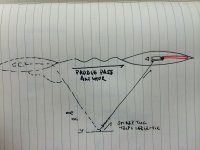

and thats about it. A quick tip always unclip the bungy from the loop in the rope LAST -when all is safely on deck. In bad conditions the chain can get stuck and while you are battling to undo the anchor the drift and swell can pull the whole system from your hands and you loose the lot. Also if the anchor goes vas in bad conditions and it comes down to you flipping or loosing your "flippen" anchor cut off....it's not worth it and it's replace-able.
Hi Malgas, thanks for sharing. The cable ties look a bit big though. I have found that not having much leverage and momentum on a kayak makes it difficult to snap the trip, thus I use very small cable ties, some guys even use 15 kg line to tie a trip?
Will be interesting to hear how others are doing this.
Will be interesting to hear how others are doing this.
zulu-X-treme
Sealiner
A small cable tie works for me, then again this is also determined by the conditions I face on the day... If the wind is howling and my 'weak-link' breaks by itself, I then tend to use 2 buckle straps... Sort of figure it out as the day goes...
Here's a link that covers almost everything you would need to know...
http://www.sealine.co.za/view_topic.php?id=69617&forum_id=26
Here's a link that covers almost everything you would need to know...
http://www.sealine.co.za/view_topic.php?id=69617&forum_id=26
zulu-X-treme
Sealiner
http://www.devonkayakfishing.com/rigging-anchor
Rigging an anchor
When it comes to the anchor itself, I use a 1.5kg folding model, some use 0.75kg models, but I've seen these drag so prefer a little more weight. I always use at least 1m of chain, this helps immensely when it comes to making sure the anchor holds. I attach my anchors using the weak link system, whereby the chain is actually shackled to the wrong end of the anchor, and run up the shank and secured using a cable tie. If you experiment with different cable ties you’ll find one that snaps with the right amount of pressure, allowing you to reverse your anchor out of most snags. You can also just notch the cable tie with a pair of pliers. Top tip is to ensure you put a few spare cable ties into your tackle box so that if you do have to trip an anchor then you can reset it there and then and carry on fishing. There’s also a method called a bridal, where a loop of line or wire is run from one end of the anchor to the other, this looks good in theory, but in practice can be very hard to trip in strong currents, and for that reason I've stopped using this method and don’t recommend it.
I use 2mm anchor warp, which has a breaking strain of around 85kg, more than enough for a kayak, and like fishing line, the thinner diameter you can use the less drag and the less there is to store. The line is stored on an old divers reel, which is perfect for the job.
Rigging an anchor
When it comes to the anchor itself, I use a 1.5kg folding model, some use 0.75kg models, but I've seen these drag so prefer a little more weight. I always use at least 1m of chain, this helps immensely when it comes to making sure the anchor holds. I attach my anchors using the weak link system, whereby the chain is actually shackled to the wrong end of the anchor, and run up the shank and secured using a cable tie. If you experiment with different cable ties you’ll find one that snaps with the right amount of pressure, allowing you to reverse your anchor out of most snags. You can also just notch the cable tie with a pair of pliers. Top tip is to ensure you put a few spare cable ties into your tackle box so that if you do have to trip an anchor then you can reset it there and then and carry on fishing. There’s also a method called a bridal, where a loop of line or wire is run from one end of the anchor to the other, this looks good in theory, but in practice can be very hard to trip in strong currents, and for that reason I've stopped using this method and don’t recommend it.
I use 2mm anchor warp, which has a breaking strain of around 85kg, more than enough for a kayak, and like fishing line, the thinner diameter you can use the less drag and the less there is to store. The line is stored on an old divers reel, which is perfect for the job.
Thanks for feedback, have also read your link on anchoring Zulu xtreme. Thanks for your input Malgas. I think I understand the anchor system fully now, what I was actually looking for was any other tips on making life easier or more comfortable on a ski. Not just on anchoring i.e any tips like tackle storage, rod protection, things to pack which I might need but will overlook etc etc.
Cheers.
Cheers.
zulu-X-treme
Sealiner
Here's a video of a rather clever invention...
http://www.youtube.com/watch?v=BYuUksj0L3c&feature=youtu.be
http://www.youtube.com/watch?v=BYuUksj0L3c&feature=youtu.be
zulu-X-treme
Sealiner
Excellent ideas here... End of the day you would not necessarily have to go overboard with your design, as long as it works and you do not end up in the water while trying to loosen your anchor...
http://www.anglersafloat.com/Anchor-Trolley-System.html
Anchor Trolley System
Fitting an Anchor Trolley System to your kayak is arguably one of the most important items that you can install. Fitted correctly can mean a comfortable safe and relaxing days fishing, fitted badly it can be extremely dangerous.
http://www.anglersafloat.com/Getting-Started.html
There are three main methods of anchoring your kayak, the easiest method and one that should be used by beginners is using a meter of shock cord with a carabiner fitted to each end, one is clipped to the cockpit carrying handle and the other end to a pot buoy. This is one of the safer methods of anchoring, should you get into difficulty simply cut the shock-cord or release the carabiner, return at a safer state of tide to pick up the carabiner.
Folding grapnel anchor, there are two weights used by kayak fishermen, the smaller 0.75kg which requires at least a meter of chain to work efficiently. The larger 1.5kg anchor is favoured in stronger tides, the chain is less necessary with this size anchor. Which ever size anchor is chosen, a weak link should be used, attach the main anchor via the bottom and add a weak link to the top of the anchor, should you become snared a hard tug to break the weak link could save the loss of the anchor. It's wise to carry a spare 0.75kg anchor as a back up. The anchor is also used in conjunction with an anchor trolley system.
http://www.anglersafloat.com/Anchor-Trolley-System.html
Anchor Trolley System
Fitting an Anchor Trolley System to your kayak is arguably one of the most important items that you can install. Fitted correctly can mean a comfortable safe and relaxing days fishing, fitted badly it can be extremely dangerous.
http://www.anglersafloat.com/Getting-Started.html
There are three main methods of anchoring your kayak, the easiest method and one that should be used by beginners is using a meter of shock cord with a carabiner fitted to each end, one is clipped to the cockpit carrying handle and the other end to a pot buoy. This is one of the safer methods of anchoring, should you get into difficulty simply cut the shock-cord or release the carabiner, return at a safer state of tide to pick up the carabiner.
Folding grapnel anchor, there are two weights used by kayak fishermen, the smaller 0.75kg which requires at least a meter of chain to work efficiently. The larger 1.5kg anchor is favoured in stronger tides, the chain is less necessary with this size anchor. Which ever size anchor is chosen, a weak link should be used, attach the main anchor via the bottom and add a weak link to the top of the anchor, should you become snared a hard tug to break the weak link could save the loss of the anchor. It's wise to carry a spare 0.75kg anchor as a back up. The anchor is also used in conjunction with an anchor trolley system.
zulu-X-treme
Sealiner
The more you fish the more you'll figure out what works for you and what does not... I still unfortunately pack way too much kit and end up making my own life difficult...
Some guys can go out with the bare minimum and be completely content, I on the other hand always go 'mal'... It's my own undoing...
You just need to get on the water and start fishing, you will soon figure out what works for you and what does not...
1. Ginger Beer (Stoney) sipped slowly, prior and during your trip will annihilate the feeling of sea-sickness, especially when on anchor.
2. Always pack a spare knife or at least make sure that the one you have can float.
3. When lowering or collecting your anchor, keep your legs out of the way.
4. When anchoring take recognizance of where your paddle is, especially if it's not tethered.
5. When anchored, expect at some point to have either your bait or a fish entangled in your anchor rope, prepare for this, it will happen.
6. When launching or landing plan to end up in the water, you normally will.
7. Keep your deck free and clear of clutter.
8. When fishing on the back line, keep your eye on the swells. Keep your craft ready for an eventuality.
9. When paddling in the dark, consider the ski-boats cannot see you easily. Stick to the piers and shallows until sun-up.
10. If a dolphin suddenly jumps into the air right next to you while fishing... RELAX!!! It's only a dolphin...
Guys please add, this could be a great list for newbies...
Some guys can go out with the bare minimum and be completely content, I on the other hand always go 'mal'... It's my own undoing...
You just need to get on the water and start fishing, you will soon figure out what works for you and what does not...
1. Ginger Beer (Stoney) sipped slowly, prior and during your trip will annihilate the feeling of sea-sickness, especially when on anchor.
2. Always pack a spare knife or at least make sure that the one you have can float.
3. When lowering or collecting your anchor, keep your legs out of the way.
4. When anchoring take recognizance of where your paddle is, especially if it's not tethered.
5. When anchored, expect at some point to have either your bait or a fish entangled in your anchor rope, prepare for this, it will happen.
6. When launching or landing plan to end up in the water, you normally will.
7. Keep your deck free and clear of clutter.
8. When fishing on the back line, keep your eye on the swells. Keep your craft ready for an eventuality.
9. When paddling in the dark, consider the ski-boats cannot see you easily. Stick to the piers and shallows until sun-up.
10. If a dolphin suddenly jumps into the air right next to you while fishing... RELAX!!! It's only a dolphin...
Guys please add, this could be a great list for newbies...
"10. If a dolphin suddenly jumps into the air right next to you while fishing... RELAX!!! It's only a dolphin... "
If a Black Fin suddenly jumps into the air right next to you while fishing... DO NOT RELAX!!! It's a BLACK FIN!!!!:ssswim:
Iv had this happen to me while fishing lol Quite scary to say the least.
"If a Black Fin suddenly jumps into the air right next to you while fishing... DO NOT RELAX!!! It's a BLACK FIN!!!!
:ssswim:Iv had this happen to me while fishing lol Quite scary to say the least.
zulu-X-treme
Sealiner
11. While trawling in water over 30m's deep my fish finder went black and soon after it felt as if I had hit a sand bank... DO NOT RELAX, your kayak has just been tested for it's food value... That sandpaper sound is definitely not a sand bank... :shark
zulu-X-treme wrote:
you guys are making me scared now!! I don't wanna be attacked by a shark((wideeye))
11. While trawling in water over 30m's deep my fish finder went black and soon after it felt as if I had hit a sand bank... DO NOT RELAX, your kayak has just been tested for it's food value... That sandpaper sound is definitely not a sand bank... :shark
you guys are making me scared now!! I don't wanna be attacked by a shark((wideeye))
zulu-X-treme
Sealiner
Guys sharks do not eat people... There's over enough evidence to support this, unfortunately the chance that you will have an encounter with a shark is absolutely inevitable, you're in their backyard, it's bound to happen... Shark's are by nature inquisitive and they will investigate...
The best thing to do is be calm, remove your paddle from the water and don't splash, you are just going to make things worse, the shark will eventually loose interest. If you really feel things are getting out of hand your paddle makes a great defensive tool...
Here's a great video of a shark encounters...
http://www.youtube.com/watch?v=Ej_UR3zALs4
OH! Yes, just cut the line unless you decide to keep it for the pot... The hook will rust out sooner than you think... If you feel confident then remove the hook depending on how tired the shark is... More often than not I just cut the line.
The best thing to do is be calm, remove your paddle from the water and don't splash, you are just going to make things worse, the shark will eventually loose interest. If you really feel things are getting out of hand your paddle makes a great defensive tool...
Here's a great video of a shark encounters...
http://www.youtube.com/watch?v=Ej_UR3zALs4
OH! Yes, just cut the line unless you decide to keep it for the pot... The hook will rust out sooner than you think... If you feel confident then remove the hook depending on how tired the shark is... More often than not I just cut the line.
zulu-X-treme
Sealiner
And talking about sharks...
http://expeditionkayaks.blogspot.com/2012/01/kayaks-shark-attacks.html
... Tim looked me square in the eye & said 'you realise there is no way in hell that those sharks will hurt you, don't you?' His message was simple, treat them as a beautiful animal of the deep like a whale or a dolphin & enjoy the privilege.
Attacks on kayakers by sharks are most uncommon. Experts point to the fact that 98% of sharks eat small fish, & taking on something 5m long in the natural world is bound to have nasty consequences for a predator. It's only really Tigers, Great Whites & a couple of other big sharks that will have a go at something as big as a marine mammal, because basically the rewards aren't worth the risk & effort.Where that changes is in the murk. Dawn & dusk, a river mouth after rain, estuarine water (Just like Richards Bay where I fish) with silty outflow etc, are places where the risk is undoubtedly amplified, as the sharks have much more difficulty in identifying their prey... They've knocked a couple of paddlers out of their boats in the upper harbour, with no more harm done than a bruised shin climbing quickly back on board & maybe a strained sphincter...
Stu again mentioned a massive hit he copped off the WA coast, which moved he & his fully loaded kayak about an inch. Not much you say? Try swimming at a loaded kayak from below, head butting it & getting it to budge. Importantly though, the 'hit' is where it ends.
http://www.topkayaker.net/articles/natureissues/sharks.htm
A great link with some interesting statistics...
http://www.fishing.net.nz/how-to/kayak-fishing-the-hazard-of-sharks/
I don’t know which of these two hazards ranks foremost among kayak fishers: the fear of capsizing and then watching your kayak blow away or the terror of a shark attack.
While the fear of capsizing can easily be put to rest with a tether and regular self-rescue training, shark attacks are not so readily banished from one’s mind. My own fear of sharks seems to increase the more I think about them – an irrational cycle that can easily spiral out of control.
http://expeditionkayaks.blogspot.com/2012/01/kayaks-shark-attacks.html
... Tim looked me square in the eye & said 'you realise there is no way in hell that those sharks will hurt you, don't you?' His message was simple, treat them as a beautiful animal of the deep like a whale or a dolphin & enjoy the privilege.
Attacks on kayakers by sharks are most uncommon. Experts point to the fact that 98% of sharks eat small fish, & taking on something 5m long in the natural world is bound to have nasty consequences for a predator. It's only really Tigers, Great Whites & a couple of other big sharks that will have a go at something as big as a marine mammal, because basically the rewards aren't worth the risk & effort.Where that changes is in the murk. Dawn & dusk, a river mouth after rain, estuarine water (Just like Richards Bay where I fish) with silty outflow etc, are places where the risk is undoubtedly amplified, as the sharks have much more difficulty in identifying their prey... They've knocked a couple of paddlers out of their boats in the upper harbour, with no more harm done than a bruised shin climbing quickly back on board & maybe a strained sphincter...
Stu again mentioned a massive hit he copped off the WA coast, which moved he & his fully loaded kayak about an inch. Not much you say? Try swimming at a loaded kayak from below, head butting it & getting it to budge. Importantly though, the 'hit' is where it ends.
http://www.topkayaker.net/articles/natureissues/sharks.htm
A great link with some interesting statistics...
http://www.fishing.net.nz/how-to/kayak-fishing-the-hazard-of-sharks/
I don’t know which of these two hazards ranks foremost among kayak fishers: the fear of capsizing and then watching your kayak blow away or the terror of a shark attack.
While the fear of capsizing can easily be put to rest with a tether and regular self-rescue training, shark attacks are not so readily banished from one’s mind. My own fear of sharks seems to increase the more I think about them – an irrational cycle that can easily spiral out of control.