
You are using an out of date browser. It may not display this or other websites correctly.
You should upgrade or use an alternative browser.
You should upgrade or use an alternative browser.
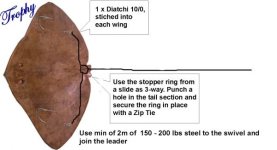
The first rig is used for shark and fish swim bait
- Thread starter Trophy
- Start date
robert.venter
Senior Member
Thanks trophy thats a very neat job there.
I also believe that if you are not confident in your rig setup or even your bait presentation, then you are just wasting your time!
I also believe that if you are not confident in your rig setup or even your bait presentation, then you are just wasting your time!
Shark Fishing with Swim Baits
Fishing swim baits is a guaranteed means of targeting larger predator sharks and is a method of fishing not to be taken lightly. It is recommended only for anglers with previous experience in targeting and landing large fish. This method of fishing will not be for the faint hearted and any anglers levels of physical fitness will be tested to the extreme limits with some battles lasting over 5 hours or more. Choosing the correct tackle is crucial to your success. Tackle should always meet the recommended minimum standard and be of the highest standard you can afford.
Having said all that it is also important to remember that your target is an apex predator and its welfare must therefore remain your top consideration in all ventures. In this article I hope to provide an insight into the fantastic art of swim baits by providing the facts, tools, methods and tips needed to carry out, what I believe, is the most unpredictable and rewarding shark fishing method
Controversy[/b]
Many onlookers and fellow anglers alike will frown upon the use of swim baits as they see it as a barbaric practice and non-eco friendly method. These are common criticisms which any serious swim bait fisherman will have to face from time to time. I hate having to justify my sport and pastime, but in defense I simply relate my swim bait as just bait. The fact that it does not come in a brown cardboard box or wrapped in cling foil does not separate it from the mackerel, Bonito, Geelbeck or any other bait form that once swam in the ocean and currently being used by countless fishermen.
It is a fact that some swim baits will die after a few hours in the water. This is very much the case with most sharks, while the skates and rays seem to survive over much longer periods of time. In some cases swim baits can be successfully returned to the water after a unsuccessful fishing session. When a swim bait dies the carcass can be used again in smaller pieces and either used as throw baits or on slide rigs.
Fighting, Landing, Handling & Survival [/b]
I have mentioned that any angler must use the minimum standards in tackle for this type of fishing. This ensures an evened match, shorter fights and a greater survival after your catch is released. It’s always nice to know that your catch is not left with long lasting damage as a result of your encounter. It is a well know that as a result of capture sharks release and build up ammonia in their systems. This can have a detrimental effect on the survival ratios and obviously a short sturdy fight is far better than a cautious and prolonged battle.
When selecting an area to fish, try to find spots that offer safe snag free locations to land your trophy catch. Identify these areas before you start fishing. Understand the effects that a change in the tide and water levels will have as this could result in a lost or seriously damaged fish. The use of a gaff must be avoided at all costs, and if used, only in the hands of a very experienced angler. If you have selected your location with conservation practices in mind then the use of a gaff can be completely eliminated.
Landing a large shark from a safe rocky platform or beach is simple enough, but not left to the faint hearted or inexperienced. Most fish, once suitable subdued, can be taken by the tail and pulled into the shallows. It is important to note that the full (dry) weight of the fish should never be moved by the tail only. Doing this will cause damage, possible paralysis and death. Instead, support the efforts with at least one third of the body in water. To move a fish with full (dry) weight its best to distribute the weight between tail and pectoral fins.
Shark survival is a grey area of certainty. Many scientists and marine protection groups claim that mortality rates amongst recreational angling releases are exceptionally high. Without proper education to all anglers I believe this could be true, however statistics collected in Namibia have proven that there is in fact a high survival rate amongst most species. The commercial ventures which cater for recreational anglers have been running for over a decade and their catch and release tagging records are proof that, if done correctly, shark angling can be carried out in a eco-friendly and sustainable manner.
Tackle, Rigs & Bait[/b]
[/b]
Tackle[/b]
Remember the species on your target lists and then consider the tackle you have at your disposal. Relate to it like this, would you take an air rifle to the battlefield? To be successful you are going to have to shell out for some specialized tackle. This will not only help in landing your dream catch, but ironically improve the chances of survival once the fish has been released.
An ideal setup:
Rod: 12 – 14 ft Graphite in a stoke 4 – 6
Reel: Capacity 800 – 900 meters of line, Std. 35 – 45 lbs of drag pressure
Line: .55 - .70 Monofilament, 80lbs braided backing
Rig: 200 – 400 Lbs coated steel, 10/0 – 12/0 hooks
Bait[/b]
Large sharks will feed on a very wide variety of potential swim baits and under the right conditions just about anything will go. Saying this there are a number of well know species that are popular for their various attributes and obvious favor in the eyes of your quarry.
[/b] [/b]
Smooth Hound [/b]
The smooth hound has to be the most preferred swim bait. The smoothie is a very tough character and stays rigged, alive and swimming for hours. They also don’t go diving straight for cover the first chance they get and very seldom get snagged. They also give the best indication of when a ‘hit’ is about to take place! Only negative is the time they take a long time to recover once put out to swim.
Grey Shark (Dusky)[/b]
The dusky shark is my second favorite swim bait. This full bodied chunky fish is also very hardy. Although they do not stay alive as long as the smoothie, they tend to swim quickly and head straight out behind the shore break. The dusky does tend to take longer to recover once put out, but makes up for this in the time it takes to get out and into the strike zone.
Lesser Sand Shark[/b]
When not swimming a traditional shark these are my next favorite bait. They are strong swimmers and need virtually no recovery time once put out to swim. Providing they are the right size they hardly ever die while rigged. They do need encouragement to stay swimming, but take a long time to reach the strike zone, but once arrived they are a favorite snack to most sharks.
Blue Ray[/b]
This is my favorite flatfish swim bait. The blue ray is a hard and fast swimmer and also stays alive on the rig for hours. I have often released blue rays after being rigged for over five hours. They move around freely and don’t need constant encouragement. Once in the strike zone they tend to move side to side rather than swim in or out. In the Eastern Cape the arrival of the Blue Rays in early summer is an indication that the sharks are not far behind.
Diamond Ray[/b]
A good alternative to the blue ray the diamond is a firm favorite to may swim bait anglers. The diamond is also a hardy fish which requires very little recovery time once put out to swim. My only draw back is that they are slow swimmers and need constant encouragement. They also have a tendency to swim in and out and take a long time to get into the strike zone. It might be physiological, but I recon of all the swim baits they are the first to dive for cover, snagging your rig!
[/b]
Species & Location[/b]
[/b]
Species[/b]
The sharks you are going to target are the apex predators and are region specific. Get to know what species are found in your local or destination waters. One thing I can guarantee is that if there are sharks to be caught the biggest catch will come from swim bait!
Common Species to be caught in order of regularity from South African waters:
Ragged Tooth Shark
Bronze Whaler
Grey Shark
Zambezi
Black Tip
Spinner Shark
Tiger Shark
[/b]
Location[/b]
Choose your location carefully and gather as much local knowledge as possible. Without doubt there are certain beaches or rock ledges which are regularly frequented by big sharks. You can be certain that a location that consistently produces good catches of average size sharks will be a prime swim bait location. In most cases it’s not possible to go out and intentionally fish swim baits. If I go fishing, I always have my swim bait tackle and rigs with me. It is an opportunistic type of fishing as getting your hands on suitable bait is never a certainty!
[/b]
[/b]
Tips[/b]
[/b]
Happy Hunting!
Tight Lines
Trophy
Fishing swim baits is a guaranteed means of targeting larger predator sharks and is a method of fishing not to be taken lightly. It is recommended only for anglers with previous experience in targeting and landing large fish. This method of fishing will not be for the faint hearted and any anglers levels of physical fitness will be tested to the extreme limits with some battles lasting over 5 hours or more. Choosing the correct tackle is crucial to your success. Tackle should always meet the recommended minimum standard and be of the highest standard you can afford.
Having said all that it is also important to remember that your target is an apex predator and its welfare must therefore remain your top consideration in all ventures. In this article I hope to provide an insight into the fantastic art of swim baits by providing the facts, tools, methods and tips needed to carry out, what I believe, is the most unpredictable and rewarding shark fishing method
Controversy[/b]
Many onlookers and fellow anglers alike will frown upon the use of swim baits as they see it as a barbaric practice and non-eco friendly method. These are common criticisms which any serious swim bait fisherman will have to face from time to time. I hate having to justify my sport and pastime, but in defense I simply relate my swim bait as just bait. The fact that it does not come in a brown cardboard box or wrapped in cling foil does not separate it from the mackerel, Bonito, Geelbeck or any other bait form that once swam in the ocean and currently being used by countless fishermen.
It is a fact that some swim baits will die after a few hours in the water. This is very much the case with most sharks, while the skates and rays seem to survive over much longer periods of time. In some cases swim baits can be successfully returned to the water after a unsuccessful fishing session. When a swim bait dies the carcass can be used again in smaller pieces and either used as throw baits or on slide rigs.
Fighting, Landing, Handling & Survival [/b]
I have mentioned that any angler must use the minimum standards in tackle for this type of fishing. This ensures an evened match, shorter fights and a greater survival after your catch is released. It’s always nice to know that your catch is not left with long lasting damage as a result of your encounter. It is a well know that as a result of capture sharks release and build up ammonia in their systems. This can have a detrimental effect on the survival ratios and obviously a short sturdy fight is far better than a cautious and prolonged battle.
When selecting an area to fish, try to find spots that offer safe snag free locations to land your trophy catch. Identify these areas before you start fishing. Understand the effects that a change in the tide and water levels will have as this could result in a lost or seriously damaged fish. The use of a gaff must be avoided at all costs, and if used, only in the hands of a very experienced angler. If you have selected your location with conservation practices in mind then the use of a gaff can be completely eliminated.
Landing a large shark from a safe rocky platform or beach is simple enough, but not left to the faint hearted or inexperienced. Most fish, once suitable subdued, can be taken by the tail and pulled into the shallows. It is important to note that the full (dry) weight of the fish should never be moved by the tail only. Doing this will cause damage, possible paralysis and death. Instead, support the efforts with at least one third of the body in water. To move a fish with full (dry) weight its best to distribute the weight between tail and pectoral fins.
Shark survival is a grey area of certainty. Many scientists and marine protection groups claim that mortality rates amongst recreational angling releases are exceptionally high. Without proper education to all anglers I believe this could be true, however statistics collected in Namibia have proven that there is in fact a high survival rate amongst most species. The commercial ventures which cater for recreational anglers have been running for over a decade and their catch and release tagging records are proof that, if done correctly, shark angling can be carried out in a eco-friendly and sustainable manner.
Tackle, Rigs & Bait[/b]
[/b]
Tackle[/b]
Remember the species on your target lists and then consider the tackle you have at your disposal. Relate to it like this, would you take an air rifle to the battlefield? To be successful you are going to have to shell out for some specialized tackle. This will not only help in landing your dream catch, but ironically improve the chances of survival once the fish has been released.
An ideal setup:
Rod: 12 – 14 ft Graphite in a stoke 4 – 6
Reel: Capacity 800 – 900 meters of line, Std. 35 – 45 lbs of drag pressure
Line: .55 - .70 Monofilament, 80lbs braided backing
Rig: 200 – 400 Lbs coated steel, 10/0 – 12/0 hooks
Bait[/b]
Large sharks will feed on a very wide variety of potential swim baits and under the right conditions just about anything will go. Saying this there are a number of well know species that are popular for their various attributes and obvious favor in the eyes of your quarry.
[/b] [/b]
Smooth Hound [/b]
The smooth hound has to be the most preferred swim bait. The smoothie is a very tough character and stays rigged, alive and swimming for hours. They also don’t go diving straight for cover the first chance they get and very seldom get snagged. They also give the best indication of when a ‘hit’ is about to take place! Only negative is the time they take a long time to recover once put out to swim.
Grey Shark (Dusky)[/b]
The dusky shark is my second favorite swim bait. This full bodied chunky fish is also very hardy. Although they do not stay alive as long as the smoothie, they tend to swim quickly and head straight out behind the shore break. The dusky does tend to take longer to recover once put out, but makes up for this in the time it takes to get out and into the strike zone.
Lesser Sand Shark[/b]
When not swimming a traditional shark these are my next favorite bait. They are strong swimmers and need virtually no recovery time once put out to swim. Providing they are the right size they hardly ever die while rigged. They do need encouragement to stay swimming, but take a long time to reach the strike zone, but once arrived they are a favorite snack to most sharks.
Blue Ray[/b]
This is my favorite flatfish swim bait. The blue ray is a hard and fast swimmer and also stays alive on the rig for hours. I have often released blue rays after being rigged for over five hours. They move around freely and don’t need constant encouragement. Once in the strike zone they tend to move side to side rather than swim in or out. In the Eastern Cape the arrival of the Blue Rays in early summer is an indication that the sharks are not far behind.
Diamond Ray[/b]
A good alternative to the blue ray the diamond is a firm favorite to may swim bait anglers. The diamond is also a hardy fish which requires very little recovery time once put out to swim. My only draw back is that they are slow swimmers and need constant encouragement. They also have a tendency to swim in and out and take a long time to get into the strike zone. It might be physiological, but I recon of all the swim baits they are the first to dive for cover, snagging your rig!
[/b]
Species & Location[/b]
[/b]
Species[/b]
The sharks you are going to target are the apex predators and are region specific. Get to know what species are found in your local or destination waters. One thing I can guarantee is that if there are sharks to be caught the biggest catch will come from swim bait!
Common Species to be caught in order of regularity from South African waters:
Ragged Tooth Shark
Bronze Whaler
Grey Shark
Zambezi
Black Tip
Spinner Shark
Tiger Shark
[/b]
Location[/b]
Choose your location carefully and gather as much local knowledge as possible. Without doubt there are certain beaches or rock ledges which are regularly frequented by big sharks. You can be certain that a location that consistently produces good catches of average size sharks will be a prime swim bait location. In most cases it’s not possible to go out and intentionally fish swim baits. If I go fishing, I always have my swim bait tackle and rigs with me. It is an opportunistic type of fishing as getting your hands on suitable bait is never a certainty!
[/b]
[/b]
Tips[/b]
[/b]
- Go for a longer rod[/b], nothing under 12ft. This gives you more control over the direction of the bait as you put it out to swim. It also gives you more control when playing a large fish. [/*]
- Go big or go home[/b], this applies to everything from tackle to bait size. I have already swum a 25 kg Bronzie and have heard of 60kg diamonds going out in search of Zambezi sharks. [/*]
- Rod tip down, [/b]this allows the swim bait less resistance when pulling off line. Initially keep the reel and free spool with the clicker on. Do not move away from your reel until you are in the strike zone and the drag is set tighter. [/*]
- Putting your bait out,[/b] work as fast as you can in getting your swim bait rigged and out. If you have access to a decent size rock pools then walk the distance and save the condition of the bait. Regardless of speed 95% of all swim baits take a good 5 – 10 minutes to recover once put out to swim. This is where a long rod helps, especially if fishing off the bricks. [/*]
- Swim Bait encouragement, [/b]is always needed to keep the bait moving. Some require more, some less. Gently lift and drop the line until the bait is agitated and moves about. [/*]
- Strike zones, [/b]this will differ from location to location, but in most cases the bait will travel a good distance and then start swimming across – left to right and back right to left. The distance will vary between 200 – 400 meters, but when the bait starts this swim pattern – it’s in the STRIKE ZONE! [/*]
- Hits, [/b]are normally very noticeable and violent! In most cases the bait will act erratically and give sure signals that a strike is about to happen. You will experience a huge knock or a huge drop. Allow the shark to take and swallow the bait, once it starts moving off you can set the hooks.[/*]
Happy Hunting!
Tight Lines
Trophy
action man
Senior Member
Trophy you are by far the best teacher i have ever come across:addn
mana to you my friend!!!
mana to you my friend!!!
Finnseeker
Senior Member
Trophy - excellent illustration and tutorial : Not trying to take anything away from yours - just showing you some of the ways I set up and have been successful for me live bait rigging and dead bait rigging for sharks.
Im using 800lb bare 49 strand 7x7 stainless steel cable for the big 1000 lb Mako's Made from high strength, corrosion resistant type 304 stainless steel, 49 Strand 7x7 cable provides excellent protection against shark and other big game toothy fish. When a shark strikes a bait, they often twirl violently - 49 Strand resists kinking, wrestles back, and allows you to hook up and haul in. I prefer to use stainless steel thimbles since I have seen cable break unless you using a closed end hook with a completed eye.
The makos have a tendancy to bite through some smaller cables so ive gone to 800lbs so no kinks, or breaks either


Some use single or double barrel crimps which I prefer since the cable is so thick and not as easy to tie a knott.
Single Barrel Leader Sleeves
 STEP 1:
Thread wire through sleeve and part being connected.
 STEP 2:
Pass the wire back through the sleeve to create a loop. Align wires next to each other inside the sleeve
 STEP 3:
Firmly crimp the sleeve and wire using special Crimping Pliers. Two side-by-side compressions may be necessary if the sleeve is longer than the width of the crimping tool.
Double Barrel Leader Sleeves

STEP 1:
Thread wire through sleeve and part being connected.

STEP 2:
Pass the wire back through the sleeve to create a loop. Align wires next to each other inside the sleeve.

STEP 3:
Firmly crimp the sleeve and wire using special crimping pliers. Two side-by-side compressions may be necessary if the sleeve is longer

Single rig hook set up :

Some rigs for the big ones we use......................

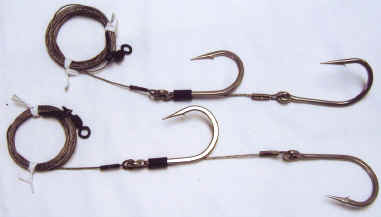
Rigging baits on circle hooks, within the context of shark fishing is divided into two areas, dead or live baits.
[font="Verdana, Arial, Helvetica, sans-serif"]Dead baits are simple and straight forward, just simply mount the hook in the snout of the fish bait as shown below:[/font]

[font="Verdana, Arial, Helvetica, sans-serif"]Live baits are a mounted with a bit more difficulty. Firstly mount a doubled length of dental floss on the curve of the hook, with a clove-hitch. Then mount the dental floss on a large sewing needle.[/font]

[font="Verdana, Arial, Helvetica, sans-serif"]Next get your lively live bait, gently in you left hand.[/font]

[font="Verdana, Arial, Helvetica, sans-serif"]Take the needle, and pass it though the eye socket of the Mackerel to the rear of the eye ball. Without puncturing the eye! This will mount the hook by a very secure part of the bait fish, but preserve a natural presentation.[/font]

[font="Verdana, Arial, Helvetica, sans-serif"]Remove the needle from the dental floss, and hook the doubled end of the floss over the hook point.[/font]

[font="Verdana, Arial, Helvetica, sans-serif"]Now twist the hook in a clockwise or anti-clockwise direction, to take up the slack in the dental floss.[/font]

[font="Verdana, Arial, Helvetica, sans-serif"]Now take the hook point and pass it under the point where the dental floss first crosses the Mackerel's head. Pass the hook from front to back.[/font]

[font="Verdana, Arial, Helvetica, sans-serif"]Finally, move the shank of the hook up under the dental floss, so that the hook is positioned on the top of the bait's head.[/font]

Im using 800lb bare 49 strand 7x7 stainless steel cable for the big 1000 lb Mako's Made from high strength, corrosion resistant type 304 stainless steel, 49 Strand 7x7 cable provides excellent protection against shark and other big game toothy fish. When a shark strikes a bait, they often twirl violently - 49 Strand resists kinking, wrestles back, and allows you to hook up and haul in. I prefer to use stainless steel thimbles since I have seen cable break unless you using a closed end hook with a completed eye.
The makos have a tendancy to bite through some smaller cables so ive gone to 800lbs so no kinks, or breaks either
Some use single or double barrel crimps which I prefer since the cable is so thick and not as easy to tie a knott.
Single Barrel Leader Sleeves
Thread wire through sleeve and part being connected.
Pass the wire back through the sleeve to create a loop. Align wires next to each other inside the sleeve
Firmly crimp the sleeve and wire using special Crimping Pliers. Two side-by-side compressions may be necessary if the sleeve is longer than the width of the crimping tool.
Double Barrel Leader Sleeves
STEP 1:
Thread wire through sleeve and part being connected.
STEP 2:
Pass the wire back through the sleeve to create a loop. Align wires next to each other inside the sleeve.
STEP 3:
Firmly crimp the sleeve and wire using special crimping pliers. Two side-by-side compressions may be necessary if the sleeve is longer
Single rig hook set up :
Some rigs for the big ones we use......................
Rigging baits on circle hooks, within the context of shark fishing is divided into two areas, dead or live baits.
[font="Verdana, Arial, Helvetica, sans-serif"]Dead baits are simple and straight forward, just simply mount the hook in the snout of the fish bait as shown below:[/font]
[font="Verdana, Arial, Helvetica, sans-serif"]Live baits are a mounted with a bit more difficulty. Firstly mount a doubled length of dental floss on the curve of the hook, with a clove-hitch. Then mount the dental floss on a large sewing needle.[/font]
[font="Verdana, Arial, Helvetica, sans-serif"]Next get your lively live bait, gently in you left hand.[/font]
[font="Verdana, Arial, Helvetica, sans-serif"]Take the needle, and pass it though the eye socket of the Mackerel to the rear of the eye ball. Without puncturing the eye! This will mount the hook by a very secure part of the bait fish, but preserve a natural presentation.[/font]
[font="Verdana, Arial, Helvetica, sans-serif"]Remove the needle from the dental floss, and hook the doubled end of the floss over the hook point.[/font]
[font="Verdana, Arial, Helvetica, sans-serif"]Now twist the hook in a clockwise or anti-clockwise direction, to take up the slack in the dental floss.[/font]
[font="Verdana, Arial, Helvetica, sans-serif"]Now take the hook point and pass it under the point where the dental floss first crosses the Mackerel's head. Pass the hook from front to back.[/font]
[font="Verdana, Arial, Helvetica, sans-serif"]Finally, move the shank of the hook up under the dental floss, so that the hook is positioned on the top of the bait's head.[/font]
Hiya Finnseeker,
No problem, I have joined 'Texas Shark Fishing' and have seen a number of rigs like the ones you posted. Its a very interesting site with some amazing catches. Our beaches and surf zones are very different, but I have been in contact with some of th guys on this forum to try and take some of the ideas and apply them here.
A big problem is the lack or cost of decent tackle in South Africa, never mind PE! As an example, I would love to move up from 200Lbs steel, but I don't like pianno wire and you just don't find anything commercially available over the 200lbs mark
Still these guys in the States are amazed by what sharks we land using our 'light by comparison' tackle!
No problem, I have joined 'Texas Shark Fishing' and have seen a number of rigs like the ones you posted. Its a very interesting site with some amazing catches. Our beaches and surf zones are very different, but I have been in contact with some of th guys on this forum to try and take some of the ideas and apply them here.
A big problem is the lack or cost of decent tackle in South Africa, never mind PE! As an example, I would love to move up from 200Lbs steel, but I don't like pianno wire and you just don't find anything commercially available over the 200lbs mark
Still these guys in the States are amazed by what sharks we land using our 'light by comparison' tackle!
Finnseeker
Senior Member
[color=#ff6633]Trophy[/color] wrote:
SA certainly does have a different mixed bag compared to the West and East coast in the USA .
Let me know if you need any stuff like a spool of SS cable, thimbles or rattles etc. I will be glad to give it to you no cost no charge . I would be only to pleased to give you this to use and see the difference.
Personally that piano wire is lethal to angler leaderman and shark as it will slice through anything its so thin. If a shark wraps up it will slice it up. I have seen some horrific tragedy's to sharks and people from it. But you have to make do with what you have and a " BOER MAAK N PLAN"
On the west coast we have the big eye threshers sharks Mako, shovel nose, great whites, salmon, hammerheads etc etc Here are some of the species below and some info. Just some info for all. Alopias superciliosus http://www.elasmo-research.org/education/shark_profiles/a_superciliosus.htm

Big eye thresher shark (Alopias superciliosus),common in deeper offshore waters of the pacific basing including deep waters of Monterey Bay and associated marine canyon
Common Thresher
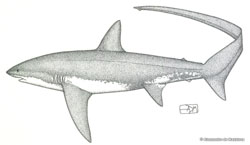 Common thresher, (Alopias vulpinas) common off California coast and Monterey bay http://www.pelagic.org/montereybay/pelagic/threshershark.html
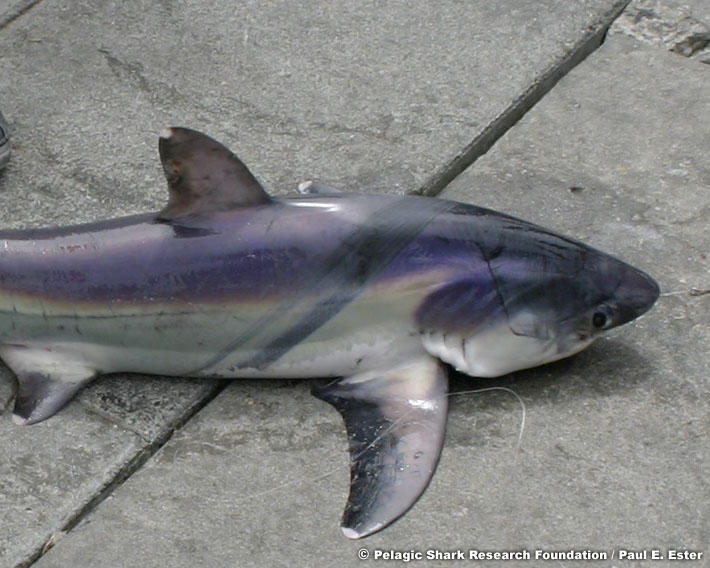
[size=+1]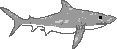
MACKEREL SHARKS[/size]
These sharks are fast, strong swimmers and include the great white shark and the mako. A type of Lamniformes shark, family Lamniformae.
[size=+1]

MAGNETIC FIELD[/size]
The Earth's magnetic field is aligned with the north and south poles, and has reversed many times during geologic history. Sharks may use the magnetic field of the Earth for navigation purposes on migrations.
[size=+1]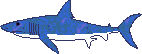
MAKO SHARK[/size]
The shortfin mako shark (Isurus oxyrinchus) has a conical snout and long gill slits. It is the fastest swimming fish. These sharks reproduce via aplacental viviparity (they bear live young but the babies are not nourished via a placenta in the womb; cannibalism often occurs within the womb). Makos can maintain a body temperature higher than that of the surrounding water.Order: Lamniformes
Porbeagle Shark, Lamna nasus.] The largest-known Salmon Shark was 10 ft (3 m) long. Classification: Order Lamniformes (mackerel sharks), Family Lamnidae (Mackerel sharks, porbeagles, and white sharks).
estuaries and harbors. Sandbar sharks have a growth rate of about 1.7 inches (43 mm) per year, a slow growth rate for sharks. The thick skin is used for leather. These strong swimmers migrate over 1550 miles (2500 km). Their diet is mostly fish, including menhaden, eels, other sharks, skates, squid, and also crustaceans. Females are mature at 16 years and give birth to 8-12 live young after a gestation period of 9-12 months. Pups are about 8.5 inches (22 cm) long at birth. Classification: Order Carcharhiniformes, Family Carcharhinidae (requiem sharks).
mackerel sharks (Odontaspididae). They include the Sandtiger shark (Eugomphodus taurus), the Indian sandtiger (Eugomphodus tricuspidatus), the Smalltooth sandtiger (Odontaspis ferox), and the Bigeye sandtiger (Odontaspis noronhai). They live in tropical and temperate coastlines of all the oceans. They all have long, thin, pointed teeth, and eat mostly fish and invertebrates.
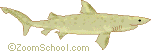
SANDTIGER SHARK[/b][/size]
Sandtigers (Eugomphodus taurus) are also known as the Ragged tooth shark, the grey nurse shark, the sand shark, and the spotted ragged-tooth shark. They are widespread Mackerel sharks (Lamniformes) that range from gray to brown and are about 10-12 feet (3-3.7 m) long. They are fish-eaters that have long, sharp teeth in a narrow snout. They eat and migrate in groups; their activity peaks at night. They are found mostly near coastlines, from the surface down to depths of 3,900 ft (1,200 m). are oviphagous and females have two uterine chambers (wombs). Developing embryos in the wombs are cannibalistic, eating their siblings. Although many embryos are produced, only two are born, one from each uterine chamber. The gestation period is about 8-9 months. Pups are roughly 3.3 feet (1 m) long at birth. Classification: Order Lamniformes (Mackerel sharks), Family Odontaspididae (Sandtiger sharks).
[size=+1]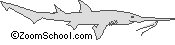
SAWSHARKS[/size]
Sawsharks are clade of shark that have a long, toothed snout, no anal fin, and the mouth underneath. These common, harmless sharks have a slightly flattened body, nasal barbels, and its pair of five gill slits are on the side of its head. These sharks reproduce via aplacental viviparity. Their diet consists mostly of bony fishes. This order of sharks is called the Pristiophoriformes.
Carcharhiniformes
aplacental viviparity, having litters of up to 52 pups after a gestation period of one year. Pups are about 12-14 inches (30-35 cm) long at birth. Females are mature at 8-10 years and have a low reproductive rate. It is fished for its fins, meat and liver oil. Galeorhinus galeus was named by Linnaeus in 1758. Classification: Order Carcharhiniformes (ground sharks), Family Triakidae (houndsharks, topes, whiskery sharks).
Order Squaliformes, Family Squalidae.
[size=+1]
[/size]
[size=+1]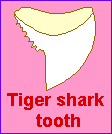
[/size]
Broadnose sevengill, Notorynchus cepedianus and the Sharpnose sevengill, Heptranchias perlo) are distinctive and rare sharks that have seven gills (most sharks have five). These unusual sharks also have a single (and small) dorsal fin. The broadnose sevengill grows to be up to 10 ft (3 m) long, is speckled and silvery; this shark has small eyes, and a wide head. The sharpnose sevengill is up to about 4.5 ft (1.4 m) long. These aggressive sharks eat fish (including other sharks, rays, and bony fish), seals, and scavenged prey (including human corpses). Broadnose sevengill sharks live in temperate seas on continental shelves (to a depth of 450 ft (135 m). The upper teeth are jagged and multi-cusped (except the center tooth). The lower teeth are comb-shaped. These sharks bear live young in shallow bays. Litters of up to 80 pups have been found. Pups are about 16-18 inches (40-45 cm) long. Classification: Order Hexanchiformes, Family Hexanchidae .
[size=+1]
SEXUAL DIMORPHISM[/size]
Sexual dimorphism is the physical differences between the males and females of a species. Female whales are usually larger than the males.
SHARPNOSE SHARK[/b][/size]
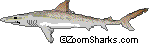
The Atlantic Sharpnose Shark (Rhizoprionodon terraenovae) is a harmless, edible, requiem shark (Family Carcharinidae). The Sharpnose is a small, slender shark with 5 gill slits, two dorsal fins, an anal fin, no fin spines, the mouth behind the eyes, and nictitating eyelids. It has a long, sharp snout, black-edged dorsal and caudal fins (which fade with age), and furrowed or wrinkled corners of the mouth. It is brown to olive-gray colored with white countershading on the belly and is from 2 to 4 feet (60-120 cm) long. A carnivore, it eats small fish, mollusks, and shrimp. The sharpnose is viviparous, with litters of 4 to 7 pups. Classification: Order Carcharhiniformes
SHORTFIN MAKO SHARK[/size][/color]
The short-finned mako shark (Isurus oxyrincus), also known as the bonito, is the fastest shark. This fish can also leap out of the water. It has has a conical snout, and long gill slits. Short-finned Makos average 5-8 feet (1.5-2.5 m) long but can reach 12 feet (3.7 m) long, weighing 1,000 pounds (455 kg). The Mako is considered dangerous to people. It reproduces via aplacental viviparity and the pups are cannibalistic in the womb. Makos can maintain a body temperature higher than that of the surrounding water. Order: Lamniformes
[size=+1]
SHOVELHEAD SHARK[/size]
Sphyrna tiburo (also known as the bonnethead shark) is a small hammerhead shark with a smooth, rounded head. It has small, sharp teeth in the front of the mouth (for grabbing soft prey) and flat, broad molars in the back (for crushing hard-shelled prey). It is a common, harmless, timid shark averaging about 3.3 feet (1 m) long. It is gray-brown above and lighter on the underside with short pectoral fins Large schools migrate to warm water in the winter and cooler water in the summer. Females are mature at 2.5 feet (75 cm) long and give birth in shallow bays to 8 to 16 pups about 14 inches (35 cm) long. Bonnetheads are found in the western Atlantic and eastern Pacific Oceans, in the surf zone, reefs, on sandy bottoms and in estuaries. Classification: Order Carcharhiniformes, Family Sphyrnidae (hammerhead sharks).
SHOVELNOSE SHARK (1)[/b][/size]
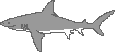
Carcharhinus leucas is also known as the Bull shark, the Ganges shark, the River shark, the Cub shark, the Zambezi shark, Van Rooyen's shark, the Slipway gray shark, the Square-nose shark, and the Nigaragua shark. It is a large, fierce predator that eats fish, including other sharks, ray, and just about anything else. It has been known to attack people and will venture into fresh water.
[size=+1]
SHOVELNOSE SHARK (2)[/size]
The Dusky Shark (Carcharhinus obscurus) is a requiem shark that is also known as the shovelnose, the bay shark, the lazy-gray, and the black whaler. It is charcoal colored on top and white with copper-colored markings below. It has a faint pale stripe along its sides. Dusky sharks average about 10 ft (310 cm) long; females are slightly larger than males. The largest one found was about 13 ft (4 m) long. It lives at all levels of the ocean and from the shoreline to out at sea. It is found in warm temperate and tropical waters worldwide. It migrates to cooler waters during warm weather, probably for reproduction and feeding. This shark is often seen following ships and is hunted as a game fish. Overfishing is diminishing the numbers of this shark. Few Dusky shark attacks are documented, but it is considered dangerous. It normally eats small fish (like sardines), large fish (like tuna), flatfish, other sharks, and eels. Females are mature when they are 9 ft (2.8 m) long and have litters of about 10 pups which are roughly 3 ft (95 cm) long each. There is a 16 month gestation period. Classification: Order Carcharhiniformes, Family Carcharhinidae (requiem sharks), Genus Carcharhinus, Species obscurus.
Carcharhiniformes) that ranges from black to gray on top (and white to cream on the belly). These long, tapered sharks are fast swimmers and are about 10 feet (3 m) long. They have a long, pointed snout. The teeth in the upper jaws are long, triangular, and serrated; the teeth in the lower jaws are only slightly serrated. Silky sharks eat fish, squid, and crabs. It sometimes travels in schools segregated by sex. Females give birth to litters of 6-12 live pups which are 29-31 inches (75-80 cm) long at birth. These sharks are harvested commercially for their meat, liver and fins.
bony fish that is much more closely related to goldfish than to sharks. These common pets are originally from south-east Asia, and may be an endangered species in the wild. These fish grow to about 8 inches (20 cm) long, but is usually smaller. Its native habitat is rivers in Borneo, Sumatra, and Thailand. These "sharks" can be found at most pet stores.
viviparous with a gestation period of about one year. Females usually have 5-6 pups in a litter. Silvertips are attracted to low-frequency sounds. Attacks on people are rare.
Bluntnose sixgill (Hexanchus griseus), the Bigeye sixgill (Hexanchus vitulus), and the frilled shark (Chlamydoselachus anguineus). These unusual sharks also have a single (and small) dorsal fin near the end of the body. These sharks are gray-brown in color and are paler underneath. The Bluntnose sixgill (also known as the Cow shark, the Grey shark, the mud shark and the Bulldog shark) is a common shark about 16 ft (4.8 m) long with a toxic liver (but edible flesh) and six rows of saw-like teeth in the side of the jaws; it eats large fish, crabs and squid, lives in dark waters at depths down to 5900 ft (1800 m), and has litters of up to 100 pups. The Bigeye sixgill (also known as the lesser sixgill and the calf shark) is about 5.9 ft (1.8 m) long, has large eyes, a slender body, five rows of saw-like teeth in the side of the jaws and lives on or near the bottom of warm temperate and tropical seas. Classification: Order Hexanchiformes, Family Hexanchidae.
[/b][/size]
SLEEPER SHARK[/b][/size]
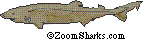
Somniosus microcephalus, also known as the Greenland shark, and the gurry shark, lives very deep in the North Atlantic Ocean. It lives at depths down to 1,800 feet (550 m) in very cold water (36-45°F=2-7°C). It is up to 21 feet (6.5 m) long. This grayish-brown shark has a short snout and is a slow swimmer. Bioluminescent (glowing) copepods attach to the Greenland shark's eyes attract prey to the shark's head! The shark's upper teeth are long and sharp; the lower teeth are flatter, more closely-set (and also sharp). These sharks gather in large numbers in shallow Arctic waters (up to 80° north) during the winter but migrate back to deep waters during the summer. Eskimo hunters traditionally used its skin for boots and its teeth for knives. This large shark is oviviparous, having litters of about 10 pups, each roughly 15 inches (38 cm) long. Classification: Order Squaliformes, Family Squalidae (dogfish sharks)
SLIPWAY GRAY SHARK[/b][/size]
Carcharhinus leucas is also known as the Bull shark, the Ganges shark, the River shark, the Cub shark, the Zambezi shark, Van Rooyen's shark, the Shovelnose shark, the Square-nose shark, and the Nigaragua shark. It is a large, fierce predator that eats fish, including other sharks, ray, and just about anything else. It has been known to attack people and will venture into fresh water.
aplacental viviparity, having litters of up to 52 pups after a gestation period of one year. Pups are about 12-14 inches (30-35 cm) long at birth. Females are mature at 8-10 years and have a low reproductive rate. It is fished for its fins, meat and liver oil. Galeorhinus galeus was named by Linnaeus in 1758. Classification: Order Carcharhiniformes (ground sharks), Family Triakidae (houndsharks, topes, whiskery sharks).
[/b][/size]

SPINED PYGMY SHARK[/b][/size]
Squaliolus laticaudus is one of the smallest sharks; it is roughly 8 to 10 inches (20 to 25 cm) long (females are about 10 inches = 25 cm long; males are up to 9 inches = 23 cm long). This deep water shark has a spine in front of its first dorsal fin but not in front of the second dorsal fin (this is unique among sharks). This harmless shark is very sleek and has a bulbous snout. The upper teeth are narrow and small; the lower teeth and larger and knife-like. It has a large spiracle (an extra, round gill slit) behind each large eye. It is dark-gray to black with white-tipped fins and bio-luminescence (luminous photophores) on its belly; these photophores light up and may serve as camouflage (they eliminate shadows when seen from below). It eats squid, shrimp, and mid-water fish (especially lanternfishes). This uncommon shark lives in deep water (down to 6,550 ft = 2,000 m) but migrates vertically each day to hunt at night in mid-depth waters (about 650 ft = 200 m). It is found in temperate and tropical oceans worldwide. Its reproductive biology is unknown. Classification: Order Squaliformes.

SPINY DOGFISH SHARK[/b][/size]
Squalus acanthias is the most common shark. These small sharks congregate in schools and migrate. They are about 3-4 feet (0.9-1.2 m) long and are found worldwide.
Tiger sharks and angelsharks have spiracles.
digestive tract enables the shark to efficiently digest its food in a small area, since the surface area of the intestines (where nutrient absorption takes place) is very large within the spiral.
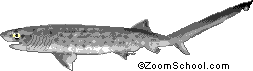
SPOTTED SEVENGILL SHARK[/b][/size]
The spotted sevengill shark (Notorynchus cepedianus) is a distinctive and rare shark that has seven gills (most sharks have five). This unusual shark also has a single (and small) dorsal fin. The broadnose sevengill grows to be up to 10 ft (3 m) long, is speckled and silvery; this shark has small eyes, and a wide head. These aggressive sharks eat fish (including other sharks, rays, and bony fish), seals, and scavenged prey (including human corpses). Broadnose sevengill sharks live in temperate seas on continental shelves (to a depth of 450 ft (135 m). The upper teeth are jagged and multi-cusped (except the center tooth). The lower teeth are comb-shaped. These sharks bear live young in shallow bays. Litters of up to 80 pups have been found. Pups are about 16-18 inches (40-45 cm) long. It was named by Peron in 1807. Classification: Order Hexanchiformes, Family Hexanchidae. It is also called the ground shark, the cow shark, the broad snout shark and the broadnose sevengill shark.
Order Squaliformes (Dogfish Sharks); Family Squaildae; Genus Squalus; Species asper (the Roughskin spurdog), blainvillei (the Longnose spurdog), melanurus (the Blacktailed spurdog), japonicus (the Japanese spurdog), megalops (the Shortnose spurdog or Spiky Jack), mitsukurii (the Shortspine spurdog), rancureli (the Cyrano spurdog).
[size=+1]
SQUALIFORMES[/size]
A clade of sharks with a short snout, the mouth underneath the snout, and no an anal fin. These include the dogfish and cookiecutter sharks.
SQUARE-NOSE SHARK[/b][/size]
Carcharhinus leucas is also known as the Bull shark, the Ganges shark, the River shark, the Cub shark, the Zambezi shark, Van Rooyen's shark, the Shovelnose shark, the Slipway gray shark, and the Nigaragua shark. It is a large, fierce predator that eats fish, including other sharks, ray, and just about anything else. It has been known to attack people and will venture into fresh water.
[size=+1]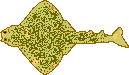
SQUATINIFORMES[/size]
A clade of sharks with a flat body, the mouth at the front of the head, and no an anal fin. This order include the angelsharks and monkfish.
[size=+1]
SQUID[/size]
Squid are mollusks. They are eaten by many sharks and rays.
rays are closely related to sharks.
[size=+1]
STREAMLINED[/size]
Streamlined means having a contoured shape that minimizes resistance to currents of water (or air). Many sharks have a streamlined shape. This type of shape lets these sharks swim quickly through the water.
[size=+1]
SWELL SHARK[/size]
The Swell shark, Cephaloscyllium ventriosum, is a harmless, bottom-dwelling shark. It is called the "swell" shark because when it is in danger it can swallow a lot of water, making its body balloon up. This increase in size wedges the shark between rocks, making it difficult to catch. This shark is light brown with dark brown marking; this color scheme camouflages the shark on the rocky sea floor. It is a light brown shark with dark brown spots. Its snout is blunt and it has a very wide mouth. It is nocturnal (is most active at night) and eats small fish. It is oviparous, laying small, greenish, purse-like eggs in rocky crevices. These eggs take 7 to 10 months to hatch, depending on the temperature of the water. Swell sharks are found in temperate waters off the western coast of North America from central California, USA to central Chile.
Hi Trophy - Yup I saw you on there ..........................Hiya Finnseeker,
No problem, I have joined 'Texas Shark Fishing' and have seen a number of rigs like the ones you posted. Its a very interesting site with some amazing catches. Our beaches and surf zones are very different, but I have been in contact with some of th guys on this forum to try and take some of the ideas and apply them here.
A big problem is the lack or cost of decent tackle in South Africa, never mind PE! As an example, I would love to move up from 200Lbs steel, but I don't like pianno wire and you just don't find anything commercially available over the 200lbs mark
Still these guys in the States are amazed by what sharks we land using our 'light by comparison' tackle!
SA certainly does have a different mixed bag compared to the West and East coast in the USA .
Let me know if you need any stuff like a spool of SS cable, thimbles or rattles etc. I will be glad to give it to you no cost no charge . I would be only to pleased to give you this to use and see the difference.
Personally that piano wire is lethal to angler leaderman and shark as it will slice through anything its so thin. If a shark wraps up it will slice it up. I have seen some horrific tragedy's to sharks and people from it. But you have to make do with what you have and a " BOER MAAK N PLAN"
On the west coast we have the big eye threshers sharks Mako, shovel nose, great whites, salmon, hammerheads etc etc Here are some of the species below and some info. Just some info for all. Alopias superciliosus http://www.elasmo-research.org/education/shark_profiles/a_superciliosus.htm
Big eye thresher shark (Alopias superciliosus),common in deeper offshore waters of the pacific basing including deep waters of Monterey Bay and associated marine canyon
Common Thresher
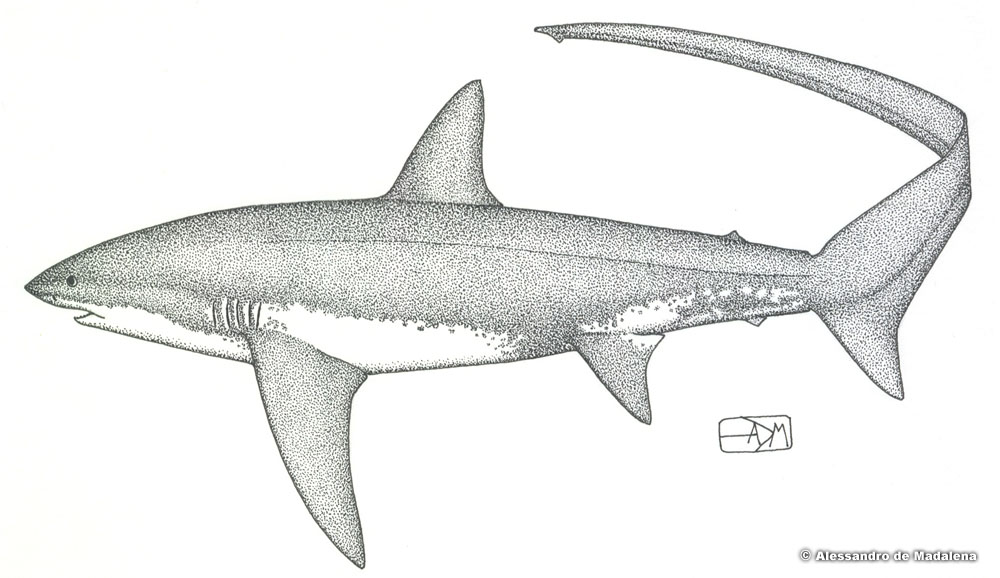 Common thresher, (Alopias vulpinas) common off California coast and Monterey bay http://www.pelagic.org/montereybay/pelagic/threshershark.html
[size=+1]
MACKEREL SHARKS[/size]
These sharks are fast, strong swimmers and include the great white shark and the mako. A type of Lamniformes shark, family Lamniformae.
[size=+1]
MAGNETIC FIELD[/size]
The Earth's magnetic field is aligned with the north and south poles, and has reversed many times during geologic history. Sharks may use the magnetic field of the Earth for navigation purposes on migrations.
[size=+1]
MAKO SHARK[/size]
The shortfin mako shark (Isurus oxyrinchus) has a conical snout and long gill slits. It is the fastest swimming fish. These sharks reproduce via aplacental viviparity (they bear live young but the babies are not nourished via a placenta in the womb; cannibalism often occurs within the womb). Makos can maintain a body temperature higher than that of the surrounding water.Order: Lamniformes
Porbeagle Shark, Lamna nasus.] The largest-known Salmon Shark was 10 ft (3 m) long. Classification: Order Lamniformes (mackerel sharks), Family Lamnidae (Mackerel sharks, porbeagles, and white sharks).
estuaries and harbors. Sandbar sharks have a growth rate of about 1.7 inches (43 mm) per year, a slow growth rate for sharks. The thick skin is used for leather. These strong swimmers migrate over 1550 miles (2500 km). Their diet is mostly fish, including menhaden, eels, other sharks, skates, squid, and also crustaceans. Females are mature at 16 years and give birth to 8-12 live young after a gestation period of 9-12 months. Pups are about 8.5 inches (22 cm) long at birth. Classification: Order Carcharhiniformes, Family Carcharhinidae (requiem sharks).
mackerel sharks (Odontaspididae). They include the Sandtiger shark (Eugomphodus taurus), the Indian sandtiger (Eugomphodus tricuspidatus), the Smalltooth sandtiger (Odontaspis ferox), and the Bigeye sandtiger (Odontaspis noronhai). They live in tropical and temperate coastlines of all the oceans. They all have long, thin, pointed teeth, and eat mostly fish and invertebrates.
SANDTIGER SHARK[/b][/size]
Sandtigers (Eugomphodus taurus) are also known as the Ragged tooth shark, the grey nurse shark, the sand shark, and the spotted ragged-tooth shark. They are widespread Mackerel sharks (Lamniformes) that range from gray to brown and are about 10-12 feet (3-3.7 m) long. They are fish-eaters that have long, sharp teeth in a narrow snout. They eat and migrate in groups; their activity peaks at night. They are found mostly near coastlines, from the surface down to depths of 3,900 ft (1,200 m). are oviphagous and females have two uterine chambers (wombs). Developing embryos in the wombs are cannibalistic, eating their siblings. Although many embryos are produced, only two are born, one from each uterine chamber. The gestation period is about 8-9 months. Pups are roughly 3.3 feet (1 m) long at birth. Classification: Order Lamniformes (Mackerel sharks), Family Odontaspididae (Sandtiger sharks).
[size=+1]
SAWSHARKS[/size]
Sawsharks are clade of shark that have a long, toothed snout, no anal fin, and the mouth underneath. These common, harmless sharks have a slightly flattened body, nasal barbels, and its pair of five gill slits are on the side of its head. These sharks reproduce via aplacental viviparity. Their diet consists mostly of bony fishes. This order of sharks is called the Pristiophoriformes.
Carcharhiniformes
aplacental viviparity, having litters of up to 52 pups after a gestation period of one year. Pups are about 12-14 inches (30-35 cm) long at birth. Females are mature at 8-10 years and have a low reproductive rate. It is fished for its fins, meat and liver oil. Galeorhinus galeus was named by Linnaeus in 1758. Classification: Order Carcharhiniformes (ground sharks), Family Triakidae (houndsharks, topes, whiskery sharks).
Order Squaliformes, Family Squalidae.
[size=+1]
[/size]
[size=+1]
[/size]
Broadnose sevengill, Notorynchus cepedianus and the Sharpnose sevengill, Heptranchias perlo) are distinctive and rare sharks that have seven gills (most sharks have five). These unusual sharks also have a single (and small) dorsal fin. The broadnose sevengill grows to be up to 10 ft (3 m) long, is speckled and silvery; this shark has small eyes, and a wide head. The sharpnose sevengill is up to about 4.5 ft (1.4 m) long. These aggressive sharks eat fish (including other sharks, rays, and bony fish), seals, and scavenged prey (including human corpses). Broadnose sevengill sharks live in temperate seas on continental shelves (to a depth of 450 ft (135 m). The upper teeth are jagged and multi-cusped (except the center tooth). The lower teeth are comb-shaped. These sharks bear live young in shallow bays. Litters of up to 80 pups have been found. Pups are about 16-18 inches (40-45 cm) long. Classification: Order Hexanchiformes, Family Hexanchidae .
[size=+1]
SEXUAL DIMORPHISM[/size]
Sexual dimorphism is the physical differences between the males and females of a species. Female whales are usually larger than the males.
SHARPNOSE SHARK[/b][/size]
The Atlantic Sharpnose Shark (Rhizoprionodon terraenovae) is a harmless, edible, requiem shark (Family Carcharinidae). The Sharpnose is a small, slender shark with 5 gill slits, two dorsal fins, an anal fin, no fin spines, the mouth behind the eyes, and nictitating eyelids. It has a long, sharp snout, black-edged dorsal and caudal fins (which fade with age), and furrowed or wrinkled corners of the mouth. It is brown to olive-gray colored with white countershading on the belly and is from 2 to 4 feet (60-120 cm) long. A carnivore, it eats small fish, mollusks, and shrimp. The sharpnose is viviparous, with litters of 4 to 7 pups. Classification: Order Carcharhiniformes
SHORTFIN MAKO SHARK[/size][/color]
The short-finned mako shark (Isurus oxyrincus), also known as the bonito, is the fastest shark. This fish can also leap out of the water. It has has a conical snout, and long gill slits. Short-finned Makos average 5-8 feet (1.5-2.5 m) long but can reach 12 feet (3.7 m) long, weighing 1,000 pounds (455 kg). The Mako is considered dangerous to people. It reproduces via aplacental viviparity and the pups are cannibalistic in the womb. Makos can maintain a body temperature higher than that of the surrounding water. Order: Lamniformes
[size=+1]
SHOVELHEAD SHARK[/size]
Sphyrna tiburo (also known as the bonnethead shark) is a small hammerhead shark with a smooth, rounded head. It has small, sharp teeth in the front of the mouth (for grabbing soft prey) and flat, broad molars in the back (for crushing hard-shelled prey). It is a common, harmless, timid shark averaging about 3.3 feet (1 m) long. It is gray-brown above and lighter on the underside with short pectoral fins Large schools migrate to warm water in the winter and cooler water in the summer. Females are mature at 2.5 feet (75 cm) long and give birth in shallow bays to 8 to 16 pups about 14 inches (35 cm) long. Bonnetheads are found in the western Atlantic and eastern Pacific Oceans, in the surf zone, reefs, on sandy bottoms and in estuaries. Classification: Order Carcharhiniformes, Family Sphyrnidae (hammerhead sharks).
SHOVELNOSE SHARK (1)[/b][/size]
Carcharhinus leucas is also known as the Bull shark, the Ganges shark, the River shark, the Cub shark, the Zambezi shark, Van Rooyen's shark, the Slipway gray shark, the Square-nose shark, and the Nigaragua shark. It is a large, fierce predator that eats fish, including other sharks, ray, and just about anything else. It has been known to attack people and will venture into fresh water.
[size=+1]
SHOVELNOSE SHARK (2)[/size]
The Dusky Shark (Carcharhinus obscurus) is a requiem shark that is also known as the shovelnose, the bay shark, the lazy-gray, and the black whaler. It is charcoal colored on top and white with copper-colored markings below. It has a faint pale stripe along its sides. Dusky sharks average about 10 ft (310 cm) long; females are slightly larger than males. The largest one found was about 13 ft (4 m) long. It lives at all levels of the ocean and from the shoreline to out at sea. It is found in warm temperate and tropical waters worldwide. It migrates to cooler waters during warm weather, probably for reproduction and feeding. This shark is often seen following ships and is hunted as a game fish. Overfishing is diminishing the numbers of this shark. Few Dusky shark attacks are documented, but it is considered dangerous. It normally eats small fish (like sardines), large fish (like tuna), flatfish, other sharks, and eels. Females are mature when they are 9 ft (2.8 m) long and have litters of about 10 pups which are roughly 3 ft (95 cm) long each. There is a 16 month gestation period. Classification: Order Carcharhiniformes, Family Carcharhinidae (requiem sharks), Genus Carcharhinus, Species obscurus.
Carcharhiniformes) that ranges from black to gray on top (and white to cream on the belly). These long, tapered sharks are fast swimmers and are about 10 feet (3 m) long. They have a long, pointed snout. The teeth in the upper jaws are long, triangular, and serrated; the teeth in the lower jaws are only slightly serrated. Silky sharks eat fish, squid, and crabs. It sometimes travels in schools segregated by sex. Females give birth to litters of 6-12 live pups which are 29-31 inches (75-80 cm) long at birth. These sharks are harvested commercially for their meat, liver and fins.
bony fish that is much more closely related to goldfish than to sharks. These common pets are originally from south-east Asia, and may be an endangered species in the wild. These fish grow to about 8 inches (20 cm) long, but is usually smaller. Its native habitat is rivers in Borneo, Sumatra, and Thailand. These "sharks" can be found at most pet stores.
viviparous with a gestation period of about one year. Females usually have 5-6 pups in a litter. Silvertips are attracted to low-frequency sounds. Attacks on people are rare.
Bluntnose sixgill (Hexanchus griseus), the Bigeye sixgill (Hexanchus vitulus), and the frilled shark (Chlamydoselachus anguineus). These unusual sharks also have a single (and small) dorsal fin near the end of the body. These sharks are gray-brown in color and are paler underneath. The Bluntnose sixgill (also known as the Cow shark, the Grey shark, the mud shark and the Bulldog shark) is a common shark about 16 ft (4.8 m) long with a toxic liver (but edible flesh) and six rows of saw-like teeth in the side of the jaws; it eats large fish, crabs and squid, lives in dark waters at depths down to 5900 ft (1800 m), and has litters of up to 100 pups. The Bigeye sixgill (also known as the lesser sixgill and the calf shark) is about 5.9 ft (1.8 m) long, has large eyes, a slender body, five rows of saw-like teeth in the side of the jaws and lives on or near the bottom of warm temperate and tropical seas. Classification: Order Hexanchiformes, Family Hexanchidae.
[/b][/size]
SLEEPER SHARK[/b][/size]
Somniosus microcephalus, also known as the Greenland shark, and the gurry shark, lives very deep in the North Atlantic Ocean. It lives at depths down to 1,800 feet (550 m) in very cold water (36-45°F=2-7°C). It is up to 21 feet (6.5 m) long. This grayish-brown shark has a short snout and is a slow swimmer. Bioluminescent (glowing) copepods attach to the Greenland shark's eyes attract prey to the shark's head! The shark's upper teeth are long and sharp; the lower teeth are flatter, more closely-set (and also sharp). These sharks gather in large numbers in shallow Arctic waters (up to 80° north) during the winter but migrate back to deep waters during the summer. Eskimo hunters traditionally used its skin for boots and its teeth for knives. This large shark is oviviparous, having litters of about 10 pups, each roughly 15 inches (38 cm) long. Classification: Order Squaliformes, Family Squalidae (dogfish sharks)
SLIPWAY GRAY SHARK[/b][/size]
Carcharhinus leucas is also known as the Bull shark, the Ganges shark, the River shark, the Cub shark, the Zambezi shark, Van Rooyen's shark, the Shovelnose shark, the Square-nose shark, and the Nigaragua shark. It is a large, fierce predator that eats fish, including other sharks, ray, and just about anything else. It has been known to attack people and will venture into fresh water.
aplacental viviparity, having litters of up to 52 pups after a gestation period of one year. Pups are about 12-14 inches (30-35 cm) long at birth. Females are mature at 8-10 years and have a low reproductive rate. It is fished for its fins, meat and liver oil. Galeorhinus galeus was named by Linnaeus in 1758. Classification: Order Carcharhiniformes (ground sharks), Family Triakidae (houndsharks, topes, whiskery sharks).
[/b][/size]
SPINED PYGMY SHARK[/b][/size]
Squaliolus laticaudus is one of the smallest sharks; it is roughly 8 to 10 inches (20 to 25 cm) long (females are about 10 inches = 25 cm long; males are up to 9 inches = 23 cm long). This deep water shark has a spine in front of its first dorsal fin but not in front of the second dorsal fin (this is unique among sharks). This harmless shark is very sleek and has a bulbous snout. The upper teeth are narrow and small; the lower teeth and larger and knife-like. It has a large spiracle (an extra, round gill slit) behind each large eye. It is dark-gray to black with white-tipped fins and bio-luminescence (luminous photophores) on its belly; these photophores light up and may serve as camouflage (they eliminate shadows when seen from below). It eats squid, shrimp, and mid-water fish (especially lanternfishes). This uncommon shark lives in deep water (down to 6,550 ft = 2,000 m) but migrates vertically each day to hunt at night in mid-depth waters (about 650 ft = 200 m). It is found in temperate and tropical oceans worldwide. Its reproductive biology is unknown. Classification: Order Squaliformes.
SPINY DOGFISH SHARK[/b][/size]
Squalus acanthias is the most common shark. These small sharks congregate in schools and migrate. They are about 3-4 feet (0.9-1.2 m) long and are found worldwide.
Tiger sharks and angelsharks have spiracles.
digestive tract enables the shark to efficiently digest its food in a small area, since the surface area of the intestines (where nutrient absorption takes place) is very large within the spiral.
SPOTTED SEVENGILL SHARK[/b][/size]
The spotted sevengill shark (Notorynchus cepedianus) is a distinctive and rare shark that has seven gills (most sharks have five). This unusual shark also has a single (and small) dorsal fin. The broadnose sevengill grows to be up to 10 ft (3 m) long, is speckled and silvery; this shark has small eyes, and a wide head. These aggressive sharks eat fish (including other sharks, rays, and bony fish), seals, and scavenged prey (including human corpses). Broadnose sevengill sharks live in temperate seas on continental shelves (to a depth of 450 ft (135 m). The upper teeth are jagged and multi-cusped (except the center tooth). The lower teeth are comb-shaped. These sharks bear live young in shallow bays. Litters of up to 80 pups have been found. Pups are about 16-18 inches (40-45 cm) long. It was named by Peron in 1807. Classification: Order Hexanchiformes, Family Hexanchidae. It is also called the ground shark, the cow shark, the broad snout shark and the broadnose sevengill shark.
Order Squaliformes (Dogfish Sharks); Family Squaildae; Genus Squalus; Species asper (the Roughskin spurdog), blainvillei (the Longnose spurdog), melanurus (the Blacktailed spurdog), japonicus (the Japanese spurdog), megalops (the Shortnose spurdog or Spiky Jack), mitsukurii (the Shortspine spurdog), rancureli (the Cyrano spurdog).
[size=+1]
SQUALIFORMES[/size]
A clade of sharks with a short snout, the mouth underneath the snout, and no an anal fin. These include the dogfish and cookiecutter sharks.
SQUARE-NOSE SHARK[/b][/size]
Carcharhinus leucas is also known as the Bull shark, the Ganges shark, the River shark, the Cub shark, the Zambezi shark, Van Rooyen's shark, the Shovelnose shark, the Slipway gray shark, and the Nigaragua shark. It is a large, fierce predator that eats fish, including other sharks, ray, and just about anything else. It has been known to attack people and will venture into fresh water.
[size=+1]
SQUATINIFORMES[/size]
A clade of sharks with a flat body, the mouth at the front of the head, and no an anal fin. This order include the angelsharks and monkfish.
[size=+1]
SQUID[/size]
Squid are mollusks. They are eaten by many sharks and rays.
rays are closely related to sharks.
[size=+1]
STREAMLINED[/size]
Streamlined means having a contoured shape that minimizes resistance to currents of water (or air). Many sharks have a streamlined shape. This type of shape lets these sharks swim quickly through the water.
[size=+1]
SWELL SHARK[/size]
The Swell shark, Cephaloscyllium ventriosum, is a harmless, bottom-dwelling shark. It is called the "swell" shark because when it is in danger it can swallow a lot of water, making its body balloon up. This increase in size wedges the shark between rocks, making it difficult to catch. This shark is light brown with dark brown marking; this color scheme camouflages the shark on the rocky sea floor. It is a light brown shark with dark brown spots. Its snout is blunt and it has a very wide mouth. It is nocturnal (is most active at night) and eats small fish. It is oviparous, laying small, greenish, purse-like eggs in rocky crevices. These eggs take 7 to 10 months to hatch, depending on the temperature of the water. Swell sharks are found in temperate waters off the western coast of North America from central California, USA to central Chile.
Kingfisher
Member
Thanks, great Lesson
Finnseeker
Senior Member
[color="#006600"]tuna[/color] wrote:
Hey Tuna - you manage to get another big one yet ? I saw Thea's great catch.Thanks for all the info it makes great reading and it's lekker to learn something everyday
Finnseeker
Senior Member
[color="#006600"]tuna[/color] wrote:
Good luck to you and Trophy and look forward to the pics, nice Raggie there . Looking forward to the report.The last was a Raggie of 123kg's
Hopefully Trophy will be helping me to get some big mammas when i go to PE area on sunday
Finnseeker
Senior Member
[color=#006600]skrops[/color] wrote:
Here is one method used on blue gills
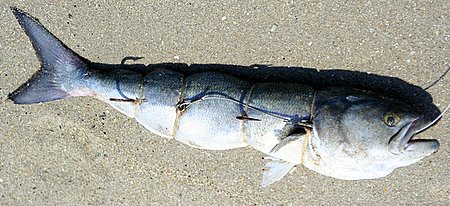
Using a cable tie is one quick method also

[align=center]

Illustration #1: After threading the hook and line through the baits lower lip, you will then pierce the side of the bait near the tail and run the hook through as shown in illustration #2.[/align]
[align=center]
Illustration #2 : After the hook is placed near the tail, you will take your first of 2 zip ties (cable ties) and wrap the 1st zip tie around the shank of the hook and tail of the fish to hold the hook barb in the proper position to the fish for hookup as demonstrated in illustration #3
 [/align]
[align=center]

Illustration #3: Once the hook is secured with the zip tie, you will then remove any slack in the leader between the fish's mouth and its tail and then place your second zip tie over the dorsal fin behind the gills of the fish to secure the line close to the fish as in illustration #4. [/align]
[align=center]
Illustrtation #4: Once you have secured both zip ties and tightened them down, you can clip the tag ends of the ties flush and your bait is ready to fish and do its job. Be careful not to place the forward zip tie directly under the gills as this will disturb the normal breathing of the bait fish. [/align]
shot guys.
would be great to see a actual picture of how you hook the swimbait to make sure hook stays proud.
Here is one method used on blue gills
Using a cable tie is one quick method also
[align=center]
Illustration #1: After threading the hook and line through the baits lower lip, you will then pierce the side of the bait near the tail and run the hook through as shown in illustration #2.[/align]
[align=center]
Illustration #2 : After the hook is placed near the tail, you will take your first of 2 zip ties (cable ties) and wrap the 1st zip tie around the shank of the hook and tail of the fish to hold the hook barb in the proper position to the fish for hookup as demonstrated in illustration #3
[align=center]
Illustration #3: Once the hook is secured with the zip tie, you will then remove any slack in the leader between the fish's mouth and its tail and then place your second zip tie over the dorsal fin behind the gills of the fish to secure the line close to the fish as in illustration #4. [/align]
[align=center]
Illustrtation #4: Once you have secured both zip ties and tightened them down, you can clip the tag ends of the ties flush and your bait is ready to fish and do its job. Be careful not to place the forward zip tie directly under the gills as this will disturb the normal breathing of the bait fish. [/align]
[color=#006600]Finnseeker[/color] wrote:
Hiya Finnseeker,
I have been chatting to a French Company that make a product called SeaFighter, have you come accross or used the product? There is an agent in SA, but he was not the sharpest tool in the shed and I have not followed up again. Thanks for the offer, I will PM you soon to chat about getting my hands on some upscale tackle and goodies.
Are you from SA? Where did you get 'Boer maak n plan'?
Here is another one, 'Boere staan saam!'
Hi Trophy - Yup I saw you on there ..........................
SA certainly does have a different mixed bag compared to the West and East coast in the USA .
Let me know if you need any stuff like a spool of SS cable, thimbles or rattles etc. I will be glad to give it to you no cost no charge . I would be only to pleased to give you this to use and see the difference.
Personally that piano wire is lethal to angler leaderman and shark as it will slice through anything its so thin. If a shark wraps up it will slice it up. I have seen some horrific tragedy's to sharks and people from it. But you have to make do with what you have and a " BOER MAAK N PLAN"
Hiya Finnseeker,
I have been chatting to a French Company that make a product called SeaFighter, have you come accross or used the product? There is an agent in SA, but he was not the sharpest tool in the shed and I have not followed up again. Thanks for the offer, I will PM you soon to chat about getting my hands on some upscale tackle and goodies.
Are you from SA? Where did you get 'Boer maak n plan'?
Here is another one, 'Boere staan saam!'
Finnseeker
Senior Member
[color=#ff6633]Trophy[/color] wrote:


Throphy - Im a proud South African yes : The Seafighters I deal with in France are below and no I have not seen the SeaFighter products around the world in my travels.[color=#006600]Finnseeker[/color] wrote:Hi Trophy - Yup I saw you on there ..........................
SA certainly does have a different mixed bag compared to the West and East coast in the USA .
Let me know if you need any stuff like a spool of SS cable, thimbles or rattles etc. I will be glad to give it to you no cost no charge . I would be only to pleased to give you this to use and see the difference.
Personally that piano wire is lethal to angler leaderman and shark as it will slice through anything its so thin. If a shark wraps up it will slice it up. I have seen some horrific tragedy's to sharks and people from it. But you have to make do with what you have and a " BOER MAAK N PLAN"
Hiya Finnseeker,
I have been chatting to a French Company that make a product called SeaFighter, have you come accross or used the product? There is an agent in SA, but he was not the sharpest tool in the shed and I have not followed up again. Thanks for the offer, I will PM you soon to chat about getting my hands on some upscale tackle and goodies.
Are you from SA? Where did you get 'Boer maak n plan'?
Here is another one, 'Boere staan saam!'


Finnseeker
Senior Member
Trophy - I also use shackles on most my gear now Stainless steel shackle you can pick up from any yactching or hardware place . Makes for quick changing the hooks, lures etc and you do not have to have 10000000 hooks you can interchange them and lures and keep expenses down and dont have time to rerig while out fishing.


