
You are using an out of date browser. It may not display this or other websites correctly.
You should upgrade or use an alternative browser.
You should upgrade or use an alternative browser.
Redbait....what is it?
- Thread starter ICTHYES
- Start date
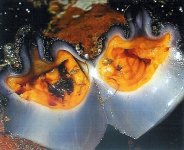
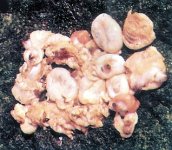
Some tips with Red Bait...
Do not let Red bait come into contact with fresh water, as this makes the bait sour. Also happens if Red bait is allowed to get too hot, ie in the sun. Galjoen will not touch sour Red bait.
To mature Redbait, hang in a wicker basket in the shade of a tree for 3 days.
Turn the Redbait pod inside out. Do not bait up with the tough teat sections. Thread the bait onto the hook until almost the entire hook is hidden - Galjoen are fussy eaters. Cotton should be kept to a minimum, only the meat round the shank of the hook should be bound with cotton to prevent the bait from coming off the hook. The fat fleshy piece of Redbait should be left round the curve of the hook, as this is where the Galjoen will strike.
Do not let Red bait come into contact with fresh water, as this makes the bait sour. Also happens if Red bait is allowed to get too hot, ie in the sun. Galjoen will not touch sour Red bait.
To mature Redbait, hang in a wicker basket in the shade of a tree for 3 days.
Turn the Redbait pod inside out. Do not bait up with the tough teat sections. Thread the bait onto the hook until almost the entire hook is hidden - Galjoen are fussy eaters. Cotton should be kept to a minimum, only the meat round the shank of the hook should be bound with cotton to prevent the bait from coming off the hook. The fat fleshy piece of Redbait should be left round the curve of the hook, as this is where the Galjoen will strike.
Fish Feeder
New member
[color=#006600]dubzaddict[/color] wrote:
Hi guys, here is my daughter, she goes fishing with me sometimes. At present she is busy studying Zoololgy & Botany...
This is her answer.....
Red bait is also known as sea squirt or scientifically as Ciona. It is an animal as it belongs to the Kingdom animalia.
its classification is as follows:
phylum Chordata (has a notochords ' like a spinal cord')
Group Protochordata (doesnt have a cranium or brain)
Subphylum Urochordata (notochorda only in larvea, adults in tunic)
Class Ascidiacea ( tunic with muscle bundles)
Adults are sessile, larvae free swimming.
Are often called sea squirts because some species forcefully discharge a jet of water from its excurrent siphon when irritated. Adults may be solitary or colonial. Adults have an incurrent siphon (sucks in oxygentaed water with food particles in it) at anterior end of body, excurrent siphon ( expels deoxygenated water) at dorsal side. They are hermaphroditic, usually have a single ovary and single testis in same animal. fertilization occurs in surrounding waters. The larva do not feed but swims for hrs before attaching itself vertically to a solid object (i.e. rock). Then undergoes dramatic metamorphosis to become a sessile adult.
P.S. for all those english fisherman, bloedwurm is lug worm in english
P.S.S moonshine is also known as clam worm
(and they are both segmented worms)
BY THE WAY I SUPPORT CATCH AND RELEASE
[color=#006600]Fish Feeder[/color] wrote:lol[color=#006600]dubzaddict[/color] wrote:Maybe it a silly Q. but i dnt knw..
 Ok, answer for "what is redbait" will be answered soon by my daughter....gimme 30 min to go inside and put pc on there
Hi guys, here is my daughter, she goes fishing with me sometimes. At present she is busy studying Zoololgy & Botany...
This is her answer.....
Red bait is also known as sea squirt or scientifically as Ciona. It is an animal as it belongs to the Kingdom animalia.
its classification is as follows:
phylum Chordata (has a notochords ' like a spinal cord')
Group Protochordata (doesnt have a cranium or brain)
Subphylum Urochordata (notochorda only in larvea, adults in tunic)
Class Ascidiacea ( tunic with muscle bundles)
Adults are sessile, larvae free swimming.
Are often called sea squirts because some species forcefully discharge a jet of water from its excurrent siphon when irritated. Adults may be solitary or colonial. Adults have an incurrent siphon (sucks in oxygentaed water with food particles in it) at anterior end of body, excurrent siphon ( expels deoxygenated water) at dorsal side. They are hermaphroditic, usually have a single ovary and single testis in same animal. fertilization occurs in surrounding waters. The larva do not feed but swims for hrs before attaching itself vertically to a solid object (i.e. rock). Then undergoes dramatic metamorphosis to become a sessile adult.
P.S. for all those english fisherman, bloedwurm is lug worm in english
P.S.S moonshine is also known as clam worm
(and they are both segmented worms)
BY THE WAY I SUPPORT CATCH AND RELEASE
Fish Feeder
New member
[color=#006600]dubzaddict[/color] wrote:
Ok, will join forum as "Fish Feeders Daughter", will answer then....ps, have to look up answers in text book to refresh. Please direct any questions that you may have to me and i will try and answeruhmmmmm oooooook and you she provided that just like that?hectic ?goodluck with the studies....I am gona be bit forward(seeing that we have an expert online) please define the blue bottle Pretty Please!
Fish Feeders Daughter
New member
[color=#006600]dubzaddict[/color] wrote:
okie dokie, about the blue bottle
It is also known as the Portuguese man-of-war
Classification
Phylum Cnidaria (sessile polyp 'like hydrant', swimming medusa)
Class Hydrozoa (medusae small, solitary or colonial)
Order Siphonophora (free swimming)
Genus Physalia
The blue like 'head'(pneumatophore) is the drifting mechanism and is filled with carbon monoxide. There are 3 different types of zooids (tentacles). When looking at the blue bottle (not that many of us do) the zooids closest to the drifting mechanism are the gastrozooids, or the feeding polyps. the next zooids are the gonophores , are for reproduction; and then the long zooids that one usually sees (basically the only ones you see if you dont know how to differentiate them) are the dactylozooids, which are the feeding tentacles. These dactylozooids sting the prey and then lift it to the lips of the gastrozooids.
The Portuguese man-of-war is a colony with a rainbow-hued float of blues and pinks. The zooids are laden with nematocysts and capable of inflicting painful stings (as im sure many have experienced). The pneumatophore acts as a type of nurse-carrier for future generations of individuals that bud from it and hang suspended in the water.
So... in other words each individual that one sees on the beach or in the water does infact consist of a colony and it may have as many as 1000 zooids
will do that .....think you gona regret saying that i can ask you questions...lets just say i have a very inquisitive mind...will make a post(ask the expert) when i get back from church ...got to go cheers
okie dokie, about the blue bottle
It is also known as the Portuguese man-of-war
Classification
Phylum Cnidaria (sessile polyp 'like hydrant', swimming medusa)
Class Hydrozoa (medusae small, solitary or colonial)
Order Siphonophora (free swimming)
Genus Physalia
The blue like 'head'(pneumatophore) is the drifting mechanism and is filled with carbon monoxide. There are 3 different types of zooids (tentacles). When looking at the blue bottle (not that many of us do) the zooids closest to the drifting mechanism are the gastrozooids, or the feeding polyps. the next zooids are the gonophores , are for reproduction; and then the long zooids that one usually sees (basically the only ones you see if you dont know how to differentiate them) are the dactylozooids, which are the feeding tentacles. These dactylozooids sting the prey and then lift it to the lips of the gastrozooids.
The Portuguese man-of-war is a colony with a rainbow-hued float of blues and pinks. The zooids are laden with nematocysts and capable of inflicting painful stings (as im sure many have experienced). The pneumatophore acts as a type of nurse-carrier for future generations of individuals that bud from it and hang suspended in the water.
So... in other words each individual that one sees on the beach or in the water does infact consist of a colony and it may have as many as 1000 zooids

[color=#006600]Fish Feeders Daughter[/color] wrote:

[color=#006600]dubzaddict[/color] wrote:will do that .....think you gona regret saying that i can ask you questions...lets just say i have a very inquisitive mind...will make a post(ask the expert) when i get back from church ...got to go cheers
okie dokie, about the blue bottle
It is also known as the Portuguese man-of-war
Classification
Phylum Cnidaria (sessile polyp 'like hydrant', swimming medusa)
Class Hydrozoa (medusae small, solitary or colonial)
Order Siphonophora (free swimming)
Genus Physalia
The blue like 'head'(pneumatophore) is the drifting mechanism and is filled with carbon monoxide. There are 3 different types of zooids (tentacles). When looking at the blue bottle (not that many of us do) the zooids closest to the drifting mechanism are the gastrozooids, or the feeding polyps. the next zooids are the gonophores , are for reproduction; and then the long zooids that one usually sees (basically the only ones you see if you dont know how to differentiate them) are the dactylozooids, which are the feeding tentacles. These dactylozooids sting the prey and then lift it to the lips of the gastrozooids.
The Portuguese man-of-war is a colony with a rainbow-hued float of blues and pinks. The zooids are laden with nematocysts and capable of inflicting painful stings (as im sure many have experienced). The pneumatophore acts as a type of nurse-carrier for future generations of individuals that bud from it and hang suspended in the water.
So... in other words each individual that one sees on the beach or in the water does infact consist of a colony and it may have as many as 1000 zooids
Land Locked
Senior Member
Welcome to Fish Feeders Daughter.
Firstly, manna to you for an informative reply.
I have posted a question at the below link, trying not to hijack the redbait topic.
http://www.sealine.co.za/view_topic.php?id=1808&forum_id=13
Thanks
LL
Firstly, manna to you for an informative reply.
I have posted a question at the below link, trying not to hijack the redbait topic.
http://www.sealine.co.za/view_topic.php?id=1808&forum_id=13
Thanks
LL

[color=#006600]dubzaddict[/color] wrote:
ok... I'll resign.reefman i think you should rethink you position research guru bru
[color=#0066cc]Reefman[/color] wrote:
NNNNNNOOOOOOOOOOOOO! Nobody can draw a trace like old Reefer![color=#006600]dubzaddict[/color] wrote:ok... I'll resign.reefman i think you should rethink you position research guru bru
old????NNNNNNOOOOOOOOOOOOO! Nobody can draw a trace like old Reefer!
Mind your manners with your language, young man!
Land Locked
Senior Member
Nick,
That is an awesome recovery. I can see no way that Reefman can not feel flattered.
LL:cel:
That is an awesome recovery. I can see no way that Reefman can not feel flattered.
LL:cel: