
You are using an out of date browser. It may not display this or other websites correctly.
You should upgrade or use an alternative browser.
You should upgrade or use an alternative browser.
My Dark secret
- Thread starter Catch 22
- Start date
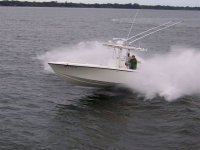
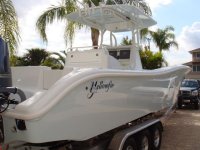

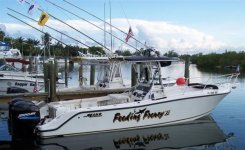
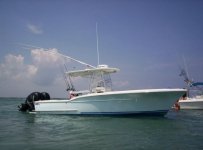
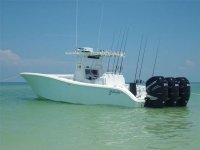

Got to love the yanks. Refuse to sign the treaty for environment, ban 2strokes due to the damage they cause, then put 3,4 or 5 300hp 4strokes ont he back of your boat that cosume more fuel in a day than my old 2strokes in a year. makes perfect sence to me.
Must admit, they look like lovely boats, especially for their sailfish and king mackrel type fishing, and hell, you get there fast.
Must admit, they look like lovely boats, especially for their sailfish and king mackrel type fishing, and hell, you get there fast.
fstf roller
Senior Member
very nice i have a love for the look of those boats deep inside as well man!
Their mono hulls are indeed awesome!!
The problem many of the US boaters face is that their fishing grounds are very far offshore. One of my friends in the US fishes some lumps 100nm from port. So, at 30knts, it will take you over 3 hours to get there. At 40knts, just over 2 hours. Since their sea's are alot calmer than ours, they can make those fast runs.
With the trend to go bigger and bigger in the outboard powered boat market, many manufacturers have built vessels that NEED to be powered by triple or quadruple motors. Take a look at our locally built 28' Cape Craft. Guys are running them with 250hp motors here. Now, up until recently, the largest motor was a 300hp. On a US built 40' mono, even 2x300's would be too weak, for the required top speed. The only option is to fit 3 or 4 X 250/300hp motors. This is why Yamaha has developed their 350hp motor.
Looking at the 42' Yellowfin boat, they rate their boat to carry a MAXIMUM of 1400hp, that would be 4x350hp Yamaha's!!
With the move to larger boats being powered by outboards, its only a matter of time before one of the manufacturers bring out a 400-500hp outboard engine!!
The problem many of the US boaters face is that their fishing grounds are very far offshore. One of my friends in the US fishes some lumps 100nm from port. So, at 30knts, it will take you over 3 hours to get there. At 40knts, just over 2 hours. Since their sea's are alot calmer than ours, they can make those fast runs.
With the trend to go bigger and bigger in the outboard powered boat market, many manufacturers have built vessels that NEED to be powered by triple or quadruple motors. Take a look at our locally built 28' Cape Craft. Guys are running them with 250hp motors here. Now, up until recently, the largest motor was a 300hp. On a US built 40' mono, even 2x300's would be too weak, for the required top speed. The only option is to fit 3 or 4 X 250/300hp motors. This is why Yamaha has developed their 350hp motor.
Looking at the 42' Yellowfin boat, they rate their boat to carry a MAXIMUM of 1400hp, that would be 4x350hp Yamaha's!!
With the move to larger boats being powered by outboards, its only a matter of time before one of the manufacturers bring out a 400-500hp outboard engine!!
shagnrelease
Sealiner
Catch I agree the Yank manufacturers are leagues ahead in building lovely big mono's, I love them!!! No idea how they would perform on our coastline, but I would imagine them to pretty damned good!!
Miles any idea about what the story is regarding "hull speed", now as far as I understand it there is a calculation that includes length, displacement beam etc and that gives you a maximium speed for a hull and no matter what you hang on the back it will only go that speed??????
When I was running a large sportfisher the owner kept reffering to this everytime we discussed the new boat that he had ordered and when we were discussing what engines to fit he would always shoot me down(this changed from week to week,even if I chose the motor he wanted last week:headb) and reffer to the "hull speed" without really explaining to much about it. I figured he was going to make the call any way so why get involved with arguing with boss.
And to this day I still have not checked the actual theory out, and have always just gone with the manufacturer recommendations for my boats.
so any ideas on the hull speed theory???
Miles any idea about what the story is regarding "hull speed", now as far as I understand it there is a calculation that includes length, displacement beam etc and that gives you a maximium speed for a hull and no matter what you hang on the back it will only go that speed??????
When I was running a large sportfisher the owner kept reffering to this everytime we discussed the new boat that he had ordered and when we were discussing what engines to fit he would always shoot me down(this changed from week to week,even if I chose the motor he wanted last week:headb) and reffer to the "hull speed" without really explaining to much about it. I figured he was going to make the call any way so why get involved with arguing with boss.
And to this day I still have not checked the actual theory out, and have always just gone with the manufacturer recommendations for my boats.
so any ideas on the hull speed theory???
Hammertime
Sealiner
Sheez Chris, we need a few of those big mono's.
I looked at the 26ft Trophy I think it was. The finishes are killer too.
My main worry though was the sea's we have are so strong and they rarely in the winter season on the long tuna runs are under 8ft. Just wonder how those hulls would stand up to the bashing.
I looked at the 26ft Trophy I think it was. The finishes are killer too.
My main worry though was the sea's we have are so strong and they rarely in the winter season on the long tuna runs are under 8ft. Just wonder how those hulls would stand up to the bashing.
shagnrelease
Sealiner
okay so after my post on Hull speed I found this on a Boat builders forum....makes for interesting reading even though it does get a bit technical.....
Hull speed
Notes on hull speed and the gross misconceptions surrounding it. These notes concern displacement craft.
I did a fast search in Google for boat “hull speed†max and got 528 hits. I did not open them all because I was laughing too much but here is a gem
Quote:
When I was a lad, I was taught that no boat could go faster than about 1.4 times the square root of its waterline length, in knots. This is consistent with JB's comment below. A 45 footer with a 36 foot waterline length has a max hull speed of about 9 knots, which it cannot exceed unless it can 'plane', or is actually falling as noted below. UN-QUOTE.
What stops a boat which is not 'planing' from going faster than its max hull speed, regardless of whether its motive power is wind or engine and regardless of 'horsepower', is the boat's inability to ride up and over its own bow wave.
Although this one is merely repetition of some family legend there are some sites that give the impression of reputability but still put forward the same nonsense even though they may cloak it in more pseudo scientific bafflegab.
Reference is often made to Froude’s Law and he must be turning in his grave. Froude was a scientist who worked in the second half of the 19th Century doing much research work for the British Admiralty. The work was for warships so any references to sailing and Froude are probably distortions even though he did like yachting.
He did his basic research on models of 3 ft, 6 ft and 12 ft for two different hull forms. He observed that when models were run at speeds in proportion to the square of their length they created similar wave patterns. In 1876 he gave his famous Law of Comparison which states that the resistances of similar ships are in the ratio of the cubes of their linear dimensions when their speeds are in the ratio of the square roots of those dimensions. This is equivalent to saying that the resistances vary as the cube of the scale when the speeds vary as the square root of the scale (Note; this is for the wavemaking resistance not the frictional.)y
Nowhere did Froude make reference to a maximum speed or an unattainable speed based on the waterline length.
When a vessel proceeds through the water it creates a wave train at the bow and another at the stern depending on the speed and the length on the waterline. If there is an interaction the resistance is higher than the smooth line ignoring all the interferences. If there is no interaction the resistance is less than the smooth “average†line so there is a series of humps and hollows. Although the LWL is the usual length used in resistance calculations the length actually depends on the pressure variation at the ends and it varies so that LWL is a kind of average used to simplify the problems.
The shape of the wave is assumed to be a trochoid which gives a good relationship between calculations and observations. Some years ago the children’s toy Spirograph allowed the construction of beautiful wave patterns among them the true trochoid. Imagine a straightedge, a large coin, a sheet of paper and a pencil.
Put the straightedge on the paper lengthways and the coin on the paper near one end resting against it. Make a mark on the coin where it touches the straightedge and then roll the coin along one complete revolution. This represents the length of the wave and the line the point makes would be the wave form where the wave height is the coin diameter. This would be a huge wave and real waves are much lower.
Now imagine a spoke in the coin from the point on the edge to the coin centre. As the coin rolls a point on the spoke also traces a curve in the form of a trochoid. Near the coin edge it would be a big wave and near the coin centre it would be a small wave.
There are mathematical expressions giving the results of energy transformations of collapsing waves and the result is that all waves travel at a speed determined by the wave length independent of wave height. It is given by the expression v^2=L*g/(2*Pi) where v is the speed in feet per second, L is the length in feet, g is the acceleration due to gravity in feet/second/second and Pi is the circumference of a circle divided by the diameter.
When the expression was developed, a U.K. nautical mile was 6080 feet so the speed in knots was multiplied by 6080/3600 to give feet/second. The term g is approx 32.2 feet/sec/sec and Pi is 355/113 approximately. Using a speed V knots then the formula becomes V^2 = L*g/(2*Pi)/(6080/3600)^2 and V = (L*g/(2*Pi))^0.5/(6080/3600) which simplifies to V = 1.340 x L^0.5, using the modern knot of 1852 metres/hr gives a coefficient of 1.341
Because Froude’s Law used his number or V/L^0.5, model testing results were initially plotted on such comparative speeds because the calculations were easier to perform, manipulate and compare. The final full size vessel speed used knots but comparisons with other vessels also used V/L^0.5
The early experimenters pointed out that the resistance was exponential and it was increasingly difficult to achieve higher speeds (so what else is new!). What we all tend to forget is that they were thinking of coal fired boilers and steam engines. The very earliest steam plants weighed in at around one ton per shp, by around 1900 this fell to about 400 pounds per shp then dropped again when steam turbines appeared. Today with gas-turbines and fast, high bmep diesels the weight has tumbled. The last US battleship with reciprocating steam engines, USS Texas, had 28,000 shp, the machinery and boilers weighed 2,350 tons. A large ferry my yard built a few years ago also had 28,000 shp. Four diesel engines each 40 tons, two gearboxes about 15 tons each, two shafts and propellers just under 200 tons and say add 30% for miscellaneous auxiliaries etc giving a grand total of about 500 tons. The same happened on small ships and boats and now an outboard hanging over the stern replaces the old huge engine and boiler as well as coal or wood bunkers.
The only limit to a boat’s speed is power and does the system fit, it is physically impossible to install sufficient hp to drive it at any imaginable speed. A practical limit is reached when the boat speed is high enough to travel fast enough to get there yet is slow enough so it is not too thirsty. It is a judgement call not a mathematical law. The so-called hull speed is a reasonable compromise and is often exceeded especially by small boats as the power needed is still relatively low and fuel is relatively cheap. It is rarely exceeded by ships except mainly by fast warships that top 1.5 or more at flank speed or Government large patrol boats around 200 feet that often exceed 20 knots.
This is not a law on the maximum attainable speed but only the formula giving the hull speed at which the created wave length equals the hull length on the waterline. If it is a sailing vessel then the boat speed is quite obvious but if the boat is powered then a propeller travels through the water at the speed of advance. The speed of advance is the hull speed times (1 – Taylor’s wake) so it is nearly always less than the hull speed. Naval architects and designers of motor vessels take care to differentiate between the hull speed and the speed of advance when calculating propellers and making power calculations. I am not aware of any other meaning of the term hull speed used by professional naval architects.
In the quote at the beginning of these notes is the notion that a boat can climb up and over its bow wave. Agreed that a planing boat may rise and may travel very fast but the wave is still there at the position where the point of contact is. On a displacement boat the idea of climbing up and over is foolish to put it kindly. It’s like asking somebody to run instead of walk so the chin can pass the nose.
The hull speed is only a guide to a speed that should not be exceeded in the interest of fuel economy but then it might as well be 1.3 or maybe 1.4 or 1.2 perhaps. But what is just as important is the power setting of the engine and sufficient power in reserve to overcome bad weather. A gas engine has the characteristic of efficient operation at almost full power whereas a diesel should not run at more than about 70% output. It is unfortunate but it means a gas engine is inefficient at lower, cruising speeds whereas a diesel is more suited.
The first two charts below show the case of a 32 foot LWL trawler type, displacement 26,000 lb with a fuel tank of 100 US gallons of diesel fuel. The power has an allowance for small waves and a slight wind. What is rather noticeable is that at top speed the range reduces by 190 n.miles per knot whereas at about half speed it changes by about 760 n.m./knot. At the S/L ratio of 1.35 the boat speed is 7.64 knots.
There should be enough power installed to overcome a high wind and yet maintain a reasonable speed ensuring you reach your destination. It is risky to simply double the power or triple it because very small boats need a higher proportion add-on than larger boats.
A quick, simple way to get a handle on the effect of wind is to use a formula based on a combination of Adm. D.W. Taylor’s experimental version and the results of the Lucy Ashton. The worst effect is at about 30 degrees off the bow depending on the boat speed and the true wind speed and angle. Instead of trying to calculate the effect just increase the effect somewhat when the wind is ahead and use the formula hp = A*V^3/50,000 where A is the projected area in square feet and V the combined boat and wind speed in knots. Strictly speaking, the power should be reduced by the effect of the boat moving at its own speed without any wind but this will be very small in proportion and can be ignored unless the boat speed is high compared to the wind.
In the latter case reduce the added power by (boat speed/combined speed)^3. If the boat made 7 knots against a wind of 20 knots then (7/27)^3 means that a reduction of 1.74% could be made, if the boat speed equalled the wind speed a reduction of 12.5% could be made.
A quick example; the transverse projected area of the example boat is about 100 square feet. That is, the average hull width above the LWL times the freeboard amidships plus the house width times the height. The chart shows the power needed to overcome a headwind with the boat travelling at various speeds.
Suppose a boat speed of 7.5 knots is chosen and the wind is neglected then 40 hp is needed. Against a wind of 20 knots the boat would make about 6.5 knots – slide left along the 40 hp line until you hit the 20 knots wind speed then read down to the boat speed. Suppose you included the effect of 20 knots wind speed then you would need about 65 hp and you would do only 6.5 knots against a 30 knot wind.
It seems a helluva waste of money to include power that may not be used so a great deal depends on the where you are sailing and the general, prevalent weather conditions. If there is always a strong wind you must make allowance but if this occurs only a few hours a week then it would be costly to allow for it. Like I mentioned earlier it is a judgement call.
If you make long trips in inclement weather it is also advisable to derate the engine generally so that it cannot operate at more than say 90% output, ie a maximum continuous rating (MCR) of 90%. In the example above 65 MCR = 65/0.9 installed ie 72.2 say 75 hp. Because of the wide range in power the propeller selection is critical and it explains the increasing interest in controllable pitch and, to some degree, electric propulsion motors. Ah well, he who calls the Piper and all that!
Hull speed
Notes on hull speed and the gross misconceptions surrounding it. These notes concern displacement craft.
I did a fast search in Google for boat “hull speed†max and got 528 hits. I did not open them all because I was laughing too much but here is a gem
Quote:
When I was a lad, I was taught that no boat could go faster than about 1.4 times the square root of its waterline length, in knots. This is consistent with JB's comment below. A 45 footer with a 36 foot waterline length has a max hull speed of about 9 knots, which it cannot exceed unless it can 'plane', or is actually falling as noted below. UN-QUOTE.
What stops a boat which is not 'planing' from going faster than its max hull speed, regardless of whether its motive power is wind or engine and regardless of 'horsepower', is the boat's inability to ride up and over its own bow wave.
Although this one is merely repetition of some family legend there are some sites that give the impression of reputability but still put forward the same nonsense even though they may cloak it in more pseudo scientific bafflegab.
Reference is often made to Froude’s Law and he must be turning in his grave. Froude was a scientist who worked in the second half of the 19th Century doing much research work for the British Admiralty. The work was for warships so any references to sailing and Froude are probably distortions even though he did like yachting.
He did his basic research on models of 3 ft, 6 ft and 12 ft for two different hull forms. He observed that when models were run at speeds in proportion to the square of their length they created similar wave patterns. In 1876 he gave his famous Law of Comparison which states that the resistances of similar ships are in the ratio of the cubes of their linear dimensions when their speeds are in the ratio of the square roots of those dimensions. This is equivalent to saying that the resistances vary as the cube of the scale when the speeds vary as the square root of the scale (Note; this is for the wavemaking resistance not the frictional.)y
Nowhere did Froude make reference to a maximum speed or an unattainable speed based on the waterline length.
When a vessel proceeds through the water it creates a wave train at the bow and another at the stern depending on the speed and the length on the waterline. If there is an interaction the resistance is higher than the smooth line ignoring all the interferences. If there is no interaction the resistance is less than the smooth “average†line so there is a series of humps and hollows. Although the LWL is the usual length used in resistance calculations the length actually depends on the pressure variation at the ends and it varies so that LWL is a kind of average used to simplify the problems.
The shape of the wave is assumed to be a trochoid which gives a good relationship between calculations and observations. Some years ago the children’s toy Spirograph allowed the construction of beautiful wave patterns among them the true trochoid. Imagine a straightedge, a large coin, a sheet of paper and a pencil.
Put the straightedge on the paper lengthways and the coin on the paper near one end resting against it. Make a mark on the coin where it touches the straightedge and then roll the coin along one complete revolution. This represents the length of the wave and the line the point makes would be the wave form where the wave height is the coin diameter. This would be a huge wave and real waves are much lower.
Now imagine a spoke in the coin from the point on the edge to the coin centre. As the coin rolls a point on the spoke also traces a curve in the form of a trochoid. Near the coin edge it would be a big wave and near the coin centre it would be a small wave.
There are mathematical expressions giving the results of energy transformations of collapsing waves and the result is that all waves travel at a speed determined by the wave length independent of wave height. It is given by the expression v^2=L*g/(2*Pi) where v is the speed in feet per second, L is the length in feet, g is the acceleration due to gravity in feet/second/second and Pi is the circumference of a circle divided by the diameter.
When the expression was developed, a U.K. nautical mile was 6080 feet so the speed in knots was multiplied by 6080/3600 to give feet/second. The term g is approx 32.2 feet/sec/sec and Pi is 355/113 approximately. Using a speed V knots then the formula becomes V^2 = L*g/(2*Pi)/(6080/3600)^2 and V = (L*g/(2*Pi))^0.5/(6080/3600) which simplifies to V = 1.340 x L^0.5, using the modern knot of 1852 metres/hr gives a coefficient of 1.341
Because Froude’s Law used his number or V/L^0.5, model testing results were initially plotted on such comparative speeds because the calculations were easier to perform, manipulate and compare. The final full size vessel speed used knots but comparisons with other vessels also used V/L^0.5
The early experimenters pointed out that the resistance was exponential and it was increasingly difficult to achieve higher speeds (so what else is new!). What we all tend to forget is that they were thinking of coal fired boilers and steam engines. The very earliest steam plants weighed in at around one ton per shp, by around 1900 this fell to about 400 pounds per shp then dropped again when steam turbines appeared. Today with gas-turbines and fast, high bmep diesels the weight has tumbled. The last US battleship with reciprocating steam engines, USS Texas, had 28,000 shp, the machinery and boilers weighed 2,350 tons. A large ferry my yard built a few years ago also had 28,000 shp. Four diesel engines each 40 tons, two gearboxes about 15 tons each, two shafts and propellers just under 200 tons and say add 30% for miscellaneous auxiliaries etc giving a grand total of about 500 tons. The same happened on small ships and boats and now an outboard hanging over the stern replaces the old huge engine and boiler as well as coal or wood bunkers.
The only limit to a boat’s speed is power and does the system fit, it is physically impossible to install sufficient hp to drive it at any imaginable speed. A practical limit is reached when the boat speed is high enough to travel fast enough to get there yet is slow enough so it is not too thirsty. It is a judgement call not a mathematical law. The so-called hull speed is a reasonable compromise and is often exceeded especially by small boats as the power needed is still relatively low and fuel is relatively cheap. It is rarely exceeded by ships except mainly by fast warships that top 1.5 or more at flank speed or Government large patrol boats around 200 feet that often exceed 20 knots.
This is not a law on the maximum attainable speed but only the formula giving the hull speed at which the created wave length equals the hull length on the waterline. If it is a sailing vessel then the boat speed is quite obvious but if the boat is powered then a propeller travels through the water at the speed of advance. The speed of advance is the hull speed times (1 – Taylor’s wake) so it is nearly always less than the hull speed. Naval architects and designers of motor vessels take care to differentiate between the hull speed and the speed of advance when calculating propellers and making power calculations. I am not aware of any other meaning of the term hull speed used by professional naval architects.
In the quote at the beginning of these notes is the notion that a boat can climb up and over its bow wave. Agreed that a planing boat may rise and may travel very fast but the wave is still there at the position where the point of contact is. On a displacement boat the idea of climbing up and over is foolish to put it kindly. It’s like asking somebody to run instead of walk so the chin can pass the nose.
The hull speed is only a guide to a speed that should not be exceeded in the interest of fuel economy but then it might as well be 1.3 or maybe 1.4 or 1.2 perhaps. But what is just as important is the power setting of the engine and sufficient power in reserve to overcome bad weather. A gas engine has the characteristic of efficient operation at almost full power whereas a diesel should not run at more than about 70% output. It is unfortunate but it means a gas engine is inefficient at lower, cruising speeds whereas a diesel is more suited.
The first two charts below show the case of a 32 foot LWL trawler type, displacement 26,000 lb with a fuel tank of 100 US gallons of diesel fuel. The power has an allowance for small waves and a slight wind. What is rather noticeable is that at top speed the range reduces by 190 n.miles per knot whereas at about half speed it changes by about 760 n.m./knot. At the S/L ratio of 1.35 the boat speed is 7.64 knots.
There should be enough power installed to overcome a high wind and yet maintain a reasonable speed ensuring you reach your destination. It is risky to simply double the power or triple it because very small boats need a higher proportion add-on than larger boats.
A quick, simple way to get a handle on the effect of wind is to use a formula based on a combination of Adm. D.W. Taylor’s experimental version and the results of the Lucy Ashton. The worst effect is at about 30 degrees off the bow depending on the boat speed and the true wind speed and angle. Instead of trying to calculate the effect just increase the effect somewhat when the wind is ahead and use the formula hp = A*V^3/50,000 where A is the projected area in square feet and V the combined boat and wind speed in knots. Strictly speaking, the power should be reduced by the effect of the boat moving at its own speed without any wind but this will be very small in proportion and can be ignored unless the boat speed is high compared to the wind.
In the latter case reduce the added power by (boat speed/combined speed)^3. If the boat made 7 knots against a wind of 20 knots then (7/27)^3 means that a reduction of 1.74% could be made, if the boat speed equalled the wind speed a reduction of 12.5% could be made.
A quick example; the transverse projected area of the example boat is about 100 square feet. That is, the average hull width above the LWL times the freeboard amidships plus the house width times the height. The chart shows the power needed to overcome a headwind with the boat travelling at various speeds.
Suppose a boat speed of 7.5 knots is chosen and the wind is neglected then 40 hp is needed. Against a wind of 20 knots the boat would make about 6.5 knots – slide left along the 40 hp line until you hit the 20 knots wind speed then read down to the boat speed. Suppose you included the effect of 20 knots wind speed then you would need about 65 hp and you would do only 6.5 knots against a 30 knot wind.
It seems a helluva waste of money to include power that may not be used so a great deal depends on the where you are sailing and the general, prevalent weather conditions. If there is always a strong wind you must make allowance but if this occurs only a few hours a week then it would be costly to allow for it. Like I mentioned earlier it is a judgement call.
If you make long trips in inclement weather it is also advisable to derate the engine generally so that it cannot operate at more than say 90% output, ie a maximum continuous rating (MCR) of 90%. In the example above 65 MCR = 65/0.9 installed ie 72.2 say 75 hp. Because of the wide range in power the propeller selection is critical and it explains the increasing interest in controllable pitch and, to some degree, electric propulsion motors. Ah well, he who calls the Piper and all that!
Hammertime wrote:
Yeah, true, thats where I think we can praise most of our local builders...the pounding we put their boats through..Sheez Chris, we need a few of those big mono's.
I looked at the 26ft Trophy I think it was. The finishes are killer too.
My main worry though was the sea's we have are so strong and they rarely in the winter season on the long tuna runs are under 8ft. Just wonder how those hulls would stand up to the bashing.
ThefishinMagician
Sealiner
Catch 22 wrote:
With a title of "My dark Secret"... i thought you were going to tell us you have a plastic kayak with a 2.5HP suzuki motor strapped to it inside your garage.I always see these boats on Tv in America and man oh man I like them!!!
Great post Catch 22. I think what is so good about the US is the choice they have, both in terms of different types of water as well as boats to fish each type. From the East coast long range canyon trips to Gulf kingfish, to Florida flats and to long range west coast boats, each one is a different design. I am not convinced as to their suitablity locally though. The gulf boats, whilst fast and gorgeous, are narrow deep vees, great in a head sea but not so nice chumming in a beam sea or running back 40m with a 4m swell behind you. (Bear in mind during Katrina, the gulf swell averaged 6m - they really do not often get the type of weather we experience / are experiencing). The east coast boats are more designed for the atlantic swells, big carolina flare, prop pockets, sharp strakes etc mean an economical smooth ride when at cruising speed, however the constant throttle jockeying that is sometimes necessary would mean the boat is on/off the plane. Due to the flare, this design averages 9 seconds to come back onto the plane. The long range west coast sportfisherman are most suited to our conditions as they are designed to run the long period Pacific swell. However, they only start at about 40'! They consider taking anything smaller than that 20 miles offshore is dangerous. Now, if we could only get the best out of all them - a Grady White hull, built like a Contender, finished like Cabo and priced in Rands - yes please! (and Yamaha are busy developing a 450hp outboard!)
^^..ThefishinMagician wrote:
Catch 22 wrote:With a title of "My dark Secret"... i thought you were going to tell us you have a plastic kayak with a 2.5HP suzuki motor strapped to it inside your garage.I always see these boats on Tv in America and man oh man I like them!!!
ThefishinMagician wrote:
Yeah, and put on my school uniform!-ha haCatch 22 wrote:With a title of "My dark Secret"... i thought you were going to tell us you have a plastic kayak with a 2.5HP suzuki motor strapped to it inside your garage.I always see these boats on Tv in America and man oh man I like them!!!
Great post Chris, and some awesome replies and responses....
I spent a fair amount of time running a few of these boats when I was based in the Caribbean for 5 years, and they truly are different animals to our local builds....
But as has been mentioned here, the roughest seas they run most of these boats in are a far cry from our average day here.
Also don't think you'd want to be surf launching a boat that weighs at least 4 or 5 times what an average SA boat weighs...
That being said, the ride quality on these vessels is in another spectrum compared to local vessels... the finish and construction is also light years ahead.... But you pay for it... thankfully in the US this is not such a big issue, but in our precious SA Rands, its bl00dy frightening!
What amazes me is how large an engine the US boats run, even on their smaller vessels... I understand the need for the huge outboards on the large CC's, especially having driven a bunch of them, having twin 300's on the back of a 36 ft centre console is pretty sluggish...
But have a look at their little bay boats and flats skiffs... we are talking about 60hp up to 115hp on boats that weigh next to nothing.... you could run 40 knots with a 40 hp on these things and they stick a 90hp on the back.... its mad!!
I agree with Tim, combine all the best of the US boats for our Rands... But I'd chuck a mix of Edgewater Boats finish in their, along with some Rybovich style too....
I spent a fair amount of time running a few of these boats when I was based in the Caribbean for 5 years, and they truly are different animals to our local builds....
But as has been mentioned here, the roughest seas they run most of these boats in are a far cry from our average day here.
Also don't think you'd want to be surf launching a boat that weighs at least 4 or 5 times what an average SA boat weighs...
That being said, the ride quality on these vessels is in another spectrum compared to local vessels... the finish and construction is also light years ahead.... But you pay for it... thankfully in the US this is not such a big issue, but in our precious SA Rands, its bl00dy frightening!
What amazes me is how large an engine the US boats run, even on their smaller vessels... I understand the need for the huge outboards on the large CC's, especially having driven a bunch of them, having twin 300's on the back of a 36 ft centre console is pretty sluggish...
But have a look at their little bay boats and flats skiffs... we are talking about 60hp up to 115hp on boats that weigh next to nothing.... you could run 40 knots with a 40 hp on these things and they stick a 90hp on the back.... its mad!!
I agree with Tim, combine all the best of the US boats for our Rands... But I'd chuck a mix of Edgewater Boats finish in their, along with some Rybovich style too....