
You are using an out of date browser. It may not display this or other websites correctly.
You should upgrade or use an alternative browser.
You should upgrade or use an alternative browser.
Mussel Cracker
- Thread starter roland
- Start date
roland wrote:
If you manage to catch a "winter Elf" for example, just compare how lively it is compared to those summer elf you catch in the surf areas. Its like 2 different species at the end of your line. Colder water has more oxygen.aquadementia wrote:
I reckon most cracker are hooked in the scissors anyway (if not swallowed inside)
I've only caught one, 7.5kg, on a long beaten chokka strip on a 8/0 thin guage hook... Fish was hooked in the scissors luckily. Didnt fight very hard but it was the middle of January with very warm blue clean water... Winter ones probably fight harder
why?


Katonkel Tom
Sealiner
roland wrote:
I think MR Woods was smoking his socks when he wrote this or he wrote this article in the early 1800's!!
Guys i think he is talking about the black musselcracker/ poensie!!
Upcoming Star wrote:
roland wrote:
guess what im doing.....RESEARCH :
The Musselcracker is probably the fish with the most names varying from musselcrusher, biskop, black biskop, stompkop, blouer, bank blouer, witbek, steenbras, stembras, black steenbras, Saqomolo and a myriad of other such names. The Musselcracker is a stocky fish with a heavy head and powerful jaws lined with rows of crushing teeth. There are two types of Musselcracker, being the White, and the Black, with the Black being the larger and better tasting of the two species.
The method for catching both species are very similar. Musselcracker are found along most of our Eastern coastline from False Bay up to Mozambique. The one consistent rule with the Musselcracker is that they love clean, clear water, even if it is turbulent. White foamy water is always a good target area. They hate silty, sand water. If there is a ground swell that is churning the sand up in to a “mud bathâ€, don’t waste your time.
Although found in the shallow surf areas, Musselcracker are also found in deep water and in rocky gullies. They can be caught throughout the year along much of the coast. Along the Cape coasts they are caught mostly in summer and in Transkei and Natal they are generally caught in spring. When fishing a new area check with the local tackle shops to find out firstly if they are there and secondly where to look for them.
The best times to catch Musselcracker are in the early mornings and late afternoons, like most other fish. If the water is deep, tides do not appear to be important.
The Musselcracker is very temperature sensitive, and big drops can put the Musselcracker off the bite quickly. They will head for warmer water as soon as temperatures drop.
Tackle
The Rod should be 12 feet plus, with plenty of backbone. You are going to be in for a lengthy fight so a rod that is light, long and strong is going to be your best bet. Graphite rods are able to handle these fish, and will be more comfortable for you.
The Reel has to have a big line capacity, and suit you and your rod. The Multiplier types are good and probably the most preferred but it depends on you and what you are comfortable with. At the end of the day that’s what counts. It is not casting distance that you need (50 meters or so is ample) but line on the spool for the runs.
Line, and plenty of it, should be 14kg plus , even up to 25kg or more if the BIG ones are around. Remember it has to suit your rod and reel. In as much as you could be taken on to the rocks I would suggest you go for a high abrasive type line.
The Trace
In as much as the Musselcracker is a big and strong fish you are going to need some hard working gear. There is basically one trace that is used, being a 3 way swivel on your main line, one leg (the shorter) of which goes to your sinker, on a piece of ± 8 kg line. The second leg must by made up of much stronger line, 12 kg plus, depending on the size of Musselcracker normally found in your area. At the end of this line you tie your hook (number 6/0 to 8/0 size – 3/0 if smaller fish are around). This hook needs to be sharp, strong and durable, and must be able to stand up to a long hard fight. The thin wire type is no good for these fish with their hard strong teeth and jaws. Although the “molar type†teeth are not sharp like that of a shark or shad, they can ‘rasp’ their way through your line, causing many people to use a wire trace to firstly protect the line from the “teeth†, and secondly from the sharp rocks that the Musselcracker darts for once they are hooked.
The use of sinker type depends on the conditions, and the lighter line (detailed above) is particularly used when fishing a rocky area. If you get tangled up when you have a fish on the line you stand a better chance of still landing your fish using this method. I suggest you use a pyramid type for sandy bottom, and spoon type for rocky areas, or if rocks are nearby.
Bait
The Musselcracker is extremely partial to baits such as Chokka, Crab, Mussels (obviously), Redbait, Prawn, Cray-tail etc. They also take fish baits, with live bait being more preferred over dead bait. The hook is threaded through the bait and tied on with fine cotton.
Other 'Baits'
Although not commonly used Musselcracker have been known to take artificial baits (Rapala etc), and obviously give a good account of themselves. I have not see or heard of Musselcracker taking spoons, but I can see no reason why they shouldn’t. Just remember to have strong hooks and a strong leader.
The Bite
The bite is normally (although not always) a long hard pull on your line ( they sometimes mess around with the bait before running off with it), … leave it … don’t strike yet …let the fish swim off with your bait, so as to make sure it has taken it properly, taking a few meters of line with it ( or plenty of line if it’s one of the Big ones), and then STRIKE! This is the tricky bit, not too hard or you’ll get broken off, but then it has to be hard enough to set the hook in that hard bony jaw. A hard strike is usually unnecessary as the fish will make a sudden dash as soon as it feels resistance on the line and will thus hook itself.
The fight is great, with long hard runs back and forth. Remember you have to get them through the surf, so take your time and play them out. You may get the fish close a number of times, only to have all that line taken again. Just be patient, it could be that 30 kg fish you’ve been hearing about. Remember to use the breakers to your advantage and, if fishing from or near rocks, to have a gaff handy.
Bag Limits
The restrictions to what and how many you can catch may vary from area to area, for example the “poenskop†- (Black Musselcracker) as it is called in Natal has a limit of 2 per day of no less than 50 cm in length, and is on the Natal Parks Boards “Critical listâ€, while the White Musselcracker is classed as a “recreational†fish has a limit of 5 per day and a length limit of 60 cm. I suggest you check with the Authorities in the area you are fishing and make sure you abide by the rules. Please don’t forget that in different areas different bait collecting rules (and licenses do apply), make sure you know your rules, you don’t want to get caught out by not knowing the rules and getting a fine (or worse – having your tackle confiscated).
THANKS RICHARD WOODS - OUTDOOR PAGES ... AND EVEY OTHER BIT OF DETAIL FROM EVEY ONE HERE
LOL
I read the same thing last night
Wasn't sure if it was "legal" to quote the text and post on here
ag dont tell me im in the wrong again
I think MR Woods was smoking his socks when he wrote this or he wrote this article in the early 1800's!!
Guys i think he is talking about the black musselcracker/ poensie!!
CRAZY SHARK
Senior Member
There is better spots than recife in pe...fior cracker that is
G
Guest
Guest
I'm following this thread closely....
For the Natal Boyz, where's the best area in-around Durban you think to target the cracker?
For the Natal Boyz, where's the best area in-around Durban you think to target the cracker?
CRAZY SHARK
Senior Member
you can target them as long as the water conditions are good..seaview,beachview,maitlands..the whole marine drive area is great and also oysterbay..bushy park delivers some crackers and poesnies at this moment..larger specimens so far at red beacon to recife point this season
Did someone try to target them at night ? I have heard of bycatch at night.
We wil normally start at first light.
Wanneer die kaker byt laat hom jou stok plat trek sonder weerstand. As jy die hom voel byt wil jy gewoonlik dadelik kap en dan kan jy hom mis slaan, het gewoonlik dan nog nie die aas begin sluk nie.
We wil normally start at first light.
Wanneer die kaker byt laat hom jou stok plat trek sonder weerstand. As jy die hom voel byt wil jy gewoonlik dadelik kap en dan kan jy hom mis slaan, het gewoonlik dan nog nie die aas begin sluk nie.
crackerkid
Member
no thats not the elbow I would know those bricks for sure my second home no sorry first home
Katonkel Tom
Sealiner
Anchorman wrote:
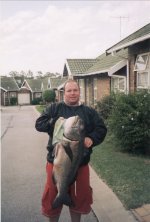
Very true Anchorman, had to swim this 1 out for a mate of mine!!Roland the most important thing everyone has forgotten to mention, is that you should target these fish with a partner, cause most of the crackers I've seen, were landed with the help of a colleague, slipping and stumbling over the rocks to go grab the fish.
Attachments
Katonkel Tom
Sealiner
That fish had its head burried in between the rocks!!