Hi Wesf
Shore based spinning seems to be taking off in a big way. As there seems to be many questions posted on Sealine relating to “spinning†I thought I would share my experiences in this regard. Whilst I do not profess to be an expert in this regard I have spent considerable time reading every article that I could find relating to spinning in local fishing magazines and also on the internet – Well done Sealine!! I have also been fortunate to chat to a number of expert anglers on the rocks and in their shops who are more than willing to share their wealth of knowledge and experience.
I live in Kwazulu-Natal and our target species are Queen Mackerel, Shad and Garrick. Other species commonly caught are bonnies and needle scale queenfish. The first spinning rig that I purchased comprised a two piece 2,7m Loomis and Franklin Extra Heavy Platinum Drop Shot Rod coupled with a Shimano Slade 4000 reel loaded with 20 pound (Dia 0,18mm) Braid. The entire outfit cost about R1,200 and was used successfully to capture a number of Shad and a large Garrick. This fun had whilst using this rig rekindled my passion for fishing and I now go “spinning†two to three times a week.
I have subsequently purchased two other spinning rods that are very different from each other but that are both fantastic. The rods are a 3meter Shimano Aerocast 300XH with a rated cast weight of 50g to 100g and a 3,18meter Daiwa Exceler with a rated cast weight of 30g to 110g.
I have experimented with both rods and found that the ideal lure weight for both is between 40 and 45 grams with the Exceler being capable of throwing a slightly heavier lure of up to about 58g. Both rods are rated for heavier lures but feel as though these are being over stressed when using a heavier lures.
The two rods have very different actions which is most apparent when attempting to achieve maximum casting distance. The aerocast is very smooth with a much softer (slower) action than the Exceler. The Exceler has a very fast action and is also much stiffer than the aerocast. I love both rods and use both extensively but believe that I cast slightly further with the Exceler, especially in windy conditions. However when I have the opportunity to fish for a couple of hours in calm conditions, I prefer the aerocast due to its smoother action. I can fish all day with the aerocast without having to use a glove as protection when casting thin braid however I always use a glove when fishing with the Exceler.
I have paired both of the above rods with a Shimano Sustain 5000FE reel. These reels are fantastic – The first I bought about 18 months ago and it has pulled many fish and many kilometres of braid. I clean the reel off after each fishing session with a water spray bottle, remove the spool and ensure that all is dry and occasional lube the shaft and inners through the oil port. I recently serviced the reel and despite it being dunked a couple of times due to me having an unplanned swim, the reel is still running smoothly and the bearings show no signs of rust or corrosion. It is convenient having two reels of the same size as I now have 4 spool of braid available. When you have a wind knot which is hopefully not too often , curse for a while and then replace the reel spool with another. Do not try to untie the wind knot on the beach / rocks , rather do this at home so as to not waste valuable fishing time. I use two bent pins to unknot wind knots have found that it sometimes helps to wet the braid when unpicking these knots.
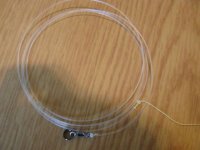
I have had good experiences with the various brands of braid that I have purchased (Rovex, JigMan and Gatorbraid) and currently have a preference for the 20 pound (0,1mm Dia) Triplefish Gatorbraid. I attach the braid to a fluorocarbon leader of 30 to 40 pounds (Maxima or Triplefish) of about 120cm to 170cm in length – I like to cast with a long drop. I ensure that the fluorocarbon leader never passes through the rod eyes when casting. I attach a small power swivel (small enough to pass through the rod eyes) onto the end of the fluorocarbon. The swivel prevents excessive line twist due to the action of the lure and also allows you to easily change lures whilst fishing. The small swivel allows you to wind the leader and swivel onto the reel once you have finished fishing – I use an elastic band to secure the braid and leader in place on reel. I am not keen on neoprene or other line guards as these do not allow the braid to dry between fishing sessions.
Lures are attached to the swivel using a good quality split ring. When fishing for shad or when hoping that that there are large Queen Mackerel about I normally attach a 10cm piece of Malins “No Kink†Boa Wire to the end of the fluorocarbon and then attach the power swivel to the Boa Wire. I have a number of these fluorocarbon / Boa Wire leaders pre-tied as it takes some practice and time to get the knots just right.
Due to the Natal surf conditions and the locations that I fish, a cast of about 80 to 100meters is required in order to place your lure where you hope the fish are. I therefore mainly use spoons and during Garrick season small plugs. Whilst there are many lures on the market I predominantly use two makes of spoons – T he Iron Candy range which is a lead spoon that is painted and the Chase spoon which is made from white metal. As previously stated I mainly use the spoons that weigh between 40 and 45 grams. I use a spoon that suits a slower retrieve in low light and “green†water conditions. I then change to a fast action bullet spoon once it is light and if the water is very clean. In my experience, shad prefer a slow retrieve (s bend or sv bend spoon) whilst Queen Mackerel prefer the bullet spoons.
Good luck and I hope the above helps.