Better than that, herewith an article written by Sean Mills (used with his permission)
Because there is nothing average about a carp, especially its size, your tackle needs to be up to the job. Because fly fishing for carp is all about spotting the fish, and then making a quick and accurate cast from 3 to 15 meters away, the action of the rod is very important. Too stiff a rod makes short, accurate casts very difficult. On the other hand, too soft a rod will not be able to handle the strength, weight and dirty fighting tactics of a hooked carp. My recommendation would be a 6 to 8 weight graphite rod of between 8.5 to 9 foot long, with medium tip action and lots of backbone in the but section. When fishing very snaggy water with bigger fish (16 to 25 pounds) a 9 weight rod would be a better choice.
Carp fight hard and dirty, and any reel used to catch them will receive a workout. For this reason, I prefer bigger reels with disk drags and backing capacities of 150 meters or more. Sooner or later, you may need every meter of backing! An exposed reel rim is essential when fly-fishing for carp. The reel should be loaded with 20 pound (9 kilogram) Dacron or Micron backing. When fishing a large, strong river with lots of snags, 30 pound Dacron is a far safer bet.
I use a floating, weight forward fly line for all of my carp fishing. These lines allow you to present the fly accurately from close to medium range and if the cast is off target, you can simply lift the line off the water and recast.
A tapered leader of around nine foot and with a 10 pound tip is great for this form of fishing. I usually add an additional length of tippet to the end of the leader. Because carp are so wary and their eyesight is so good, the thinner and stronger the tippet the better. In the old ratings, 4x to 2x are ideal. In snaggy waters, 0.30mm line with high abrasion properties is much safer. One of the most essential items of tackle for catching carp on fly, is a good pair of polarized sun glasses. Without them, you will not be able to spot the fish in the water and you will therefore not be in a position to cast a fly to them. I prefer amber or brown coloured lenses that increase contrast while blocking out surface glare.
A large landing net is very helpful in landing the fish quicker. I like a strong net with a telescopic handle that folds down and can be clipped onto the back of my multi pocket vest. Normal trout style nets are useless on the average carp, which normally weigh over 2.5 to 4 kilograms.
Carp flies
Because carp feed on a wide range of aquatic food items, many different flies have been successful for them. My most successful flies are as follows. Woolly buggers in black, black-red, white, yellow and dark brown; gold bead hairs ear nymph; white caddis grub; black zulu; San Jan worm; crazy charlies in white or brown; Dels Merkin (a crab pattern) in white and brown and skinny buzzers. Recently, a weighted #8 white shrimp imitation has proved very effective (Sweet and salty shrimp). My most successful dry flies include Deer hair patterns like the D.D.D, flying ant; Daves hopper; muddler minnow and Adams. I commonly use these flies in sizes from 10 to 4. When the fish are very spooky, I may go down to #16 flies and when fishing for large carp in the rivers, I may go as large as a #2 long shank. My most successful fly for carp has been the woolly bugger in different variations and I weight them either with a gold metal bead in front or with bead chain or lead dumbbell eyes. I leave some flies un-weighted to sink slowly and thus cover fish cruising close to the surface, but generally I want my flies to get down to where the fish are feeding, quickly. Carp have relatively large mouths and I have even caught some using large deer hair mouse patterns and baitfish imitations. Recently, on many waters that we fish, using imitative blood worm imitations (The carps favourite food) in size 14 to 10 have proved deadly. I always use de-barbed hooks. Also make sure that your hooks are sharp!
Method
It is essential to realize the following about carp before setting out to pursue them with fly. Firstly, they can easily find enough food to maintain their energy requirements and will not therefore chase a fly as readily as trout. Why expend energy on chasing a rapidly moving fly, five meters away, when there is plenty of food a few inches away under the sand? This then is the key to hooking carp on fly. No matter what fly is used, it needs to be presented a few centimeters in front of the fishes head. Secondly, carp mainly feed on the bottom although they do cruise a few centimeters bellow the water surface and they do also indeed feed on the surface at times. Therefore, if the carp is feeding on the bottom, in 60 cm of water, the fly needs to get down to where it is feeding, quickly, before it moves off again. If the fish is cruising just below the surface, the fly needs to sink slowly enough so that by the time the fish reaches it, it will be at eye level. If the fish is feeding on the surface, then a dry fly (floating fly) will be the best option.
Carp can be separated into two distinct types. Those that are cruising, and those that are feeding. Feeding carp are looking for food, usually insects, and they are less likely to spot you so they are always easier to catch. When carp feed on the bottom, the tail lifts up and the mouth is used like a vacuum cleaner come shovel as they dig, blow and suck the insects out of gravel, sand or mud. This feeding behavior is very similar to permit, spotted grunter, white steenbras and bonefish. This feeding activity in water less than a meter deep unleashes silt, fine bubbles and their tails create ripples and vortexes that are unmistakable to the trained eye. If you see such activity, endeavor to get to the spot quickly without being seen. The closer you can get, the better. Now try to spot which end is the tail and which end is the mouth. If the fish is still rooting about in the mud, cast about 80 centimeters past it and about 5 to 10 centimeters in front. Quickly draw the fly in for a few centimeters and then allow it to sink to the bottom, the closer to the fish's mouth that it sinks, the better. If the fish spots it and if the fly looks like food, then it will move up to it, and inhale it. As soon as this happens, set the hook!. Some carp like to take moving flies while others prefer them lying on the bottom. The angle that you cast to the fish can also be critical. Casting to a carp that is facing you or that is side on to your position is easiest. If the carp is facing away though, life can get complicated. If you mess up on the cast and the leader or tippet sinks on to the fishes back, it is history! Casting to either side of a carp that is facing away from you is the answer, but unfortunately they keep moving. The one advantage of casting to a fish that is not facing you though is that it cannot see you approaching.
When fishing in muddy water, I normally cast at bubbles that the carp release as they feed. If you cast directly over the bubbles, the fly will soon sink in front of a fish and be taken. Watch the leader as it enters the water for unnatural movement. If the leader does not move after a cast has been made, I wait for a half a minuet or less and then slowly retrieve the fly for a meter. If nothing happens, I recast. I call this method, bubble bashing. A refinement of this method is to use a treated yarn bite indicator, positioned 1 and a half times the depth of the water onto the leader. This system shows up any takes instantly and will drastically increase your success rate using this method.
If you spot cruising carp, they have either just been feeding or are about to start. What I normally do is to cast the fly in front of the fish and allow it to sink. How far you cast in front depends on the conditions. The clearer the water and the quicker the fish is moving, the further in front you need to cast (leading the fish). 2 meters to 50 cm is about the average. If the fish is moving very slowly, then it is better to cast closer to the fish but well past it, the fly can then be drawn back quickly and then allowed to sink. An interested carp will turn down and follow the fly and take it before it hits bottom. Watch the leader, if it moves unnaturally, strike.
If the fish are feeding on the surface, you need to cast a large dry fly (#8 to 6) close to it and then allow it to drift. If the carp is interested, it will rise and suck the fly in. Wait for it to turn down before striking.
River carp can be a real challenge to take on fly. On the one hand, they are more willing to chase a fly, but on the other, they can be far more spooky and the current can cause problems of its own. When the carp are feeding in slacker water, the same methods used in still waters should be used. When the carp feed up rapids however, there are two methods that work well. These are upstream nymphing and down stream and across. In deep, fast water, the upstream nymphing method with fairly big and heavily weighted flies works best. To do this, you approach the fish by wading carefully upstream (in their blind spot) and then cast the fly over them and allow it to drift back down to you while keeping the rod tip up. This way the fly sinks rapidly and fishes past the fishes head and if it is taken, the leader will stop dead or move upstream, Strike quickly and hold on! In shallow, fast rapids, the downstream method works well. When you spot a carp feeding up the rapid, approach it from upstream carefully so that it does not spot you. Now work your way across so that you are almost in front of the fish, but about 7 to 10 meters upstream of it. Now cast a large woolly bugger or similar fly to the side of it and allow the current to swing the fly across its path. If all goes well, the fish will chase after it and take it. Set the hook and be prepared for a long fight!
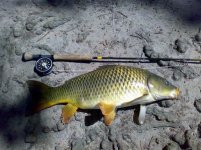
Landing a hooked carp on fly tackle is another story, these fish are strong! Remember to take your time and use lots of side strain. Carp are dirty fighters and they will head for any cover when hooked so take care. A big (20 pounds+) and fit carp could keep you busy for a long time!

 ::H
::H

 i'll get there some time.