Hey Guys I need some help on ''How does the tide

G

Guest

Guest
Hey Guys

I need some help on ''How does the tide work with the Moon'' I do have some knowledge but please i need clarity on this??:(
 

Nivi4Zn

Senior Member
Well On Dad im no expert or geography teacher

But from my knowledge the tide is controlled by the moons and suns gravitational force on the earth. The moon actually pulls the tide towards it and exerts the same force pushing it out. This is not a very good explanation, but ill try and get more detailed info for you.

Cheers

Nivi4ZN:D
 
G

Guest

Guest
Hey guys Maybe if i simplify it eg. a)spring tide how

                                                                     b)neap tide

                                                                      c) full moon


Red Eye

Sealiner
[font="Arial, Helvetica, sans-serif"]How do the effects of the sun and the moon affect tide? The gravitational pull of the moon tugs on the surface of the ocean until its surface mounds up and outward in the direction of the moon. When the mound of water has reached its highest point it is called high tide. On the side of the earth opposite the moon, the centrifugal force caused by the earth’s rotation produces another mound of water and high tide on the opposite side of the earth. Somewhere in between these two high tides are two flat areas on the surface of the ocean, these are low tides.
earthtides.gif
[/font]

[font="Arial, Helvetica, sans-serif"]The moon appears to rotate around the earth each day, however it is the earth’s rotation that gives this appearance. The moon actually orbits the earth in an elliptical pattern, taking 27.3 days to complete one orbit. The length of time that it takes for the earth to rotate around so that the moon is in the same position is actually a little over a normal 24 hour day. It is 24 hours and 50 minutes or a tidal day. That is why the tidal cycle starts approximately 50 minutes later each day. As the earth rotates, the moon’s gravitational force continually mounds the water and that fluid mound moves around the earth. The actual height of the tide is influenced by the shape of the coastline and depth of the water.[/font]

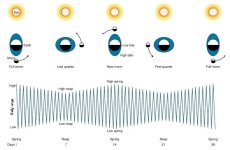
[align=left][font="Arial, Helvetica, sans-serif"]Two other areas that need to be covered are "spring tides" and "neap tides." It was mentioned previously that the tides are affected by both the sun and the moon. Actually, the sun’s effect is less than half that of the moon but when these two bodies are in alignment and pulling in the same direction they cause higher high tides and lower low tides called spring tides.[/font][/align]
[font="Arial, Helvetica, sans-serif"]On the other hand when the Sun and Moon are at right angles to one another with the moon pulling one direction and the sun pulling another there is somewhat of a canceling affect and you get lower high tides and higher low tides called neap tides.[/font]
 
G

Guest

Guest
Hey Redeye

That's a mouthful:shock:,;) thanks for that in-depth explanation,:D but i would also like to know when is it the best time to fish? full moon, springtide,neaptide??
 

MickJack

Senior Member
Hey Red Eye


I heard that you got your nickname when an overeager

beginner shad fisherman struck for a bite so hard

that he dislocated the shad's jaw and his 7oz sinker came flying

out and struck you in the face!

Is this true?

HeHe
 

Old Sea Dog

New member
Spring tides occur twice per 28 day lunar cycle (month), firstly during the full moon and secondly during the new moon. It is generally accepted that fishing is best over spring tides, from three days before spring tide and lasting until three days after, with fish being more active during these periods, all other factors being equal. This could be because there is then more surf and swell activity which dislodges more bait organisms from the sand, reefs and rocks, but that is just a guess.

Don't believe for one second that you can't catch fish at other times, though, or that fishing over spring tides will guarantee you a catch. It could be useful to plan your fishing trips over these periods though, eg. make sure that you take your leave over a spring tide, rather than over a neap tide. With the extra low tides during spring tide it is also easier to collect bait from the rocks, or you could create a good chum hole during low spring tide that will bring in the fish once the tide turns to incoming.

A full moon has the added benefit over the new moon that you can fish at night without too much effort with the moon providing enough light unless it's overcast.

I hope this helps.

PS: Neap tides occur during the moon's "first quarter" and "last quarter", which you could describe as "half moon", neither full nor dark.


Red Eye

Sealiner
No MickJack,

My eyes are Brown actually.

Red Eye as in potent bait!!! lmfao

See attached pic.


Attachments

  • Red Eye.jpg
    Red Eye.jpg
    60.6 KB · Views: 128

PRASHIN-ZN

New member
 

Hi, maybe this might help, this is from the net. 

Tides are the cyclic rising and falling of Earth's ocean surface caused by the tidal forces of the Moon and the Sun acting on the Earth. Tides cause changes in the depth of the sea, and also produce oscillating currents known as tidal streams, making prediction of tides important for coastal navigation The strip of seashore that is submerged at high tide and exposed at low tide, the intertidal zone, is an important ecological product of ocean tides.

The changing tide produced at a given location on the Earth is the result of the changing positions of the Moon and Sun relative to the Earth coupled with the effects of the rotation of the Earth and the local bathymetry (the underwater equivalent to topography or terrain). Though the gravitational force exerted by the Sun on the Earth is almost 200 times stronger than that exerted by the Moon, the tidal force produced by the Moon is about twice as strong as that produced by the Sun. The reason for this is that the tidal force is related not to the strength of a gravitational field, but to its gradient. The field gradient decreases with distance from the source more rapidly than does the field strength; as the Sun is about 400 times further from the Earth than is the Moon, the gradient of the Sun's field, and thus the tidal force produced by the Sun, is weaker.
 
Top