Hi All
Simen asked me to post a formal report on our recent expedition to Flamingo Lodge, Angola. I know some of the guys have been anxious to hear how it went. My apologies for only now getting to it. Those of you who have “dependants†will understand my position. Since our return late Saturday night my time has not been my own. Even at work they apparently piled the ‘bollie†up for the full two weeks of my absence!!!
Anyway, here goes.
Let me start by stating that it was an adventure of a life-time. It wasn’t about the fishing only. The trip from Cape Town via Namibia to the meeting point at Ruacana was uneventful, yet long. We got together at Ruacana at 14:00 on Sunday, 11 July 2010 as arranged after two days’ drive from Cape Town. This was when we learnt that some of the key players would probably only meet up with us at a later stage due to Visa issues. But have no fear, Mevrou Spyker was here and with the guidance of Leon we embarked on our trip.
At the Calueque (Angola) Border Post we immediately realised that language was going to be a problem. The officials couldn’t understand Afrikaans or English. Luckely M’boytjie’s (Deon) Dad (Aubrey) could speak Portuguese and he probably saved us hours of time and pains throughout our trip. The poor chap was extremely in demand!!
It took us about an hour and a half to get through that Border Post. We soon realised that we had left civilisation as we knew it. The “main†road from Calueque Border Post to Cahama, the first Angola town some 170 kms further consisted of two tracks in the dust which obviously did not appear on any maps. We refilled our tanks at Cahama at the very favourable price of about R2,80 (29 Angolan Kwanzas) per Liter. Things were looking up!! We had to get through the large town of Lubangu before daylight. Only about 180 km from Cahama….no problem…. but try it with roads with potholes as big as swimming pools and oncoming trucks that drive at break-neck speed in the middle of the road/track and we soon realised that in Angola you measure distance not in terms of kilometres but rather in hours! We also lost about an hour at the one roadblock where the officials had to be bribed to allow us through. Two of our party’s passports apparently did not have all the required stamps and this provided the opportunity for the officials to demand bribes before allowing us through.
Anyway, we got through Lubangu with very little problems, apart from having to take some detours as a result of roads that were closed with no signage to warn users of such closures. We reached the top of the Sera De Leba pass by about 02:00 on Monday morning, 12 July 2010, some of us having been driving since 06:00 the previous morning. We slept on the ground next to our vehicles until first light, brewed a quick cup of coffee, took some photos and embarked on the last stretch via the town of Namibe to Flamingo Lodge.
The pass is impressive. It is steep with short dangerous corners and a lot of obstacles, movable and immovable. The stripped wrecks of cars and trucks that didn’t make the pass safely littered the roadsides all the way to Flamingo Lodge.
I’m not going to describe what Flamingo Lodge looks like. The guys will probably post photos here. I may, however, mention the following regarding the Lodge:
The Lodge is not really geared for campers. Do not expect serviced sites with electricity points and water. The Lodge’s water comes from a borehole in a nearby river bed. It’s only useable after it had been boiled. There is no electricity. Simen brought his own generator for the fridges and lights at the cooking and washing area. The camp has two showers and toilets of which only one has gas heated water. We soon, however, got used to nominating who was to use the facilities next. It created sufficient drinking time while the guys took turns using the showers and toilets. No problem!!
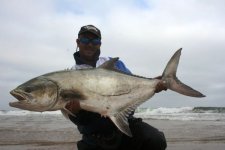
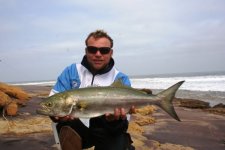
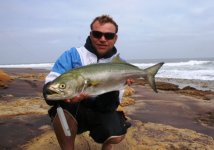
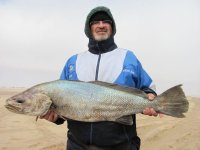
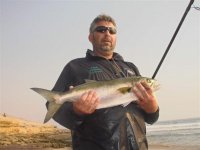
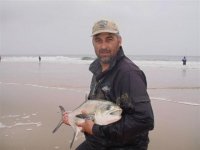
It is important to realise that although the fishing is relatively better than most other sites, one still has to work for it. The weather and sea conditions still play a role and some days several anglers blanked or at least didn’t catch any size fish. The main edible fish species targeted were Cob, Shad and Garrick. Although only a small number of anglers targeted non-edibles several small Bronzies were caught. Both bait and artificial lures were used. The best bait was Chokka while White mussel and Sardine also produced, albeit mostly Blacktails which are around in abundance. We used plugs, poppers, spoons and soft dropshot lures. I might be wrong but I reckon the plugs, especially the white chisel nose plugs of 2 and 3 oz worked best. Yellow and lime green also produced but not as much as white. The spoons of the same weights (v-backed) produced Shad, some of which reached 3 kgs and more. They did, however, also take the plugs.
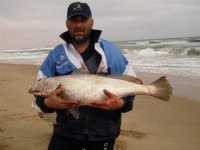
The Garricks mostly went for the plugs while some Cobs were caught with dropshot. My larger Cobs (between 8 and 16,7 kg) were caught on chokka, while I also caught smaller Cob on White mussel.
These comments are based on my own experience. I know, however, that some anglers either concentrated on artificial lures or fished only with bait such as chokka and sardine. Their experiences would obviously differ from mine.
Although I am more comfortable with bait fishing I must confess that there is nothing like the adrenalin rush experienced when you see the large dorsal fin or tail of a Garrick speeding towards your lure and the moment it smashes your lure and takes off like a steam train! It is exhilarating and leaves you half spent afterwards, both physically and mentally.
Angling conditions were not perfect. We had large swell on some days with typical “langbeen†water. Flat the one minute and large waves the next minute that would dump any unsuspecting angler. I was personally dumped and totally engulfed no fewer than three times in one day, prompting the “straf-dop committee†to present me with the “pink hat and drinking pot†that evening for “excessive swimmingâ€. LOL
Talking about the Pink hat and drinking pot. As far as I can recall Hannes was the first to be presented with it, while M'Boytjie also got it for getting his Toyota bakkie stuck to its belly in sand. Being the only Ford among five Toyotas we were very grateful for him. It took the heat off us!! LOL
Some general comments and advice to anyone thinking of going on future trips to Flamingo Lodge, based on personal experience:
Make sure that all your documentation is correct and that all the required stamps, etc are made in your Passport. Any slip-up provides opportunities for the local officials to demand bribes to correct or to simply let you through the road blocks.
Take sufficient warm clothes and warm bedding. Such items should, however be as dust proof as possible and the clothes should dry quickly. We had very little sun and our wet clothes from the previous days never fully dried.
There are no facilities to do washing. Your undies are washed under the shower and hung to dry…. sometimes taking three days to dry totally.
Consider taking along a Long John wetsuit and rubber boots. If not, be prepared to walk around wide-legged with sand rashes and take along a large pot of Vaseline to treat rashes and plasters for the cuts and bruises caused by the reefs. Us Cape Townians are used to fishing with wetsuits in the cold Cape water. We wore our suits all day and sometimes even wore our thermal shirts with wet weather jackets. Some of the other guys clearly some days did not enjoy the conditions.
Take along extra reels, rods and line. The fishing is hectic and several very expensive rods and reels broke or had to undergo emergency repairs. It was interesting to note that several fairly expensive brands of coffee grinders packed-up totally while cheaper models survived. As far as I know several Daiwa Exceller reels broke while some had to be repaired. Before the Shimano supporters start chirping, I also know of a Trinidad reel with a handle that stripped and became unusable.
With regards to other tackle, I would suggest that you take along several plugs and lures. The coast there has reefs all over and several plugs and lures were lost every day. For those that prefer bait fishing…. take along sufficient weights.
I reckon the other guys would also have items to contribute to this list.
I must say we were a brilliant bunch together and I’m sure most of us will go on similar expeditions together again. In this regard a lot of credit should go to the two team captains, Spyker and Simen for the roles they played in this regard. Incidentally, Simen’s team, the Garricks narrowly beat Spyker’s team the Shads at the end of the trip.
Lastly, the name of Mevrou Spyker, Marina should be mentioned with a lot of respect. She carried a lot of weight and pressure during the first few days when Spyker and Simen’s fates were still uncertain. Most of the foodstuff, the generator and the chef were with Spyker and Co and Marina had to keep the party going with what she had at her disposal. She coped admirably and a lot of Manna should go her way. Jy was ‘n STER, Marina!!
PS. Several “manne†that initially loudly proclaimed that they don’t eat raw fish when I offered to make some sushi surprised everybody, including themselves when they polished a full plate of Garrick sashimi in record time, with chopsticks and all, nogal!!
A last word to those who are still contemplating going on future planned trips to Flamingo Lodge. I can recommend it. It is worth every cent and minute spent. As already indicated, it was not only about the fishing. The whole trip was an adventure and something that you will never forget.
Some technical stats.— We did a total of 5 912 km’s from Cape Town and back. We consumed 886 liters of Diesel at a cost of R5 850. Our best consumption was 9,18 km/L or 10,90 L/100 km’s and our worst was 6,25 km/L or 16 L/100 km. Our average was 6,67 km/L or 14,99 L/100 km. This should tell you something about the amount of 4x4 driving we had to do. We spent a further R2 781 on drinks, sleep-over at camping sites and Cross Border permits. This had to be split between three persons. In all we spent just under R9 000 on the trip, over and above the deposit to Spyker and Co and costs for personal items, tackle, vaccinations and Visa’s, etc.
I hope this report will be of use. Feel free to pm me for any additional info/stats. As already stated, the other guys will most probably each have their own experiences and pieces of advice to add.