
You are using an out of date browser. It may not display this or other websites correctly.
You should upgrade or use an alternative browser.
You should upgrade or use an alternative browser.
do aliens exist?
- Thread starter calamari
- Start date
saltydonut
New member
Why do fisherman more than any other hobiest or sportsman believe in Aliens?
You would too if you had a hobby/ sport that took place in the dead of night and involved talking "kak" while you are waiting for a bite.
Also sometimes we partake in alcohol,
to keep the cold away you know!
You would too if you had a hobby/ sport that took place in the dead of night and involved talking "kak" while you are waiting for a bite.
Also sometimes we partake in alcohol,
to keep the cold away you know!
Consciousness, Psychedelics, & Reality
Graham Hancock is no stranger to modern discourse on the nature of consciousness. Since his early scholarly days he has challenged materialist science with alternative theories addressing mysteries of ancient civilizations, extra-terrestrials, psychedelics, and consciousness. In a recent lecture at the National Arts Club Art and Technology Committee, Hancock continued his controversial examination of the aforementioned topics.
He opened his lecture with a question addressed to famous evolutionist, atheist, and author, Richard Dawkins, probing him on one of atheism’s most imperative conjectures, “How do you prepare for life in a world where there is no God?â€
Hancock went on to recite Dawkins’s answer, “You prepare for it by knowing that life is what we have and so you better make it a life to the fullestâ€. Although he asserted that he couldn’t agree more with the notion of living one’s life to the fullest, Hancock didn’t accept Dawkins’s materialist view which states that consciousness is only a product of electro-chemical brain activity. He believes there is a lot more to consciousness than that expressed from the empty reductionist view point.
“What science is this [opinion] based on? What has [Dawkins] done to prove that there is nothing after death?â€
Hancock argues Dawkins’s statement with a bold case, expressing that he is merely stating his “very narrow and very limited ‘religious’ beliefâ€. Dawkins’s belief is just that, an act of faith, because there is no scientific evidence to back up his claim. But nevertheless, a large majority of people still buy into these scientists’ beliefs based on their university credentials.
Last year, Hancock released a TEDx Talk that was subsequently banned due to the subject matter discussed. Hancock elaborated on the reason in his lecture,
“Certainly the brain is involved in consciousness in some vital way, but it’s unclear exactly how and this is the first area that I got into trouble with TED for my brief TEDx Talk which was on their website for a couple of weeks before they took it off. I couldn’t understand why they took it off, but it later became clear that there is a faction of scientists who advised TED who belong to what is called the materialist/reductionist tendency, and they believe that all phenomena can be reduced to matter, and that there is nothing that exists outside of the material realm if it cannot be measured or counted.â€
Does the brain create consciousness like a generator produces electricity? Material scientists believe that consciousness is an epi-phenomenon or a miracle or sorts. They understand its development in relation to the Darwinian concept of ‘survival of the fittest’, that our brains evolved to have this consciousness as an advantage over other species. They state that once we’re dead, consciousness no longer exists, and we are simply reduced to matter. “What about near-death-experiences or out-of-body-experiences?†Hancock asks.
To refute this model, Hancock uses the analogy of a TV and its antenna. “The relationship of the brain and consciousness might be more like a TV set and the TV signal. And again, I got into trouble with TED even for suggesting this, but they will say ‘I know consciousness is localized to the brain because when I shut off this area of the brain , this or that area of your consciousness will blink out, and therefore that proves that your brain makes that bit of your consciousness’. But isn’t that true with the TV analogy? If you damage the TV screen, the picture won’t be so good, but that doesn’t mean the signal isn’t there still.â€
To get a clearer understanding of consciousness and life after death, Hancock suggests looking back at ancient civilizations, particularly the ancient Egyptians, who possessed a remarkable model of the afterlife. By studying the intricate and numerous hieroglyphs in the pyramid walls (transcribed today in what is known as the Book of The Dead), one quickly realizes the Egyptians honoured death even more so than life as a large majority of their lives were based around the preparation for death, and that when this time came a soul would face Anubis in a review of their life. The consequences of a person’s life choices were something to reflect on deeply according to the Egyptians. Likewise, the Ancient Egyptians believed in reincarnation – after each life a soul would review lessons learned in the previous life to ensure that they would not repeat them in the next.
Interestingly, Hancock also adds an alternative narrative to the Egyptian civilization which may challenge many people’s beliefs. Referencing the Tibetan Book of The Dead, Hancock revealed their belief that love, ethics, and mediation alone cannot bring one enlightenment. He asserts that the Egyptians used psychedelic plants to access higher levels of consciousness. Famous ethnopharmacologist Dennis McKenna proposes the Tree of Knowledge depicted in engravings was actually a reference to the plant Acacia Nilotica, which contains levels of DMT in its bark. The Egyptians were known alchemists, so this extraction theory should not be considered far-fetched.
Hancock moves his attention to the ancient texts of the Hermetics and the Gnostics, quoting an line from one of the texts, “Man’s duty is not to acquiesce in his merely human state but rather in the strength of his contemplation of things divine to scorn and disguise that mortal part which has been attached to him because it was needful that he should keep and tend the lower world.†This was also a central aspect of the Egyptian texts, that we should not be attached to our material body, that we reach for the ‘heavens’ as a metaphor for our spiritual self.
The Gnostics also were also early opponents of certain sects of Christianity, specifically Catholicism, stating that no ‘God’ would judge another human being, let alone advocate burning someone at the stake. They viewed Christ as a teacher who didn’t actually die for our sins, that we are responsible for our own sins. Another controversial concept from early Gnosticism reveals that the serpent in the story of Adam and Eve was not in fact the devil, for the serpent was trying to tell them about the ‘Tree of knowledge’, and ‘God’ was trying to keep this knowledge away from humans to ensure they wouldn’t attain godly power through this knowledge. An early Gnostic art piece exposes the Tree of Knowledge for what it actually is, the psychedelic mushroom Amanita Muscaria.
A faction of the Gnostics called the Cathars who lived in Southern France in the 1100s were surprisingly advanced for their time: they believed in equality for all, influenced the Troubadour music wave, ate mainly vegetarian, promoted universal literacy, and even made their own paper. Unfortunately, anyone who held Cathar/Gnostic beliefs was persecuted by the Roman Catholics in a crusade which took place in the late 1100s. This was largely due to the fact the Cathars saw the Pope as an agent of the devil.
Most monotheistic faiths impose leaders between the people and the divine (i.e., Christianity, Judaism, Islam). These ideological factions talk the talk about peace and love but walk the walk of hatred and suspicion. Hancock makes the daring assertion that it’s these three faiths which are at the root of the world’s problems today. The state is the next form of segregation which ultimately places the control of our consciousness in the hands of others. States operate on fear, hatred, and suspicion, (war on terror, national security). Hancock addresses the pointlessness of patriotism, asking what its relevance really is. “Why should we be especially attached to someone because they happen to be born on the same piece of land as me? Shouldn’t we be interested in a community of ideas? Shouldn’t we be patriotic to the entire human race? We’ve become a species of amnesia, lulled into a false sense of purpose.â€
“There is a war on our consciousnessâ€, Hancock states. It is curious why a natural brain hormone like DMT is a Schedule I drug, yet the ancient Egyptians pegged it as the ‘Tree of Life’. Shouldn’t we have sovereignty over our own consciousness? Natural mind-expanding plants are categorized as dangerous, yet pharmaceuticals and alcohol kill millions each year. Perhaps Hancock isn’t too far off in his statement.
https://youtu.be/21zidDPO_XM
Dr halibut hoffman
Moderator
Piiiiing. The sound of a hammer hitting a nail on its head. 
I would love to comment on this thread, but it is way beyond me!!
On a lighter note....you guys must be aliens!! This English is out of this world...it is from another planet. I have never, ever in my life read a paragraph like this. After I read it, i understood less than before i began!!
I am too scared to say well done....and I am too scared not to!!
Great English though, and you guys are great to!!
Kenny
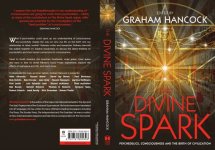
This is the newest book I'm reading, it has been recently printed and edited by Mr Hancock.
It has brought many new thoughts to the foreground.
It may appear to be quite deep (my library is pretty large now)
Some literature you may want to consider by Micheal Tellinger - 'Slave Species of god'. (mentioned some while back on the early days of this thread) A piece of literature not easily chewed or swallowed by many.
If you can get your head around that, other lights will appear in the tunnel.
http://resonance.is/the-divine-spark-book/
Attachments

Kenty
Sealiner
..What Simon is actually saying , in essences , is that they were drug addicts , to use "stimulants" OR other forms of herbs to "alter" ones thoughts OR "increase" ones brain intensity , this then is actually ALIEN....Sooo...who then taught these people to use such :stimulants"??...There must be ALIENS....in my opinion...
No you tjop!!
Not drug addicts!!
The NWO, or the new world order, (Humankind) has turned it all around; and manipulated the populace to believe in manmade religion's and to conform to what we now as "norm's".
We as humans are yet so far from the actual truth, but are evolving to find the answers...The herbs are there, they have always been there!!
Attachments
Kenty
Sealiner
Psy wrote:
AND...what he looked like before his death.....two words...DRUG ADDICT!!!
No you tjop!!
Not drug addicts!!
The NWO, or the new world order, (Humankind) has turned it all around; and manipulated the populace to believe in manmade religion's and to conform to what we now as "norm's".
We as humans are yet so far from the actual truth, but are evolving to find the answers...The herbs are there, they have always been there!!
AND...what he looked like before his death.....two words...DRUG ADDICT!!!Attachments

Dr halibut hoffman
Moderator
Sugar is addictive as are many plant extracts. Some of the chemicals made by our brain and also commonly by a whole swathe of nature are on the very opposite side of the spectrum and the experiences they produce that create awareness of what we would define as "alien life" which is all around us, is so reality shattering that it can be very traumatic but also liberating. Not the kind of thing one could manage to do everyday nor habitually. There are archeological theories though that our religious rituals stem from a ritual, eg. sabbath and communion rituals, use of "mind-opening" herbs and fungi. Scary, yes, liberating, yes, addictive.. not, stimulant not. Those would be sugar cane, coffee, coca, ephedra, catha edulus, tobacco etc.. And all of these two have been very influential in the formation of human culture yes, but the most influential are the ones being spoken of here. The mind-openers. Take care. These plants require great respect and are not toys or for games.
Aliens Do exist.....
It is incomprehensible to to think that they don't.
Remember everything that is not of this earth is considered alien.
If there is only 1 microbe on another planet, then aliens exist.
It is an absolute impossibility to even think there is no life of some sort out there somewhere.
There are more stars, not planets than grains of sand on the earth.
Even more interesting....
There are more atoms in a grain of sand than stars in the universe.
Check out these 2 videos and expand you mind.
https://www.youtube.com/watch?v=1Eh5BpSnBBw
https://www.youtube.com/watch?v=rENyyRwxpHo
It's no surprise that religion is always discussed when the question is asked 'do aliens exist' or as it is normally asked 'do you BElIEVE in Aliens.' If this post asked does God exist, or do you BELIEVE in God, the conversation would have taken a similar path with long justifications, even claims of undeniable physical proof, and this on both rsides of the argument. BELIEVE or as religion would put it 'faith' or the lack there of, is the motivation for everyones point of view.
The only way faith becomes fact in an individuals life is personal encounters, or interaction. And for it to become a generally accepted fact, would require either NASA or similar proving they have found something, or if the aliens come to us, and by that I mean all of us in such a way that their is no debate. Religion would need something similar.
Until then everyone will have an opinion, and a justification for their opinion, but at the end of the day very few people will change their opinion or faith through being told by fellow humans that they are wrong.