
You are using an out of date browser. It may not display this or other websites correctly.
You should upgrade or use an alternative browser.
You should upgrade or use an alternative browser.
Catfish info
- Thread starter Skuimkop
- Start date


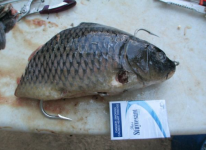

Looking very good. For me I would make the bridle on the first two a little bit longer, this may improve hook-up rate. On the bottom two I would prefer to rig the hooks pointing the other way around but that is just my opinion. They are nice and proud and should hook up well if the cat swallows the bait.
When using dead fish baits I prefer to de-scale the baits. Doing this before cutting them is much easier.
All the rigs I see here make we want to go and fish, will have to make a plan.
When using dead fish baits I prefer to de-scale the baits. Doing this before cutting them is much easier.
All the rigs I see here make we want to go and fish, will have to make a plan.
Sight fishing/hunting for barbel using a casting float rig.
First time I used this technique at an exclusive fly-fishing venue for yellow fish on the Vaal . We were wading in the water moving up-stream fly fishing for yellows. Close to lunch time and heading back to the vehicle I found a nice quit back water/eddie. Suddenly I spotted barbel surfacing (gulping) in this back water. I tied on a half chicken fly and proceeded to beat the water for more than an hour without success. (Trying all the barbel flies I had). We headed back to the vehicle for lunch.
I never go fishing without a rod I can use for barbel. The morning when the person I was fishing with (a seriously ethical fly fisherman), picked me up and saw me loading an Exage 10ft casting rod into his vehicle, he just shook his head.
The only meat bait I could find where some skinless chicken breast the Toppies wife had packed in for lunch (cholesterol free!!). He again just shook his head when I took this rig out and was more concerned that we may get kicked out as it was a fly fishing only venue. After lunch I rigged up and again we went wading. I ended up catching 7 barbel from this eddie before I ran out of chicken fillets.
Since then I have used this technique with success on many occasions. This method gives you another tool in the catfish arsenal and actually works very well. Especially when things are a bit slow and during the day or when the cats are in general, less active.
Here is a quick overview of how I go about this:
Equipment:
1. Wading boots (felt on the soles) if you going to wade the rocks in the river-otherwise you will not have any shins left. Don’t try diving booties, they don’t work)
2. When wading minimize what you need to tag along as you will need to keep your balance. If starting out you could use a wading stick. Tie a string to it so you can clip to your belt otherwise it will get lost. This will help you keep your balance until you get use to this,
3. Long nose to remove hooks.
4. River: Small fibreglass boat with trawling motor-I use a 3m fibreglass job-for rivers
5. Dam: Big boat for dams.
6. Landing net if fishing from the boat.
Tackle:
1. Rod: For wading or stalking from the bank-8ft or 10ft Shimano Exage(old model) or equivalent. From the boat the 8ft.
2. Reel: On the 8ft I use a Penn Sargus 6000 and on the 10ft a Penn Sargus 8000.
3. Line: If fishing in dams with not so many snags/structure (Boat or bank) braid 50-80 lb could work. River with lots of snags/structure I prefer mono. Up to you on breaking strain but I use about 25-30lb on the 8ft outfit and 30-40lb on the 10ft. Distance is not an issue here as your casts in general will not be long.
4. Rig: Main line, Bimini twist to make a short double line section, two double figure of 8 knots to join the double mainline to leader (1/3 to double the mainline breaking strain as an estimate for the leader). So 15kg mainline to 24kg leader. No leader can also work if mainline is strong enough.
5. When using braid I don’t use the Bimini knot to the leader, some other knot. I cannot remember the name now.
6. Adjustable float fitted about .5 to 1m from hook.
7. Hooks: One of the few instances where I would use J hooks is here, however I still prefer a bridled circle hook.
8. Float: Large enough to float the bait you will be using. Older shad top bung type floats work well. Just make sure to remove the clips/rings and drill a hole through the centre to pass the line through. Big Styrofoam floats also work but take a hammering from this type of fishing.
9. The float has two jobs in this presentation; float the bait (depth control) and pop/vibrate-attraction.
Bait:
7. Here the presentation of softer bait is beneficial as you will be throwing baits at the cat when it is at or close to the surface. You want the cat to grab and swallow the bait in one go as opposed to toying, de scaling and taking time to swallowing it as would be the case when a large ground or live bait is used from the side.
8. Good baits to use would be fillets with the skin on and scales removed (karp, muddie, barbel, kurper etc.). Cut into a nice thick long strip. Match the size of the bait to your rig as you need to cast it. No need for super long cast, accuracy is more important.
9. Plattie(alive), just hook through one boud/thigh with J hook. Don’t inject with air just as is.
10. OX heart strip.
11. With this type of fishing we will be targeting or using the predatory side of the cat fish as opposed to the scavenger side to our benefit. The same as what artlure anglers would do basically, only difference is we use bait. Therefore no need for juicy or smelly baits. We need bait we can present close to the feeding or surfacing cat and draw his attention. When we use large dead ground baits we target the scavenger characteristics of the cat.
12. The bait needs to be able to stand up to cast and retrieve, so too soft bait like liver will obviously not work.
13. When wading the river I pre make baits with bridles as you don’t want to fool around trying to make a bridle bait in the river. Carry with you what you anticipate using. Method:
You have to look for the catfish. They like hanging around gully’s, back waters, eddies, behind large rocks, under trees where birds (cormorants, finches, vink nests etc.) are sitting. Any places where the water is not moving too fast and food may gather. In dams this could be deeper holes, inlets etc. Basically move around (slowly and quietly) and look for them. Soon you will see where a cat comes up, takes a gulp and goes down again. If in reach cast, if not stalk closer. Often you will see the cat moving slowly in one direction, you can then cast in front of him in the direction his is going. As soon as he surfaces cast directly at the spot or just in front. Let the bait settle. If nothing happens give the rod a tug. You just want toâ€pop†the float and not pull the bait. This is irresistible for the cat and will call him to the bait resulting in a strike.
Don’t forget the barbel is first and foremost a predator. So as soon as this bait hits the water close enough to the cat, the vibrations of the bait hitting the water will trigger a strike almost immediately. If not the resulting “popping†with the float will. If you have no strike after a few minutes retrieve the bait (unless when using the plattie you can leave it a bit longer) and get ready for the next cast as the cat may be moving in a certain direction.
The 7 cats I mentioned caught in the start where all together in one back eddie, this seemed to make them more aggressive and attack the presented bait more vigorously.
This method is a more active way for us to target cats and is indeed an exciting way to do so. So next time you are out there fishing for barbel and the conventional way is a bit slow or you are bored waiting for the big cats to pick up your bait. Try this rig/method and go and hunt down a big cat!!
I guarantee you will also be hooked.
IWyk wrote:
Fully agree with you. Those pics was taken before I was thinking of changing the hook direction on those big baits.
Follow this YouTube link below where I demonstrate that my hooks won't fall flat against the bait by using Super J-hooks (because of there curve) of Team Catfish and to make use of a toothpick.
https://www.google.co.za/url?sa=t&source=web&rct=j&ei=o217VLHMJMiP7AbvmYCgDA&url=http://www.youtube.com/watch%3Fv%3Do2YrGPyCeRs&ved=0CCUQtwIwAA&usg=AFQjCNFU2hFpCH9ZWOx1NZBuJrQli-Lydw&sig2=1hJ_gTVemD99T4IHl0Toqg
On the bottom two I would prefer to rig the hooks pointing the other way around but that is just my opinion. They are nice and proud and should hook up well if the cat swallows the bait.
When using dead fish baits I prefer to de-scale the baits. Doing this before cutting them is much easier.
Fully agree with you. Those pics was taken before I was thinking of changing the hook direction on those big baits.
Follow this YouTube link below where I demonstrate that my hooks won't fall flat against the bait by using Super J-hooks (because of there curve) of Team Catfish and to make use of a toothpick.
https://www.google.co.za/url?sa=t&source=web&rct=j&ei=o217VLHMJMiP7AbvmYCgDA&url=http://www.youtube.com/watch%3Fv%3Do2YrGPyCeRs&ved=0CCUQtwIwAA&usg=AFQjCNFU2hFpCH9ZWOx1NZBuJrQli-Lydw&sig2=1hJ_gTVemD99T4IHl0Toqg