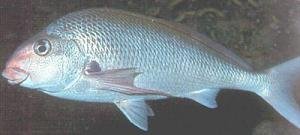
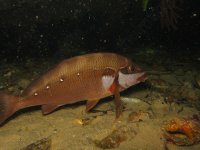
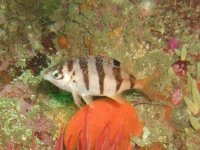
Bank Steenbras?

miles

Sealiner
Hiya

BANK STEENBRAS or BANKIES as we call them are quite a common species. They're found from from the Cape all the way into Durb's.

Previously, there were thought to be only one species, but they have two species, called the Cape Bankie and the Natal Bankie. The Cape Bankie grows to about 10kg's whilst the Natal bankie 5-6kg's. They belong to the family Cheilodactylidae.

Bankies are pretty common in some area's, like Struisbaai down here in the Cape. They are a species that prefer deeper waters. They RARELY take bait and is thus seldom caught on rod and reel. They are how-ever a very popular spearfishing species. They taste great too!!

On the photo below, the bankie is the first fish on the top....
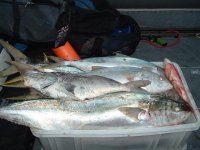
 

Attachments

  • Struisbaai 17 Feb 2005 10.JPG
    Struisbaai 17 Feb 2005 10.JPG
    50.2 KB · Views: 632

martinb77

New member
Thanks Miles! much apreciated, thats why i have never seen them caught before,
some divers told me they have spotted them around hangklip.

keep well martin
 

fishersteve1972

New member
miles wrote:
Hiya

BANK STEENBRAS or BANKIES as we call them are quite a common species. They're found from from the Cape all the way into Durb's.

Previously, there were thought to be only one species, but they have two species, called the Cape Bankie and the Natal Bankie. The Cape Bankie grows to about 10kg's whilst the Natal bankie 5-6kg's. They belong to the family Cheilodactylidae.

Bankies are pretty common in some area's, like Struisbaai down here in the Cape. They are a species that prefer deeper waters. They RARELY take bait and is thus seldom caught on rod and reel. They are how-ever a very popular spearfishing species. They taste great too!!

On the photo below, the bankie is the first fish on the top....
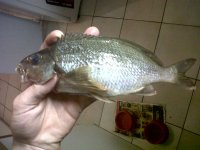
I've spearfished a few in East London and they always seem to be around when the waters below 16 degree C.The eastern cape species are quite dark in colour as in Miles's post and always seem to be deeper than 10 meters.Seen some in transkei and they tend to be pink in colour and dont mind the warmer water,probably the second species.Hard to target them on a rod,more like catch them by mistake I think.
 
Guys we caught a Bank Steenbras on the 5 mile at Struisbaai about 15 years ago. It wasnt a big fish, probably about 3kg if I remember it correctly. We were also not 100% sure what it was. It looked like a White Steenbras, but had a different mouth, and slightly different colouring. From what I can gather, they are not caught that often, and I have never seen one since. I believe that the Spear fisherman see quite a lot of them on the bank while shooting Yellowtail.
 
ive caught bank steenbras in knsyna lagoon they dont grow that big, and hav dark almost black verticle line on thier body execellant eating but they stocks arent the strongest so relaese em if you can 
 
I know this has been posted a long time ago. Today I caught one of 25cm from Gordons Bay Harbour. And no, it doesn't look anything like a white steenbras. Today was the first time I saw that fish as well in my whole life. Reddish colour when it gets out of the water. Very short fins as well. According to the internet they can grow up to 180cm.
 

Jannus.

Member
I know this is an old post, I went spearing today at ballito and came across a large school of large fish that looked like white steenbras. I was uncertain but I thought it to be a bankie. When I searhed the web I came across this topic. The fish appeared quite large underwater. I would estimate the largeste one at about 75 cm
 

mtayl61

New member
The pink species is the natal fingerfin. There is also a two tone fingerfin which looks very similar to the bank steenbras, but it is found further south and it is small. These are very plentiful. They only get to around 25cm whereas the bank steenbras gets a lot bigger. Then in the cape you also get the redfingers which looks like a kind of klippie. It has those fingers on its fins, but they are a bright red and unlike the other fingerfins the body is very mottles. They can be a pest when fishing off the rocks.
 
Top