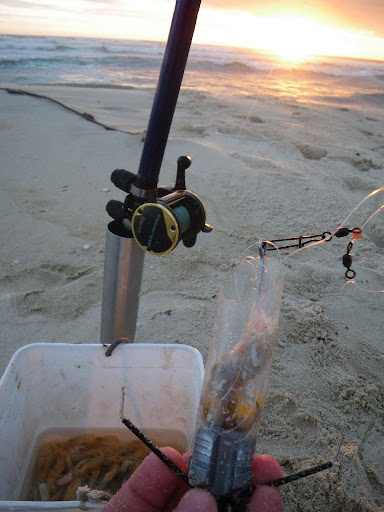
My experience is that it is really difficult to beat bloodworm as best bait for bigger steenies in the False Bay - Arniston area. Although baits like chokka certainly produce good results, bloodworm is the consistent number one bait for me in this area. It is quite resilient to peckers and also aerodynamic, allowing very long casts, which is most often than not required to reach the areas where the bigger specimens feed.
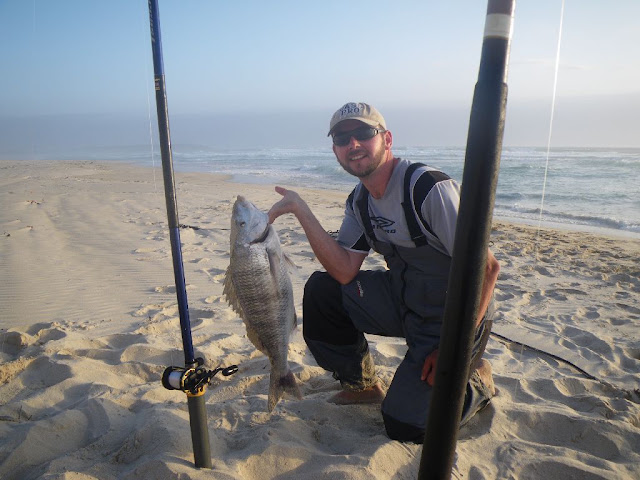
The bigger fish certainly prefer the outer sand banks and casting onto them or if the spot allows it, just behind them, is the best area to target the bigger specimens. By following this approach with fresh bloodworm my average steenie taken on these back sand banks weighs in at around 8kg consisting of fish in the 4 - 17kg class. It is very important that the waves do not dump on the sand banks. A nice rolling wave action is what you want.
Because the bigger fish really likes the outer sand banks, I have always preferred to fish for them with the dropping tide. As the tide drops and the water gets shallower, the waves start to work on these sand banks and this is when steenies like to feed in these areas. I am a firm believer of early mornings being the best time of day for steenies and have probably caught 90% of fish during the period 05h00 – 08h00. With a high tide at about 02h00 - 03h00 at night, this means you will be fishing a dropping tide with the waves starting to brake on the outer banks at about 05h00 – 06h00. Perfect conditions for steenies!
Because of the different coastline orientation at the various spots along the False Bay – Arniston area it is impossible to say which wind direction is the best. Consequently, each spot has its own set of ideal conditions. For example, Struisbaai-Plaat really produces big steenies after a couple of days of South Easterly wind when the wind turns North-West. Very soon after the wind turns, the Plaat comes alive. It is so sudden, that I like to call it the SE – NW “switchâ€, because the steenies suddenly starts to bite, nearly like switching a light on! On the other hand, just 25 km’s towards the west at Brandfontein, things are completely different. Here a change in wind direction from onshore (west – south west wind) to an Easterly direction really switch the steenies on. So, within a 25 km stretch of coast, completely different winds have a profound effect on the feeding pattern of these fish.
Cold water is a problem, especially in the stretch of coast between Kleinmond – Cape Aghulas. This is mostly caused by SE – E winds if it blows for too long. Therefore at Brandfontein (for example) the Easterly wind really produces big steenies on the first day, and maybe the second day as well, but then the water temperature drops dramatically, making conditions very poor. What is then needed are a couple of days of North-westerly wind to warm up the water again. Good steenie fishing therefore depends heavily on quite frequent passage of cold fronts.
I agree with Uncle Bob that it is far better to use cone sinkers than grapnels for steenies. I also agree that the hook trace must be long. My hook traces are up to 1 m in length. Also, keep the terminal tackle as light as possible. I use very small power swiwels and a hook trace never exceeding 0.45 mm, but preferably 0.40 mm. I try not to use leaders in excess of 0.60 mm connected to my main line (0.40 mm). Don’t play around with small hooks if you want consistent success with the bigger fish. I mostly use very sharp 4/0 hooks with bloodworm baits up to 20 cm long extending up the hook trace.
Some interesting observations that I have made over the years about white steenbras caught at Struisbaai/Brandfontein:
a) Their guts are often packed full of brown mussels shells, showing that they are prolific reef feeders, besides sand burrowing for worms, prawns etc. This is especially true following winters that had big storms. These storms apparently open deeper reefs on Struisbaai-Plaat where they love to feed on brown mussels. I have lost many big fish on these reefs, but also believe that these reefs, if they are washed open, makes for very good steenie years.
b) You clearly get two body shape types of steenies and their fighting patterns are different. You get a longer, more slender shape of fish that really takes a lot of line very quickly during its first run. It then remains deep and will follow the first run up with another couple of shorter runs. In the shallows, however, it provides little resistance because it probably expended all its energy in the deep. The second type of fish is more stocky and shorter. It does not make long runs at the back, but gives you all hell close to shore in water as shallow as knee-deep. It is these fish that are very easy to lose in the last small breaker at your feet. In 2003 I caught a 17kg specimen of the latter type at Struisbaai-Plaat. After hooking it, it took me only 10 min on light tackle to get it to within 25 m of me, but then it simply turned around and stripped over 100 m of line of my reel. In the end it took me 45 min to land the fish!
c) On rare occasions they will simply not touch bloodworm, but take salted moonshine worm freely. When possible, I make sure I have both types of worms in my bait box.
d) They can swim long distances in a very short time. I once caught a tagged steenie that swam from Stilbaai to Struisbaai in 3 days!
e) If you think White Musselcracker (brusher) is a dirty player among reefs, then you have not yet hooked into huge steenies with reefs in the vicinity. They just know exactly where these reefs are and swim straight for them. I have hooked many huge fish on apparently “pure†sandy beaches, just to lose the fish in the deep on some invincible reef. So far, this has stood between me and my biggest dream, to catch a steenie above 20 kg. And don’t think switching to heavier tackle will solve the problem; they just don’t take the bait when presented on heavier tackle – a very clever fish indeed!



 ...One of the best threads Ive EVER read on this webpage!!!