where to mount my new transducer

Johan

Senior Member
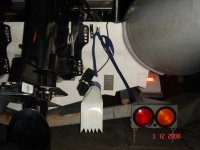
I need to drill 3 new holes. No way around that this time! Where would you guys say is the best position to mount this transducer?

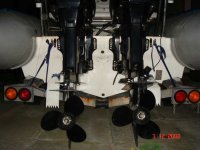
Note where the old one is sitting - after I used the bracket to get the transducer in deeper I noticed that when I lift my right outboard a little (for better fuel economy) the transducer speed wheel start spinning at about double the speed the GPS is showing. So obviously the props jet some water through the transducer. F/F pickup is also poor when this happens. This also happens when going high speed. When I stop I can sometimes hear the speed wheel rattle as it is still spinning! Obviously I want to get the thing as far away from the outboard as possible. The only other option really is where I marked in red. Will this be appropriate?
 

Attachments

  • DSC02651.JPG
    DSC02651.JPG
    40.3 KB · Views: 218

Bingo

Senior Member
Hi Johan

I would put it as low as possible midway between the two plaining chines, other wise you must try the patent I posted a photo of in a previous post. The only draw back is that you must lower and lift it every time you launch and trailer your boat. You can also not travel at full speed with it extended.

Stywe lyne:fishn 
 

Johan

Senior Member
If you look closely there is a part of the trailer onto which the boat lands. So that position will unfortunately not be suitable. Maybe I should just put it where the current one is and play with the depth a bit?
 

FLUKE

Sealiner
Air bubbles are what effect the Quality of the fishfinder so lowering it may reduce the number of air bubbles passing below the transducer. I have never found the fishfinder speed reading to be reliable at high speed, rather use your GPS for speed. In my humble opinion I would leave it where it is and adjust the height.
 

FLUKE

Sealiner
Where you have marked with red will have the most air bubbles as it is the highest point from the water and that is where any air trapped between the pontoon and hull would escape. I personally would not mount it there.
 

Johan

Senior Member
Fluke, good point. You are absolutely right! I suppose the best place would be right at the bottom between the two motors? If only that was possible!
 

Johan

Senior Member
It works perfectly! I used the same position and even the same bracket. I just countersunk some new bolts for the furuno transducer. Whats nice is that the furuno transducer can be unlocked simply by giving it a sharp blow and I carry a spanner with me on the ocean so I can adjust the depth right on the water. It wasn't necessary yet since I can read the ocean well above planing speed which is actually all I wanted.
 

Richard M

Senior Member
I never had any problem fitting my garmins f/finder transducer and speed sensor. Just made sure they are outside the prop path as it can lead to prolems if they are not. I get pretty good accuracy on the speed sensor when checking it against the GPS all the way from slow to WOT. My trailer also interferes with where I could put the sensor, so you do not have too many options. I fitted mine on the standard bracket and have not had to lower it at all.
 

miles

Sealiner
Hiya

Richard M, your fishfinder and GPS's speed readings differ most of the time.

A fishfinder or any other device that uses a paddle wheel at the rear of the boat (usually attached to your transducer), measure speed in STW (Speed Through Water), whilst a GPS will measure SOG (Speed Over Ground).

Here's a very simple and easy explanation:

http://www.sailtrain.co.uk/navigation/sog.htm
 

Richard M

Senior Member
In a dam with very little or no current, the speed over ground is virtually the speed over water. I have no doubt that in a river current or in the salty stuff there will be a difference. I have taken the time to calibrate the speed sensor properly and when the GPS indicates 36 km/h, the speed sensor reads 34km/h. About an 8% error which is not bad. Most cars have about a 7-10% error between true speed and indicated speed. The important point is that you need to use the speed sensor for trolling (it makes it easier to judge the speed over water) in the sea as the GPS has no correction for current speed. Dont want to be pulling lures above 12 knots (although this works sometimes) which is easy to do if the current is running fast and you are going against it. I like t troll from about 6 to 10 knots max.
 

neilg

Sealiner
Well it seems the "speed feature" on a Fishfinder using a paddle system helps with reading for strong the tide is pulling.

That is a plus !
 
Top