We have a cabin cruiser on the Kowie river witch w

Mouldz

Sealiner
Fanie wrote:
Guys, you realise if you lie about the flotation and you get into trouble you are in deep deep sh2t. This isn't the quick and easy around the law.
I agree I dont want to go the illegal route,but I am tired of all this beuarocratic red tape,we wanted to do the right thing,firstly when we went to pay our registration in JulY they said not to worry the new stickers have not arrived they will contact us,three months later no contact, and secondly the bouyancy issue,its becoming a joke,I went to pay my fishing liscence in January,they did not have the annual liscence forms but I could just fill in the monthly one and they will charge me annual rate,now whats the bet if our intelligent nature conservation officer sees this he is not going to accept my explanation as the actual pathetic reciept they issue is long faded and the amount cant be seen
 

Fanie

Sealiner
A bit like the wet bikes that has to have a bailing bucket. My one friend got one of these tiny decorative tin buckets they sell beside the road. Whenever the samsa agent ask him where the bailing bucket is, he holds the 'bailing bucket' up.

Hey, it's a bucket...
 

thika

Sealiner
Fanie,

This is what I going to certify

It's the best I can do

I am not having holes cut in my deck, and in anycase how does one figure out the compartments in a sealed boat?

What's YOUR take on the 60 percent buoyancy?..see my posts above

Flotation Certificate


Vessel Name:     


Vessel Number :              


Description :      6,6m Glassfibre, blue and white hull, white sides, white cabin & blue flotex carpeted deck


Build Details :

Builder :              Acecraft Marine

Date of Build :    1988

Model :                660 DV


Principal Dimensions :

Length Overall :                  6,600 m

Breadth Overall :                 2,700 m

Depth (Gunwale to Keel) :  1,112 m


Construction :   GRP and Marine Ply


Propulsion :       

  1. The recommended propulsion for the vessel is :                                           2 x  115 HP[/*]
  2. The minimum recommended propulsion for the vessel is :                          2 x    90 HP [/*]
  3. The maximum allowable propulsion for the vessel is :                                 2 x 135 HP[/*]
  4. The maximum allowable weight of the motors fitted may not exceed  :                   Kgs 
[/*]


Built in Buoyancy :

  1. The under deck of the vessel is filled with bottles as is indicated on the sketch below :
[/*]
Volume =  1,534 m[suP]3[/suP]


[align=right]2,600m x 1,350 x 0,520m = 1,83 m[suP]3[/suP][/align]
[align=right]0,700 x 2,100m x 0.320m = 0,47 m[suP]3[/suP]  [/align]
[align=right]1,300m x 0,750m x 0.070m = 0.07 m[suP]3[/suP][/align]
[align=right]1,000m x 1,300m x 0,520m (x 50%) = 0,34 m[suP]3[/suP][/align]
[align=right]2,71 m[suP]3[/suP][/align]
[align=right]Less 25% (v) = 0,68 m[suP]3[/suP][/align]
[align=right]2,03 m[suP]3[/suP][/align]
[align=right]@ 75% (bottles) = 1,52 m[suP]3[/suP][/u][/align]
[align=right] [/align]


Designweight :

Light Weight :          680   Kg

Dead Weight :          1373 Kg

Maximum Weight :  2053 Kg


Volume of Buoyancy space =  1,52   m3

Maximum vessel weight      =   2053 Kg

Percentage buoyancy            =   74,03%


Deadweight :

2 x 90HP Engines (4 Stroke) :  358 Kg

1 + 4 Crew (5 x 75Kg) :            375 Kg

Fish in hold :                              160 Kg

Fuel (2 * 200L fuel tanks) :       400 Kg

Crew Effects :                        80   Kg[/u]

                                          1373 Kg
 

Fanie

Sealiner
Thika,

Adding proper buoyancy to a vessel is actually a bit more complicated - and involved.

The idea is to still get you home safely, and secondly to keep the vessel in a usable state of flotation.

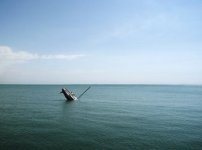
If you take the buoyancy you calculated and put it all in the same place in the hull, usually more foreward then in the event of making water the motors will still go under and you will have a floating boat, but with only the nose sticking out of the water. Hardly usable.

The other thing to consider is if the boat weighs say 1000kg and you have 1200kg's of flotation in it, it will barely stay afloat. In swells it is going to go under and up again, if you add your weight it is not going to be a real support either.

Disasters happen quickly, or one would be able to avoid them, but even in good weather, if something under the water - a steel pole or semi submerged container (who knows what could be out there) and the hull gets slit or holed and if you're a ways from any kind of dry you're in for a very difficult time without proper flotation fitted.

The argument for fresh water is yes but if you have a life jacket on you have your own flotation and that of the boat can be less. Well. Some of our waters we have crocks and hippo's, you get past those first.

Get the life jacket on and have your buddy drop you off somewhere then get home on your own. Picture changes a bit then. One of the times we were on jozini the hippo's were so agressive we had to leave a couple of times, I hate to think about having sinking problems then.

Most guys think they can swim the one or two or five km to shore, while in fact one may make a few hundred meters. Most also do not know that our sea current flows up to 6km/hr, I'd like to see any one beat that.

One of my friends got swept out like that. Nobody even knew when it happened. He had a diving suit on which gave him a bit of buoyancy and he kept his head. He was circled back after losing sight of land and was able to swim out. A very lonely and very scary experience.

So I think it is important to have good and planned flotation and there is no such thing as too much of it.

I always advise anyone who asks to firstly fit what works irrespective of the legal requirements for your setup then worry about the legal. All boats are different, you have to work out what is required aft to float the motors etc. I'm actually surprised no one came up with the self inflating buoyancy thingy for small boats with huge motors yet.

Easy to check if your boat will make it. Pull the plug and fill the boat with water like swells spashing in and see what happens. You can leave it on the trailer so you can get it out.

He he... imagine being in a shipping lane and you can't move.
 

Attachments

  • boat-07.jpg
    boat-07.jpg
    26.3 KB · Views: 93

thika

Sealiner
Thanks Fanie,

If you go to the Ace Craft page you will see my boat

It is indeed a very seaworthy vessel being a late model Ace Craft, top of the range at that time

I have no doubt that the 2200 bottles will be adequate..these were NSRI boats and to this day Sharks Board boats

I am not keen to flood the boat...all sorts of electrics, bilge pump, motors swamping, I have a recessed cabin, and so on

I am keen to know what the compartments look like for my own benefit, not only for the required diagrams on the BC

My question remains:

WHY IS ONLY 60 PERCENT OF THE BOATS WEIGHT REQUIRED AS BUOYANCY?

What am I missing?

Cheers

Thika


thika

Sealiner
PS:

I still believe the only way to try and survive is to have a sheltered selfinflating liferaft with your EPIRB attached to it

I have fished many many times far off the Transkei and Moz coastlines, only boat on the ocean. Don't care how well your boat floats in a calamity..you will die from exposure!

Small money if you look at the price of your outfit and what guys spend on electronics and fuel

Thika
 

thika

Sealiner
And not wanting to harp on this further, but skiboats al have the light stuff under te deck and the heavy stuff above deck

So unless you are on very still water, physics says that the swamped boat MUST overturn sooner or later in a swell, let alone a storm, and then it WILL stay upside down

So at best you will only be left with a platform to hang onto..in a mono that means you are in the water

How many boats have you seen float right side up? Every single accident I have witnessed the boat goes over...nose up or down is academical

In Elands Bay a month ago two poachers picked up trouble..boat went over...at night and in calm water 3 miles out...one guy was rescued first light in very bad state..he says his pal could only hang on for two hours before he had to let go..he still hasn't been found
 

Breads

Senior Member
"WHY IS ONLY 60 PERCENT OF THE BOATS WEIGHT REQUIRED AS BUOYANCY?"

Still puzzling for me as well. Have asked around, but only viable suggestion was that the material the boat is constructed of (plywood, fibreglass, etc) gives the other 40% buoyancy.
But that was only mentioned as a possibility, not confirmed.
 

Fanie

Sealiner
I have no doubt that the 2200 bottles will be adequate
Beer bottles :-o

WHY IS ONLY 60 PERCENT OF THE BOATS WEIGHT REQUIRED AS BUOYANCY?
This is the minimum requirement.
Pressure from users with showpieces, not boats ;-)

Many boats were manufactured without flotation fitted before it became a requirement, to now do it properly means you have to take the deck out, prepare the interior and fit the foam, then refit the deck.

By itself a very large undertaking, most people cannot do this themselves, and who pays (again).

Also, since most boats are GRP, it adds to another problem. New polyester resin does not adhere to old polyester well, so there is an added risk of delamination, actually weakening the boat instead of enhancing it.

This is why the pour foam is so popular. The guy can make a relative small 'inspection hole' and pour the foam in it without ripping the boat. The drawback is the hull and foam is not prepared and if water (it always does) find a way into the hull the foam will absorb it over time and the boat will become heavy.

The foam using guys should be made aware of this and weigh their boats once in a while to see if any significant weights has been added. This not only affect trailing, it also affect a boat's handling on the water. If enough water is absorbed over time then you won't have buoyancy any more either. To fix this now will mean you have to rip the boat.

Just filling a hull with loose bottles may have the bottles float out if the hull gets holed big enough. If placed into different compartments the risk becomes less.

So what is the real risk. I've heard of only a few guys that holed their boats, capsizing is a lot more frequent and probably more serious and expensive.

Maybe we should put a few wave breakers on our coast line to make beach launches safer, it may save more lives and in the long run cost less. But then again, who pays. It's much easier to target the user than to take responsibility for the launch sites out there.

And the problem is not the usually older experienced guys who look after their boats and who always did.

There has to be balance in all things. Imo this 'safety craze' is rediculous. No use being untouchably 'safe' on the water, yet when you set foot on land any one of the hordes can just take a pot shot at you to steal your stuff.
 

Fanie

Sealiner
BTW, these are just my views. Each guy out there has his own, I'm not claiming to quote the law or whatever.
 

thika

Sealiner
The "minimum" requirement means that the boat will sink to the ocean bottom and you will be floating with the debris. So what are you trying to say Fanie?

To keep a 1 kg weight from sinking you need one litre of buoyancy, and thats that

Can someone perhaps answer this question?

It's a simple technical question and SAMSA must have the answer, but their forms are stupid as it stands now
 

PH

Senior Member
 

The Old Man said that a body displaces it owns mass in water mass.

Consider a 10 liter metal can.

If you fill it with water it will sink due to the weight of the metal.

If you fill it 60% (6 liter)with "weightless" foam, and fill the rest with water, you have 40% (4 liter) weight of water, 60% ( 6 liter) of the remainder of the can will be above the water.
Granted - it will be partially submerged.


 Is this reasoning correct?
 

PH

Senior Member
 

To keep a 1 kg weight from sinking you need one litre of buoyancy, and thats that


If you have a 1 liter steel box (actually slightly bigger to take the weight of the steel into account) that displaces 1kg of water the box will be "just" submerged

If you take a 1liter steel box that displaces 500g of water, the steel box will float 50%

(ie you added 500ml boyancy)
 

Fanie

Sealiner
The "minimum" requirement means that the boat will sink to the ocean bottom and you will be floating with the debris. So what are you trying to say Fanie?

To keep a 1 kg weight from sinking you need one litre of buoyancy, and thats that

Can someone perhaps answer this question?


If you weigh 100kg's, how much flotation do you need to barely stay afloat (assuming you are not completely hollow inside :-D) ? If you say 5kg then you need 5% buoyancy. Water displaces things too, negative or positive depending which media density is the most, you or the water.

if the boat weighs 1000kg you need according to the law 60% of that in displacement to stay afloat fully submerged.

I agree it doesn't work that way in real life. Many small power boats does not have that much space below deck to float the 200hp. The bigger the motor the worst it gets because the motor is mostly metal and heavy.

Fuel's density is less than water so it floats. Fiberglass is denser than water so it sinks, but not as heavily as metal if you understand what I'm trying to say.

If you weigh things above the water it will have one weight, if you weigh it under water it will weigh less.

Under water you will have the weight of the material less the amount of water it displaces.


Metal floats in mercury if the mercury's density is higher than that of the metal.
 

Fanie

Sealiner
The human body is around 61.8 percent water by weight. So if you weigh 100kg's you will weigh around 38kg's under water.

Water weighs nothing in water. You have all kinds of hollows inside you, lungs and so on and some people have nuts large enough to float them completely - especially if you're a blue bull supporter, but those hollow parts contribute to flotation. That is why a life jacket needs to float only a few kg's and not the full 100kg's.
 

Fanie

Sealiner
Of course we're assuming water's desity close to the surface. The deeper down you go the higher the pressure and the closer together the water molecules get squished and the denser water becomes.

If you throw the anchor out then if the rope is long enough and the water deep enough there may be a place where the anchor's density and that of the water is the same - and the anchor won't touch bottom, it's going to maintain depth.

That is why divers need weights to stay down. The guy on the surface wants to sink because his body is denser than the water at that depth.
 

Fanie

Sealiner
So because it is almost impossible to calculate the exact amount of flotation each boat part required, they are working on a wild thumb suck middle of the road figure that should be ok for most boats.

The easiest way to work this is to take the weight of the rear part of the boat and calculate a buoyancy figure for that and do the same for the front half. If you have the same amount of buoyancy for that part of the boat it should float level, if you calculate it at the required 60% it's obviously going to sit deeper in the water. How deep depends on what you have as a boat and what is in it.
 

PH

Senior Member
Fanie,

I know nothing about boats but under capsized circumstances, why would it be important to have the boat float level? As long as one has something to hold onto apart from the PDF that you are wearing?
 

Fanie

Sealiner
Hi Ph,

The boat has to be the life raft. Imagine you survivd a capsize and are with an upside down boat that floats with the keel up, so you cannot sit on it out of the water, you can only hang onto it.

If you had bait aboard I'd be worried about sharks. You're going to become thirsty within an hour. It is very uncomfortable to be in the water in a life jacket.

Hypothermia which is always the biggest threat, will begin to set in in a short time because the water temperature is always lower than you body temperature, even in our warm Benguela current.

On a level floating boat which you can sit on, you'll be more dry and hypothermia is less of a problem. You should be a lot more comfortable and the chances of a shark thinking you are a sardine or squid becomes a bit less. If someone gets hurt or shocked it could make all the difference getting them on a safe and comfortable floating something.

The order of priorities should always be first safety, secondly comfort and the rest.

So how long do you think one will last hanging on to the boat being in the water. If you're lucky someone sees you and comes to your rescue. If not you may be in for an extended stay. Only reported missing after you are supposed to be back and that could be late afternoon, search in the dark is difficult so you may have to stick it out till morning.

Also keep in mind what a rescue thingy cost. Helicopters and boats and everyone running around.

Capsizing never was a good idea, I would rather have something else happens :-D


Just imagine holing a boat that doesn't have flotation - and it sinks below your feet. There you are...
 

PH

Senior Member
Noted Fanie, Thanks.

I think I'll stay with my kayak or sailing dingy which you can "upright" yourself - which I've done many times.

Dammit my sg. MWEB DSL lyn is moer stadig vanaand. ???
 
Top