Those old fishermen stories....

Ray Hall

Senior Member
Hi All,

I am sure we all know some or heard some strange and wonderfull stories from fishermen before.

What is you favourite story?

Let me start with mine.

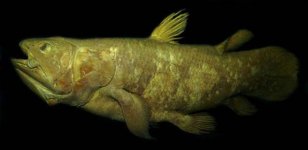
One of my friends father, which is and old salt and been fishing his entire life.  Told of a story when he was still a youngster.  He was fishing with his dad (i think) around the Glentana, OUteniqua strand, Tergniet & Reebok area.  Dont know the exact spot. But something BIG picked him up. This was early morning or late afternoon, they were fighing this monster.  They just could not land this thing. After a hour or two, they almost landed the creature, which they said was a SELEKANT!!!!!  They could not see clearly, but they noticed the odd looking tail, and the massive body.  Needless to say the fish came loose and was never ever seen after that.......

mmmm.....:fishn

Dont think there is much truth in that....
 

Attachments

  • Lacha_u3.jpg
    Lacha_u3.jpg
    19 KB · Views: 669

Ray Hall

Senior Member
Size / Weight / Age
168 cm TL male/unsexed; (Ref. 30865); 200 cm TL (female); max. published weight: 95.0 kg (Ref. 26162); max. reported age: 48 years (Ref. 30865)
Environment
Demersal; non-migratory; marine; depth range 150 - 700 m (Ref. 38430), usually 180 - 250 m (Ref. 27564)
Climate / Range
Deep-water; 13°C - 25°C (Ref. 38429); 3°S - 34°S, 25°E - 51°E (Ref. 46167)
Distribution Indian Ocean: well known population off the islands of Grand Comoro and Anjouan in the Comoros. Other populations in South Africa (Ref. 11228, 38218), Madagascar (Ref. 26162), and Mozambique (Ref. 27415). Likely to occur as strays at islands like Astove and Cosmoledo (Ref. 1623). International trade banned (CITES I, since 18.1.1990).
Countries | FAO areas | Ecosystems | Occurrences | Introductions
Short description Dorsal spines (total): 8; Dorsal soft rays (total): 30 - 31; Anal spines: 0; Anal soft rays: 27 - 31. D VIII+30-31; A 27-31; P 29-32; V 29-33; C 20-25/35-38/21-22; LL 94-104; gills 4; gill rakers replaced by spiny tooth-plates. Head naked, the opercular bones exposed; gill cover expanded posteriorly and ventrally as a thick flap of skin; lower jaw with two large, overlapping gular plates; teeth conical, set on bony plates attached to palatines, ectopterygoids, and dentaries; maxilla absent (the structure at the side of the upper jaw that appears to be a maxillary bone is a thick fold of skin connecting the upper jaw to the rear of the lower jaw). Swim bladder elongate, filled with fat; intestine with spiral valve; osmoregulation involves retention of urea and trimethylamine oxide in the blood, but urea is not resorbed by the kidneys and excess salts are excreted by the rectal gland. In adults the brain is incredibly small, occupying only about 1% of the cranial cavity; but in the smallest juveniles, the brain completely fills the cranial cavity. Color in life: dark metallic blue, the head and body covered with irregular white or pale bluish spots. After death, the bluish color fades to dark brownish black.

Known as the living fossil. Inhabits steep rocky shores, sheltering in caves during the day (Ref. 38425), with as much as 14 individuals in a single cave (Ref. 38426). Foraging singly over open substrate at night (Ref. 38426), it drifts passively with the current or swims slowly with its paired fins and its second dorsal and anal fins (Ref. 38427). May travel as much as 8 km at night searching for food and retreats to the nearest cave before dawn (Ref. 38426). Preys on fishes and squid (Ref. 26162). Beryx, Polymixia, Symphysanodon, apogonids, a skate, an eel and a swell shark have been known to be eaten (Ref. 11228). Its main enemies are likely to be large sharks (Ref. 26162). Ovoviviparous, with as much as 5-29 young (Ref. 11228, 37171). Gestation period estimated at 3 years, which would be the longest known in vertebrates (Ref. 30865). A small relative gill area (Ref. 38428) restricts coelacanths to a life 'in the slow lane', drift-feeding at night in cold waters and resting in slightly warmer caves for food consumption during day time (Ref. 38429). Recently, Prof Hans Fricke and associates have succeeded in observing and filming Latimeria in their natural habitat. Using a two-man submersible, Fricke found several coelacanths in depths of 120-400 m on the barren lava slopes off Grand Comoro. Coelacanths have distinctive white markings, and this allowed recognition of individuals and tracking of their movements. During the day, Latimeria retreat to caves, with as many as 13 fish crowded together in a single cave. Several individuals occupy overlapping home ranges, and Fricke never saw any aggressive encounters between coelacanths. By resting in caves (were there are no strong currents) the coelacanths save energy and avoid encounters with large predators (deep-water sharks). After sunset, the coelacanths leave their caves and drift slowly across the substrate, presumably looking for food, within 1-3 meters of the bottom. On these nightly hunting forays, the coelacanth may travel as much as 8 km; and before dawn they shelter in the nearest cave. While searching for prey, or moving from one cave to another, Latimeria appears to move in slow motion, either drifting passively with the current and using its flexible pectoral and pelvic fins to adjust its position, or slowly swimming by a synchronous sculling movement of the second dorsal and anal fins. In slow forward swimming, the left pectoral and right pelvic fins move forward, while the right pectoral and left pelvic fins are pulled backward. This tandem movement of alternate paired fins resembles the movement of the forelimbs and hindlimbs of a tetrapod walking on land. Latimeria does not use its lobed fins for walking on the bottom, and even when they are resting in caves they usually do not touch the substrate. Like most slow moving fishes, the coelacanth can make a sudden lunge or fast start by means of a quick flip of its massive caudal fin. During its nightly foraging swims, Latimeria was often seen to perform head-stands, in which it rotates its body into a vertical position, with its head near the bottom and its caudal fin curved perpendicular to its body. It then held this position for two or three minutes at a time. This curious behavior may be used when it is scanning the bottom with its putative electoreceptive rostral organ, or it may be a reaction to the bright lights of Prof. Fricke's submersible (Ref. 3822
 

camo shorts

Senior Member
Couldn't help myself Ray, JLB Smith's a legend, sorry cut&Paste
SPECIAL FEATURES Still considered the zoological find of the century. The first specimen of the Coelacanth, which was believed to have become extinct some 60 million years ago (since the time of the dinosaurs), was identified in 1938 by J.L.B. Smith, in South Africa. A fisherman trawling near the mouth of the Chalumna River in the eastern Cape had caught the strange creature in his net.


REFERENCES


MacKenzie, D. 1995. Can the Coelacanth be saved?. New Scientist. 146(1975). pp 6- (29, April).


Armstrong, S. 1991. Hunt is on for the Last of the 'fossil' fish. New Scientist. 130(1770) pp 13- (25, May).


--------------------------------------------------------------------------------

This information has been made available with help from WWF and Chevron
 

miles

Sealiner
Apparently, very oily!! The locals on the small indian ocean islands have been catching ceolacanths for quite some time and they actaully used the scales as sandpaper, to fix their bicycle wheels...........

Much to their suprise, the modern world has now informed them of the 'extinct' creature that was a marvel to the scientific world........

Wonder what else these islander catch that the rest of the world doesn't know about.......
 

Catch 22

Senior Member
My Grandfather coming from a Norwigian background and being a lighthouse keeper himself had just about any story there was to tell....some true, some not so true but every story was legend and awesome.

He had this story about the guy who fished through the night and when it was morning again the guy was at a totally different spot than where he started fishing and the reason being he looked down and saw he sat on a giant perlemoen all night and this perlemoen was walking all across the banks and carried him to a different spot.

Stories like the guy who caught a big galjoen and he pulled it quickly out the water but as he pulled the line got stck. He pulled even harder and the line came loose and the galjoen shot past him, line broke and that was it, galjoen gone. Then when he got home he saw his wife had cooked a galjoen for dinner, one that apparently fell through the chimney and landed in the pan unexplained...

It was not the story, but the way he told it.

Then Cape Receife lighthouse, now that lighthouse has some bad vibes,and stories,and believe u me they are true...
 

tauruck

Sealiner
Did you ever hear about the Vaal Monster?. It was the Free State version of Nessie. As youngsters we too bang to go near the Vaal for years because of the stories. Jaws was a guppy compared. Lol.
 

leonard williams

Senior Member
did you ever hear about the ghost that comes to you at night in the transkei, its a little xhosa boy who was belived to be a gillie and was thrown off the rocks by fishermen who got drunk one night, and now he appears in the distance as a white vision almost like he has that white clay on his face and he comes to you then all of a sudden a huge wave would take you off the rocks and into the deep waters,im like so careful when im fishing the transkei alone at night.whos heard it?
 

ahm3d

New member
Jus got back 4rm PSJ in the transkei....
Damn glad i made it back safely. Never heard that 1 b4 but did see something that looked like an anaconda in the river at night. very fast in the water. we packed up and left immediately.
the locals reassured us that its a fresh water otter of some sort and really is deceiving when seen at night...
 

afghan

New member
my uncle very often repeats the night my grandfather gave a light (cigarette) to a unusually tall man with no legs and he walked on the water into the night, apparently a few older fisherman hav also experienced this. This took place at was then patterson groin, now the durban beachfront piers. Imagine this oke appearing during a shad run on the pier, instant sobering........and s..t .lol
 

kitefisher

Sealiner
leonard williams wrote:
did you ever hear about the ghost that comes to you at night in the transkei, its a little xhosa boy who was belived to be a gillie and was thrown off the rocks by fishermen who got drunk one night, and now he appears in the distance as a white vision almost like he has that white clay on his face and he comes to you then all of a sudden a huge wave would take you off the rocks and into the deep waters,im like so careful when im fishing the transkei alone at night.whos heard it?

Lenny,,::SYou scaredy- cat  ,lol ,Macho-surfer- angler from Sunwich-Port lol,wonder what the local chicks will say if they read this post  .Little wonder your "deurnag-sessie" in July  at Villa ended at midnight sharp .LOL

Keep well buddy. ::S See ya over Christmas 
 

Dosti

New member
Snake park Pier also has ghosts, see fishing from outside, walk into pier and they disappear. Probably same fishermen died when fell over side at front of pier, in the 80s some of those rails were replaced, and left out for days, poor oke fell in and drowned.

My late uncle was thrashed by spiritual aliens, fish was poisoned at Snake Park in the 70s. I still want to meet these ghosts, need help with Lotto and Suncoast.
 

leonard williams

Senior Member
haha kite fisher, yup thats exactly why i kicked down, was kak scary walking back up over the railway lines, was looking all around me.chicks wont like it for sure but its debatable.anyway got to get ready for work now check the time out, study study study sealine study!saltist
 
Top