You are using an out of date browser. It may not display this or other websites correctly.
You should upgrade or use an alternative browser.
You should upgrade or use an alternative browser.
THE OFFICIAL ACE-CRAFT FAN PAGE
- Thread starter thika
- Start date

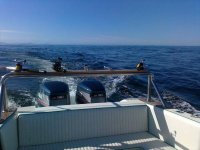
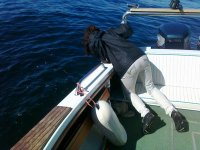
The result:
This fish cost R1000.00 plus
I would have paid twice that much for a day on that beautiful sea with such a good woman, and on such a good boat
And to top it off, had a nice Mothersday lunch prepared by Gerhard ( Kwando) and his wife Hester when we got out....
Life is good in a good boat
PS:
Boat made 41 knots, and even 26 knots on one motor, and eats any swell from any angle
ACE CRAFT ....luxury, safety and performance....all other boats should be banned!!!!
Attachments
thika wrote:
Crew must not see pictures on internet. !!
Congratulations on the Snoek , nou is die ys gebreek.!!
Crew starts chumming:
Crew must not see pictures on internet. !!
Congratulations on the Snoek , nou is die ys gebreek.!!
Thanks BFC,
We were the only boat from horizon to horizon and no birds to be seen, so guess we got lucky
Not the right gear, and caught that one when stopped for lines up and the rapalas sank down
Should have jigged then with my YT spoon, but Freda was so sick at that stage (unlike her) that we made for land
Lots of snoek at Lambertsbay and Doring Baai, so will bring ny boat up here next week when they have finished tarring the road
How the project coming on?
Hi Thika
That looks lovely man, your boat is also a beaut. I'm gonna be up at my place in Brittania bay soon for a week or two, have you maybe got any fishing info on the St Helena area for me, sometimes get some tail and longfin, not too far out this time of the year?
cheers
That looks lovely man, your boat is also a beaut. I'm gonna be up at my place in Brittania bay soon for a week or two, have you maybe got any fishing info on the St Helena area for me, sometimes get some tail and longfin, not too far out this time of the year?
cheers
Help
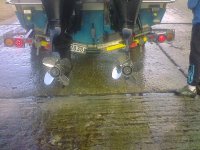
We have a Ace Craft 660 deep vee with outmounts. Had 2 x 115hp ultra long (25")shaft Yamaha engines with 3 blade 19P props.
Have stuck on 2 x Suzuki DF115 4 strokes with long shafts (20"). Have mounted them as low as we can go on outmounts, but are experiancing ventilation.
Changed the props from 3 blade x 21P to 4 blade 17P but now experiancing over revving (ie going over 6,500rpm)
Andrew from Atlantic Suzuki said to me that "if props (or engines) are not set at the correct height no amount of prop changing will solve ventilation". So we are thinking about extending the shafts to ultra or ultra-ultra longs (30"). Then looking at what props we should add on.
For those with similar Ace Crafts tell me what length shafts you have on your Ace Crafts. Does anyone have longs or ultra-ultra's?
Would also be interested in what props you are running with what engine models.
Thanks for the reply Seadoc. You are right and we are thinking that way. It seems thogh there maybe an option to go UUL (30"). But I am asking on the forum whether anyone else with a 660 Deep Vee Ace Craft has gone to UUL's. Its quiet expensive and we just don't want to spend the wrong way.
After the extension we will look at the props as I don't believe we are getting correct rpm readings with the present ventilation taking place.
After the extension we will look at the props as I don't believe we are getting correct rpm readings with the present ventilation taking place.
My 2c.if you see going to go to ultra ultra long do it to keep your powerhead further out the water not to put your props deeper. Thay boat was designed for ultra's so putting anything other than what its designed for is crazy!If I may ask what made you go from ultra to long?
Hi Seaboy. We bought second hand Suzuki 4 strokes to replace our UL 2 strokes. They came off another boat. The price was good but they needed quiet a lot of work, but at the end of the day, even with all the cost it was a good buy.
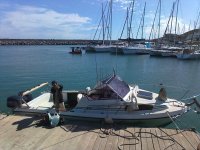
Here's a poor pic
I have looked at raising the motors and the available holes. Maximum height increase would be 2.36". So if we go another 5" (L to UL) that would be 2.64" deeper if we raised the motor (like it was before with the UL Yammies). To UUL that would be 7.64" deeper. Not sure whether there is a downside of going too deep.
Attachments
Skippy,
I sent you a PM
UUL not a good idea..too much drag in the water
My boat runs perfectly on the UL's...130/115 HP the same thing
If you managed only 28 knots and only 4000 RPM, then something was seriously wrong
Remember, cavitation is not only a up/down thing, could also be sideways
So, check your tow-in...should be about 12 mm on that deep vee
If you want to take a drive up to Mykonos, I can meet you late tomorrow afternoon and you can test and measure my boat's set-up
I do 41 knots at 5500 RPM, even whilst the starboard motor needs some tuning
I even do 26 knots GPS speed on ONE motor (other one trimmed out the water)
Theo
082 940 8100
Skippy, the height of the motors is fairly critical to get them perform optimally. Too high and you will get ventilation and too low and the increase in drag, as Thika said, will seriously decrease the performance. The rule of thumb is to mount the motors so that the ventilation plate is at the same height as the bottom of the hull. This will apply to motors mounted on the transom. For every meter away from the transom (if you use motor brackets or out mounts) you raise the motor 2.5cm.
If you only get 4000 rpm at WOT , no matter what your speed, it means that your motors are laboring and you will drastically shorten the engines' lives.
Once your motors are mounted at the correct height you should test run the boat on flat water with your usual load on the boat and your motors should rev out the manufacturer's claimed maximum rpm.( 5500 to 6000 rpm for the 130 Yammies from memory) For every inch in propeller pitch that you go up or down you will drop or increase about 200rpm. So, Thika's setup sounds about right.
Many people confuse ventilation and cavitation. (not you, I see!) Ventilation is when the propeller sucks air down from the surface or gets caught in an air pocket in the water. This can come from a disturbance on the bottom of the hull, or the motor may be mounted to high on the transom causing it to suck air. It can also be from the exhaust gasses that get expelled through the centre of the propeller getting sucked back into the prop. The propeller spins in this air pocket instead of pushing its way through the water. Normally you will need to reduce the rpm’s right back to let the air go and then take off again. It feels a lot like the clutch slipping in your car.
Cavitation is when you get lots of pitting on your propeller. At the early stages it will be noticeable by pitting in the paint. Eventually it will eat into the blades of the propeller and in extreme cases the blades can be weakened to the point that they break off. The cause of the pitting on the blades is from quite a violent reaction under the water.
Cavitation is caused from low and high pressure areas in the water. When water is pressurised it raises the boiling point of the water. This concept is used in household pressure cookers, when water is pressurised it can be heated above 100° C without boiling and turning to steam. Water also works the other way – if you lower the pressure below atmospheric pressure it lowers the boiling point.
As the boat moves through the water, if the bottom of the hull has imperfections, it creates low pressure areas. These low pressure areas cause the water in that area to boil and turn to steam. These pockets of air travel backwards through the water. When they hit the propeller which is creating very high pressure areas on the blades the steam implodes back into a liquid form with a very violent reaction literally eating away the material of the propeller.
benniejordaan
Sealiner
thika wrote:

Nice to see out on the water!
Ace Craft will do that to anyone! LOLCrew starts chumming:
Nice to see out on the water!
Hi Seadoc. Thank you for the long explanation. With our XL 115hp Yammies with 3 x 19P props at 4000 rpm we would get about 23 knots. We could push the throttles some more but always felt that would be pushing the motors too hard. Not knowing what I am learning now from you guys I realise we should have established what was going on. So I think we might have been able to get 25 knots or so at 4500 rpm maybe a little faster. But hardly reach 5000 rpm which are those motors maximum torque. Thier WOT was 5500 rpm, which we would never have even got near. So yes I believe those motors were lagging and there was about 24% slippage taking place.
What would have happened if those props were 4 blade and slippage was reduced to say 10%? Should we have been running with 17P on those motors?
Well thats all in the past. Now looking at lengthening the shafts on our Suzuki's. Going to cost around R27K. I think it is a whole bottom unit and not just spacers. Perhaps we can sell the old units and shafts as spares.
I have a worksheet to calculate theoretical speed through the water which I attach. At this moment I believe we are looking at too many variables. Motor height, prop pitch and 4 blade SS. I think we need to get our motor height correct before any prop attributes can be measured.
Attachments
You are on the right track, Skippy! It does not matter wether you use 3 or 4 blade propellers, the principle is still the same, your motors should rev out to the recommended maximum rpm at WOT with your normal load on the boat and of course correctly trimmed and the motors at the right height. If your pitch is to high you will not get there and , as I said, the motors are lugging which will load the internals and shorten engine life. Too low a pitch will cause the motors to over rev or hit the rev limiter at WOT and at cruising speed they will rev higher than ideal and burn more fuel. You can calculate prop slippage from tables but good quality SS 4 bladed propellers should have minimum slippage.
The problem is to find a dealer willing to let you test a few different propellors to find the correct type and pitch before you buy!
The problem is to find a dealer willing to let you test a few different propellors to find the correct type and pitch before you buy!
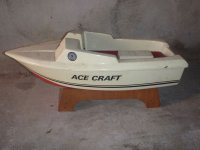
The Smallest AceCraft ever made is for sale for R500.
http://capetown-westerncape.gumtree.co.za/c-ViewAdLargeImage?AdId=386097784
http://capetown-westerncape.gumtree.co.za/c-ViewAdLargeImage?AdId=386097784