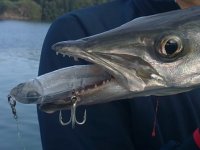
Light tackle spinning with artificial lures is by far one of my most favourite ways of fishing. Here in South Africa we have an abundance of fish species from fresh water to saltwater that can be targeted using this method of fishing, the list of lures is endless...
Spinning is known in Japan as the Lure Casting Game, and these guys are the true masters due to them fishing heavily targeted areas where the fish are “educated†and so nothing but the best will do. I have had the privilege of fishing with some of these guys over the past few years, and my eyes were really opened to this kind of fishing.
Rods, reels and lines do make a difference, and these will depend on what lures one is casting, the lure weight and species one would target because different rods have different actions, and can cast different weights, are rated for different line strengths and this subject alone could fill several pages in a book.
One of the characteristics of a good spinning set up for lure casting is that the set needs to be low weight, as using a heavy set up will impede on a person’s ability to impart proper action onto the lure and will also cause fatigue and even muscle and joint damage to the angler. This fact alone already puts a reasonably decent spinning rod on the higher price tag, and really if you want results you need to start with the proper rod that has strong light eyes, I also prefer using smaller reels for this kind of fishing due to the control the lighter set allows a person.
Longer rods will allow a person better casting distance, whilst shorter rods will allow for better casting accuracy and more importantly shorter rods allow better control on your lures and the action one imparts onto them. Looking at my set ups I can see that all my favourites vary from 6’2†to 6’8â€.
Typically I like a spinning rod that has a light sensitive tip action, whilst having a strong butt section.
Form and movement is everything
Form being the shape and size of your lure, movement being the speed and action of the lure, and whilst other factors like colour, contrast, hot spots and noise play a part, I believe that the form and movement of the lure is key to successful spinning, and I proved this time and time again fishing next to someone who keeps on changing lures whilst not paying attention to the movement and I have pulled fish after fish and they have caught nothing.
With my style of spinning I like my rod tip pointing down towards the water and lower than the reel as I find that in this way I can impart the best action on the lure, whilst having full control, this also increases sensitivity as you line is not affected by the wind and so you have more direct contact to your lure. This type of spinning is not really possible with a long rod and so perhaps the reason that I prefer shorter rods.
Retrieves will vary according to the lure used, and the speed required, but for certain one needs to learn how to synchronise the action on imparts to the rod and the turns one is doing on the reel. Particular attention needs to be paid to the rod tip, as with this type of direct spinning the movement that the rod tip does is directly proportionate to the lure movement.
Basically what I am saying is that simply casting out and retrieving a lure is not sufficient and will end with a session that has poor results. One really needs to focus and pay attention to what is happening, where the lures is, what it’s doing, how to make it do what you want and what reaction it will have to what you do to the rod.
When buying a new lure, I strongly recommend a fishing session in the swimming pool where you can learn how that particular lure works and how it responds at various speeds and with various actions that you impart to your rod, then and only then should you take that lure out fishing with a full knowledge of how it works.
Pausing, jerking, dropping, lifting, skipping, twitching and many other actions are critical to success and so one really needs to learn how to get the lures to work and vary your retrieves and actions on a constant basis and watch to see what happens and if you get chases or bumps. Generally cheap lures do not produce the results because they are unbalanced and cannot swim properly and cannot be tuned.
Colours & Character
It is true that certain colours will work better than others, and this will vary from area to species targeted. As an example when spinning in Durban harbour brighter lures with chartreuse or hot pink produce the best results, whereas at Kosi Lakes subtle colours with grey’s, silver and black produce better results, and I think that water clarity plays an important role. Blue lures produce very little in Durban harbour, whilst just outside the harbour blue is a king colour.
Lures with hot spots like oversize eyes, red on the gill area, an orange chin, black dot on the tail area often will produce results when other lures will not, or sometimes lures with high contrast two tone colours do the trick.
Retrieves and actions
Fast Jerk
This is probably one of the most important retrieves to learn for estuary and inshore lure fishing and is usually done best with shallow running minnow type lipped lures like the Rapala X-Rap splash bait, and then there is a host of specialist Japanese lures for this from Tackle House, Mega Bass etc.
With this retrieve you keep your rod tip down, and then as you reel you synchronise the medium up and down movements of the rod tip (+/- 300-400mm) with a full turn on the reel making the whole action a singular movement. If your rod tip splashes against the water surface it is OK.
If using a suspending lure with this type of retrieve, it is good after every few casts to take advantage of this property and in the middle of a retrieve to just pause for a few seconds and the continue retrieving.
Twitch Jerk
This is an all round good retrieve, and is not a very fast retrieve. It is a good retrieve to use with jig head lures (drop shot) and buck tail jigs; it is also good for top water stick baits.
Again with the rod tip down you make short jerks with the rod tip (100-150mm) and synchronise this with half turns of the reel.
This retrieve will allow the weighted lures to rise and sink and will give stick bait’s a left to right (walk the dog) action.
There are many more ways one can manipulate a lure, some lures have inherent movements whilst others require complete manipulation by the rod in order to perform.
.