
You are using an out of date browser. It may not display this or other websites correctly.
You should upgrade or use an alternative browser.
You should upgrade or use an alternative browser.
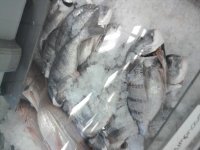
Please help me identify these fish
- Thread starter 200ts
- Start date

benniejordaan
Sealiner
Yip, looks like White stumpnose (Rhabdosargus globiceps) to me!
benniejordaan
Sealiner
http://www.wwfsassi.co.za/?m=5&s=5&idkey=1114

Stumpnose, White
Scientific name Rhabdosargus globiceps
Other names White stumpnose, Witstompneus
Fishing method Linefishery
Area of capture South Africa - FAO Area 47
SASSI colour Orange
Summary White stumpnose (Rhabdosargus globiceps) is a member of the seabream family (Sparidae) and is endemic to Southern Africa. A comprehensive stock assessment has not been done for this species, however, commercial linefishing catch rates have declined over the last 70 years, in some places such as the Southern Cape catch rates have declined by as much as 99.8%. West Coast stocks are considered to be optimally exploited while the South Coast stocks are considered to be collapsed as this species is also often caught as bycatch in the inshore trawl in this region. They are associated with both rocky areas and sandy bottoms, juveniles are also common in estuaries and in the surf zone along sandy beaches. They are a relatively fast-growing species and are distributed from Angola to the Eastern Cape. Unlike many other seabreams, they do not undergo a sex change from female to male as they mature.
White stumpnose are an important species in the traditional linefishery. This fishery operates from small ski- and deckboats within the inshore zone along most of the South African coastline. They are also caught as bycatch in the inshore trawl fishery, white stumpnose caught in this fishery are considered less sustainable than the linecaught option (see white stumpnose assessment for inshore trawl). Linefishing is a relatively selective fishing method which has few impacts on the marine environment and is carried out with either a rod and reel or a handline. There is generally very little bycatch or habitat damage caused by this fishing method. However, some species targeted by this fishery are over-exploited or collapsed because of their specific life history characteristics.
The minimum size limit is 25cm for recreational and commercial fishers.
For more information, email us at sassi@wwf.org.za.
What can YOU do? Rather choose a green-listed alternative such as santer or line caught panga. These alternatives have similar firm flesh with medium oil content as white stumpnose. Or if you don´t want to cut white stumpnose out of your diet completely, eat it on a special occasion rather than every time you eat out.
Stumpnose, White
Scientific name Rhabdosargus globiceps
Other names White stumpnose, Witstompneus
Fishing method Linefishery
Area of capture South Africa - FAO Area 47
SASSI colour Orange
Summary White stumpnose (Rhabdosargus globiceps) is a member of the seabream family (Sparidae) and is endemic to Southern Africa. A comprehensive stock assessment has not been done for this species, however, commercial linefishing catch rates have declined over the last 70 years, in some places such as the Southern Cape catch rates have declined by as much as 99.8%. West Coast stocks are considered to be optimally exploited while the South Coast stocks are considered to be collapsed as this species is also often caught as bycatch in the inshore trawl in this region. They are associated with both rocky areas and sandy bottoms, juveniles are also common in estuaries and in the surf zone along sandy beaches. They are a relatively fast-growing species and are distributed from Angola to the Eastern Cape. Unlike many other seabreams, they do not undergo a sex change from female to male as they mature.
White stumpnose are an important species in the traditional linefishery. This fishery operates from small ski- and deckboats within the inshore zone along most of the South African coastline. They are also caught as bycatch in the inshore trawl fishery, white stumpnose caught in this fishery are considered less sustainable than the linecaught option (see white stumpnose assessment for inshore trawl). Linefishing is a relatively selective fishing method which has few impacts on the marine environment and is carried out with either a rod and reel or a handline. There is generally very little bycatch or habitat damage caused by this fishing method. However, some species targeted by this fishery are over-exploited or collapsed because of their specific life history characteristics.
The minimum size limit is 25cm for recreational and commercial fishers.
For more information, email us at sassi@wwf.org.za.
What can YOU do? Rather choose a green-listed alternative such as santer or line caught panga. These alternatives have similar firm flesh with medium oil content as white stumpnose. Or if you don´t want to cut white stumpnose out of your diet completely, eat it on a special occasion rather than every time you eat out.