Lobito Bill Fish Challange

Gerhard

Sealiner
Well the competition started today....

And where did I find myself???

Stuck 5 hours drive away in a container office .....

I know of at least two Sealine members that is part of this competition.

Mr Pargo man and Carlos Moran...

Pargo Man aka Jan gave me a quick phone call this afternoon and all I can say is that I am missing out big time!!!!!

Of the 50 boats in the fleet today only 5 boats did not get a bill fish!!!!!

Jan and his team had a double strike. Marlin and Sailfish
at the same time.... Must have been hectic


Jan will keep me updated during the week as the competition finish on Saturday.

Cant wait for the Full Report next week.... ::S::S::S
 

Pargo Man

Sealiner
Ahoi All,

quick summary, fotos to follow, t&r video footage to be advised asap.

1. Carlos and IGFA Resident Rep Doc Iain stood by Cam Nicolson... loosing his potential Atlantic Sail WR on 6 lbs line after 2 hrs fight... and that's only on the resting day.

2. 464kgs Blue Marlin is the new Angolan Record, a GRANDER!!! Wow!

3. My team "Malta da Kianda" produced stable hook ups with billfish every day out... but we fumbled most of them... i.e. 3 sails and 2 marlin. Hence, we came in 28th (of 50 teams) with just two sails (unfortunately one eye-hooked and taken at 39,6 kgs) plus plenty Dorados above 8 kgs, best 15 kgs. Winners are "Tubaroes", "Tudo Fixe second and "Jikula o Mesu" 3rd. Statistics: 67sails t&r, 5 taken, 21 Blue Marlin of which 6 taken, biggest Marlin 464 kgs, biggest sail 39,6 kgs, biggest Dorado 22 kgs. Consider a hook-up turnover of 3 or 4 to one by the boat... that's billfish bonanza!

4. Bottom line: Lobito is one fantastic billfish address in the tropical Angolan Atlantic.

Detailed report to follow asap.
 

Pargo Man

Sealiner
Lobito has come and gone, but the new Angolan fame remains:
 
a Blue Marlin of 1.022 lbs (=464,0 kgs) has been caught and puts
Angola on the world map of "Grander" fish!
 
"Malta da Kianda" fishing team was sometimes understaffed.
Still we managed to achieve a respectable 28th place in 50 teams.
This was most obvious when we had twice "Double Strikes" on billfish
and we only managed one of the two fish each time.
 
We caught two Sailfish, but lost three more. We hooked two (and a half)
Blue Marlin, but also couldnt turn over to score. Had we scored all fish,
we would have been top 10.
 
The Lobito "Marathon" fishing is extremely tyring under the scorching heat of the African sun. Countless Dorados, Sailfish and Marlin demand team anglers "switched on" at all times... and the Benguela "Gulf" holds plenty of big Marlin.

The magnificent Benguela bay retains during March and April the eddies of the cold Benguela current, the warm Bay of Guinea current and the freeshwater of the Catumbela river. The foodchain starts here! Everything going well, you're the alpha predator... and your prey grows toe exceptional sizes out here!!

Simple statistics suggest that every boat has 1,67 billfish every day out t&r'ed, 10 Dorados of which 3 above 8 kgs / 20 lbs, a tuna every other day and a shark plus a wahoo once in four days.

The presence of the fleet made ice a commodity short in demand. Thanks to a brilliant organisation by the sponsors NDS African Lines, DESCO power and the Lobito Port Company, not even one fish got wasted. It was up to the individual teams to donate their capture to orphanages, church organisations, ngo's or simply the staff at their guest houses.
 
The competition is a "neo-classic" only in its fifth year of existence. World Regulatory Body IGFA INTERNATIONAL GAME FISHING ASSOCIATION fully sanction the event and the winner books the World Cup entry in Mexico 2010. So attractive, originally 60 teams had signed up.

Next year more teams are expected from Namibia, RSA, Mocambique, Sao Tome and other big game routinees.
 

Attachments

  • 1022 lbs Lobito Blue Marlin with Captor Mario Proenca.JPG
    1022 lbs Lobito Blue Marlin with Captor Mario Proenca.JPG
    39.1 KB · Views: 160

Pargo Man

Sealiner
Lobito Logbook "Djamila2" and Team "Malta da Kianda"
Sunday March 22nd
07H00 loading the Pajero
07h45 depart to Lobito 500km on "new" roads
10h00 breakfast in the beach in Porto Amboim, half way
11h30 taking diesel at Rio Canjala, 100km left to Lobito
12h45 arrival in Lobito, first stop at "The Tackle Box" owner Mark, definitly the best tackle store in Angola
13h45 port entrance Lobito; no hickups or stops all the way to the quay, manning the "Djamila2", engine check, slings under and boat lowered over the quay into the prestine cristal clear waters of Lobito port


14h15 start engine
14h30 entering "Clube Ferrovia" marina; tight but safe berthing promptly
15h30 trasfer to bunkerpier; taking 150 ltrs gas free of charge
16h45 mooring back in berth an leaving to Hotel "Casa Rosa" 500m from the Club
17h45 Sun-Downer in the "Zulu" restaurant also on "Restinga" peninsula engulfing Lobito bay

Top Organisation by the three sponsors:
- free fuel all days
- ice f.o.c. in any quantity desired
- f.o.c. seatransport by NDS lines from / to Lobito
- one week f.o.c. mooring in Clube "Ferrovia" marina
- restless "Marinheiros" on the mooring for wash down etc of all boats

Monday March 23rd / test fishing and skippers meeting
08h45 tackle up for sea testing; our makeshift outrigger instablel (so we couldn’t use them at all)
10h45 depart; Dorados, Dorados, Dorados, but no bill's sofar;
Water choppy at 28 celsius and greenish inshore! Air 30 c plus African sun beating the sh!t out of our brains at 12°30' South
17h00 back to the marina
19h00 Skipper's Meeting and intro of the jury


Tuesday March 24th 1st of 4 fishing days
05h25 rise and shine
06h30 by the boat; takle stowed; taking ice
07h00 Province Governor; Port Director and the press in position
07h30 sounding the bells and Bimini Start of 50 teams... craaaaazy
07h40 round cape "Farol Velho"; we take her North to avoid the crowds
08h15 first message incoming on the VHF Radio: Team "Nguendeiros" with billfish in line
09h00 wetting our lines 12 miles out; timid sails playing with us until we start dropping back free spooled… missing 10 sails before things work out
12h45 "Double Strike"; one well timed drop back brings us one small Blue and a Sail into the lines
our junior angler Sacha singlehandedly has to clear all lines, navigate and announce on VHF; Double Strike... the jury wants to know if they understood well?!?
Double que?!?
13h20 Xico pumps his marlin factory style, Fish by the boatside, but to few hands helping dives under the outboard, rips the hook out of the beak and is gone to grow to size....
... was a small but worthy one; sadly having no pics... again to few hand for all the tasks
13h35 my sail by the boat; eye hooked, so we decide to euthanize and bring to the scales
15h00 Dorados Dorados Dorados
16h00 Lines Out; on VHF: 2 Dorados for the scales plus the sail
17h00 arrival, bunkerpier, scales
17h30 across the fleet t&r 16 Marlin, 20 Sails; one 290kgs Marlin for the scale, another big fish lost (died in the deep) after 4 hrs fight for Team "Tubaroes"
Malta da Kianda current rank 17
Sail weighs in at 39,6 kgs

Wednesday March 25th; 2 of 4 days
05h45 rise and shine, all muscles still aching
07h10 limping behind the fleet
07h18 round Restinga in ugly chop; green wate all the way to the horizon
10h00 finding blue water at 20 miles
11h00 sail taking our ballyhoo combo Drop Back; but lost 500m jumping
14h30 again a double strike; this time its junior Sachas and Xicos
announcing on VHF Radio: dois bicos nas linhas... this time no doubtful calls from the jury

Sachas magnificant Fish tailwalkers, but spits the hook after 5 brave stand-up minutes;
Xico easily put his sails bill into my hands and Sacha wins his smile back to film the t&r for the jury; the rod holder unfortunately is ripped from the foundations…
450 point for our team score; a nice Dorado ontop and thats it for the day
16h00 lines out
17h30 arrival, bunkerpier, scales
Fleet punished the bills; Team TS brings the 464,00 kgs "Grander" Marlin to the scales; all mayhem breaks loose press everywhere and everyone wants a pics; Angola telly news bring the fish etc etc etc that’s marketing the sports and the specialist tourism
Malta da Kianda decling in the ranks despite the Sail t&r to 20th

Thursday March 26th Resting day
Tourism Excursion into the desert; convoy of 23 Teams follow the invitation; visiting Biopio hydropower station; 40°c in the shade; strong winds feel like the blowdryer; bare chested wash ladies on the riverbanks of the "Rio Catumbela" right below the damm; later the traditional Biopio dance and speeches delivered at the brand new municipal complex; national reconstruction reaching deep into the hinterland
13h45 return to Lobito; port Director invites all for Ochsen on the spit!!
Style!
16h15 Xico, Sacha and I in the DIY store to find a solution for the rodholder... should have bought two as it turns out later…
17h25 rigs the spares at the boat club... tough in the scorching sun...
... and while we were doing our tourism program IGFA resident Representative Angola Dr Iain, his brother Cam Nicolson and well known RSA Fishing Guide and Angola expert Carlos Moran with spectators go fishing…
sole objective: 6 lbs Sail world record ... Cam holds other record, but this one is missing; hooking a giant sail estd at 50kgs, but they fail to after 2 hrs already wiring the leader; when the sail manages to throw the hook eventually by the "Bitchalot"!
That would have been the one. Try again Lobito 2010?!!

Friday March 27th fishing day 3 of 4


We gotto make it count
... but nothing goes in the blue water
... only on the way home through the green filth we get nibbles on the ballyhoo


... another sail jumps by the boat waving us byebye
16h00 Lines out... nada para declarar... nnot even a single Dorado
16h10 but all of a sudden Xico and Sach sight a Testbuoy of the fisheries ministry 5 Meilen from the port entrance... we approach and see fat Dorados chased out of the water, a hugh marlin full out of the water behind them estd 600 lbs airborne...
nothing to loose we put our ballyhoo back in the pond and solve in 25 minutes 7 Dorados and a Mako-Baby … just the marlin stays under... time to go now… the engine stutters for fuel


Entire fleet hardly caught anything today
Malta decline to rank 25

Saturday March 28th 4of4
05h15 rise and …; love for the sports
06h45 on the marks
07h40 at "our" Buoy; Dorados Bonanza! But no Marlin
09h00 enough Ballyhoo gone to the Dorados; suddenly we sight a Sail...
but he cruises just past our proposals in dead calm to leave the dire ballyhoo for the  Dorados...

10h00 decide to turn to blue water; another good solitary Dorado and the second rodholder ripped out of the thread...
14h15 Xico gets his Malin in the Spread, cool as ice drops back, well hooked; 650m line in the water in the first run, the large fish gives its all estd 700 lbs....  craaaazy; Sacha and I clear the dek in less than two minutes to give Xico space... message on VHF: Marlin na Linha, Marlin na Linha
14h22 end of story; teaser Daisy Chain fails and fish is free (perhaps attacked by wahoo)... calling the jury to admit the defeat; that was rank 15…
the impression of that magnificent animal is murnt into our brains; next year we'll try to be back when he will have 800 lbs...
19h30 big ceremony with fire works; top live music...
and then I cannot remember anything but the rain in which we strolled back to our hotel..


Sunday March 29th.
08h00 wakeup; breakfast and stowing the Pajero
10h00 at the Club; unmooring "Djamila2" and trasfer to commercial port
11h00 craneing "Damila2" Sacha and myself out of the pond
11h30 driving off to Luanda
20h00 arrival Luanda through thick Sunday suburbia traffic jam..

Conclsuion: rich waters
67 sails, 21 marlin, Dorados (max 22kgs), Wahoo (15,5), Yellowfin Tuna (26 kgs), shark

Worth mention:
- dangerous coastal road, plenty of ugly accidents
- speaking Portuguese of great advantage
- Hotels & travel expensive

Fishing:
- standup advantageous; lines 80 lbs or chair 130 lbs
- chair boats not of significant advantage; even when fishing 130 lbs and fat Marlin-Konahead
- Teams need definitely  4 anglers plus a dedicated helmsman (who must not intervene in fishing) otherwise the free-spool-watch doesn’t work


- train routinely with your fishing mates

- arrive early to get into the rhythm before contest
- bait instead of lure, Ballyhoo functions well, but is hard to find


- green water is not always "fishless"; who dares wins!
- outrigger a must for quick maneuovres onto sighted fish without tangle
- clear deck and minute organisation a must when fishing for the big ones; Dorados immediately under deck; single hook less accident prone; health nothing to gamble with in Lobito
- sun protection absolute vital, "rehydration" very important


- food & bev hygiene to be observed rigorously

- remember malaria chemo prophylaxis; polio refresher
 

Attachments

  • Sacha plus 1st day sail.JPG
    Sacha plus 1st day sail.JPG
    44.2 KB · Views: 151
Awesome fish, well done Pargo Man.

Just a pitty such a majestic creature had to meet it's fait! I wish they would introduce a scoring system that would allocate "double points" for successfull tag and release and bonus poins for hook out. Like in they do in the states with shark angling comps.
 

Pargo Man

Sealiner
Ahoi Benniejordaan,

thanks for your concern regards t&r. Let us not discuss the issue to the bone, please. Allow me to fill you in on the particular problems of Angolan fishing briefly.

The Angolan tournament rules are simple:

1. minimum weights for bycatch, before you can present it at the scale

2. sailfish t&r (formula) earns you 450 points which is equal to bringing a 50+kgs specimen to the weighing station. Conservation is concern, not unnecessary dangling.

3. Blue Marlin t&r (formula) earns you 1.000 points which is equal to bringing a fish in, that weighs in excess of 250 kgs.

Luanda is the most expensive town on earth regards cost of living. Take in account the prices of any fresh food, you can be assured that nothing of our catch goes to waste. Again, a fine balance had to be struck. Angola is still not at the point, that fresh produce can be found at reasonable price, so you cannot deny anglers making use of their prey.

Amongst our club colleagues we get very loud and direct, if any billfish is taken, that had a reasonable chance to survive, be it the 50 formula or the 250! No fish was taken in Lobito, that had been able to be revived. My sailfish had unfortunately the hook from the inside in the eye, eyeball hanging by a thread only, so it would have starved within weeks. Hence we decided to bring him in, despite reducing our chances at the leaderboard by a half. Concerning the big Marlin of Mario Proenca, the fish fought for over 4 hours. Marlin get into the "dead" zone after 2 hours latest, so they decided to take the dying fish, rather than feed it to the crab.

Nothing goes to waste, so my sail was donated to a christian youth organisation, and the Lobito port staff (couple of hundred family fathers) could get a share of the big marlin steaks f.o.c. for the sunday stew.

Angling in my part of the world does have to do with killing fish, as you see. My four kids actually only allow me to go out under the condition that we have fillets in beer batter that same evening:wfish


Thanks for your understanding.
 
Hi Pargo man,

My point in the scoring system is that should 2 boats catch a marlin each of 250kg. The team who "boats" the fish will only get 250 points and the team that successfully releases the fish will get say 350 points earning them an extra 100 points for the release. This would certainly encourage the use of circle hooks and the releasing of these beautiful creatures.

But please don't get me wrong, it is not an attack on the Lobito comp or Angola in any way. I am meerly stating a point in general.
 

Pargo Man

Sealiner
Ahoi again,

my English skills let me down, so I try to repeat more clearly:

The 251 kgs Marlin boat bringing the fish home get: a) the fish kilos times two (=502 points) plus b) a bonus of 500 points equals 1.002 points... but all the crews of the fleet will shout at you because you killed a future grander

:X:uzi:swear

in comparison

A boat filming their successful t&r of a Marlin estd only 90kgs gets a) a t&r premium equal that of a 250 kgs "dangler" ie 500 points plus b) the full bonus premium of 500 point equals 1.000 points.

Big advantage of small over large: 1. You get your gear back in the water much quicker to release yet anotherone and 2. you retain your reputation withing the community.

 :first

The philosophy is to "fish around" the big marlin avoiding a tiring and potentially lethal combat of that fish for more than an hour (after which most Marlin will die), but rather fish a small Marlin quickly and release him in top shape within 30 to 45 minutes. After years of experience most boats in the fleet will fish not lighter than 80 lbs lines, combo lures/ballyhoo rather than the 50cm marlin konas. It's as everything in life an educational process in which the Angolan competition scene more and more defends the release in best shape, rather than bringing any more bills to the tally. IGFA rep Doc Iain made a big impact on the crews out here. The IGFA recognise and reward our increased skills by granting us 8 wildcards (IGFA qualifier events) for their world cup in Mexico.

The recent Lobito grander was a sign, that stocks are recovering and growing out to size. Only back in the 2000/2001 season, a marlin was not only rare, but almost never larger than 100 kgs.

Particularily the big migrator mamas (Blue, white and sails) need our protection while they come through our home turf waters. Almost all in the fleet know that. 

The big Marlin taken in Lobito and the big sails as well I consider accidents, rather than the disregard of some sportsfishermen in Angola for their bill population.
 

Attachments

  • Xico n Jan releasing a Blue Marlin during Big Blue Cup Nov2008.bmp
    300.1 KB · Views: 133

Gerhard

Sealiner
Guys,

I have seem how Jan and the guys here in Angola operate when it comes to bill fishing and tag and release is utmost priority for them.

Fishing is a blood sport and some times fish do die while fighting...

But I can do nothing but compliment the guys on doing an stunning job in tag and release...

Remember there is nothing preventing these guys to kill a big fish and sell it... Remember Luanda is very expensive to live in and fresh fish will be sold easily yet the guys are serious about conservation as anybody else I have seen...

Big hats off
 

Fin-S

Sealiner
Hi Jan,
Thanks for the reply and well done on the sailie. I do not dispute the right to harvest fish and indeed cannot see the point in fishing if we release everything. However perhaps you could help change the perception that a marlin is in trouble after an hour on the line. Numerous T&R studies with pop up tags have been conducted by TBF, WHORI, and others that show it is more the fishes condition at release point rather than length of fight that is critical. Some of the stats show fish being released after 6 hours surviving happily. The story about the deadzone and brown fish has now been disproven. However, there has to be a limit as to how long you can take to revive a fish - the accepted norm now in most competitions is 30 minutes. If the fish fails to kick in this time then it is boated.
As regards the prevalence of marlin, the spawning biomass is still at a record low of approximately 17% - I would think the upswing in local population levels is more as a result of changing migration routes - note the reduction in big fish in Ghana. However, everything we can do to help conserve and grow the species is welcome - and you are to be commended for your efforts. Tight lines.
 

Pargo Man

Sealiner
Dear FinS,
Dear All,

guess I'm ready for advice. FinS put it politely: There's always room for improvement.

My conviction: Afirmativo! What is good for our predators, is good for us. So release as much as you can manage.

Therefore my request for advice:
The last 10 month me and my team executed unnnecessary stress on the marlin and sail stocks. I mean we really could do better, if we had better hock technique.

Please comment on size and form of hook for trolling (compulsory to troll in the Angolan competitions).

How can we use 4 to 6 roods trolling for Blues and Sails with just two fishermen vigilante on the rods, and still convert with less foul hooking (eyes and such...)? What size and make circle do other competition anglers recommend?

Thanks dearly for any and all advice.
 

Fin-S

Sealiner
Hi Jan,

Sorry it has taken me a while to respond, but the fishing has been pretty good locally and I did not want to miss the opportunity to get some tuna in the freezer!

You raise some good concerns and to be honest, even with the best will in the world, we are still going to kill some fish - particularly in a trolling only competition.

Most skippers will tell you that to get the best hook up for tournament fishing, you should fish a stiff rigged double j hook rig. Unfortunately whilst this has the best hook up ratio, it also causes the greatest mortality. The easy solution is to ban J hooks, and only fish with circles. This does however require a concerted effort and some would say a raising of skill levels. Assuming you could convince the local organisers to go circle only (I'm sure Iain would support it) then I think you would be halfway there. The circles to use would be those tournament approved by TBF, namely Owner, Eagle and Mustad. Sizes are from 12/0 to 20/0. The smaller ones are rigged on a ballyhoo / Ilander / Sea witch combo, whilst the larger are rigged on skippies / bonnies / tuna / dorado. Rigging methods would either be swivel, wire or floss rigs. I would then run only 5 lines (you are on a 585 right?), short for sails port and short for blues starboard. Long for blues port and long for sails starboard and then a centre rigger with a big livie on. Obviously you need the dropback when fishing with circles, so either rig them from the riggers or via a coil of line on the deck to a rubber band. The key is the crew has to stay awake - it is a concentration game. Although moving to circles when trolling takes a leap of faith, I can assure you that if they are rigged right, they do work.

That is all assuming you can move to circles. If not, then either you can try and adjust the scoring so that more teams will use them if they get extra points (and hence release more) or you need to persevere with J hooks in the knowledge that the resource is suffering. Either way, as mentioned, you are to be commended for your desire to conserve.
 

shagnrelease

Sealiner
 

Hi gents,

this is a hook rig that we have found and have been experimenting with here in sa and have had a very good hook up ratio, and zero damaged fish.I use these in conjunction with the soft moldcraft lures and have actually allow for a drop back as well as feed fish that come up behind a lure, regarding the circle hooks on Baits I believe teh size of the hook should match the baits head size(as with j-hooks) and we generally run them from a rigger with a soft release and the reels just in gear, when the fish is peeling line we generally point the rod in the same direction as the fish and giving it a 5 count before engaging the drag to strike, the rod stays pointed at the fish until you can feel the tension and only then will we raise the rod gently to the fighting position.

the below article may help with the building of the single hook rig, send me a PM should you require any info on the lures we use.


hope this helps.

The Gaff Rig Marlin Lure


Increase your offshore success with this innovative big-game rig.


gr1.jpg

Anglers find it safer and easier to release a fish caught on a single hook. It’s better for the fish, too.


What’s the most effective way to rig a marlin lure? The question has been debated ever since the first billfish was taken on an artificial, with most anglers falling into two major camps: double hook versus single hook. At first blush it might appear that the former offers a logical advantage; after all, wouldn’t two hooks give you a better chance of hooking up? However, it seems that a growing number of big-game anglers have discovered this not to be the case, so they are switching to single-hook rigs — and catching more fish as a result.

Single-hook rigs offer numerous benefits. Without the additional weight and profile of two hooks, lures tend to track straighter and perform better. Also, single-hook rigs are relatively less complicated and time-consuming to make (if you don’t want to spend the money for pre-fab rigs). Furthermore, removing a single hook from the mouth of a fish is much safer and easier, and less stressful for the fish.

Early Rigs


gr2.jpg

The success of the Gaff Rig lies in the placement of the single tuna-style hook and the use of slick shrink-tubing, which slides easily through the jaws of a billfish.


Single-hook rigging has its origins with Red Bailey, the well-known St. Thomas charter captain. Once a proponent of trolling big natural baits such as mackerel, Bailey rigged with single hooks and fished a very light drag so that his inexperienced charters could transfer the rod to the fighting chair, advance the drag and come tight to the fish without assistance from the crew. Since the marlin didn’t feel any resistance during the rod transfer, they held onto the baits longer, and Bailey’s catch numbers soared.

Bailey eventually applied his single-hook, dropback technique to lure fishing. Using mostly Mold Craft lures and stiff No. 19 wire with a single hook, he discovered that the marlin would hold onto the soft lures long enough for his anglers to transfer the rod to the fighting chair, strap on the harness and set the hook. What’s more, when the drag was advanced to the strike position, the marlin was usually swimming parallel to the transom or away from it, which produced a better angle for setting the hook.

Once word of Bailey’s success began to spread, several pro-circuit boats picked up on the technique. In 1991, Mold Craft president Frank Johnson and I traveled to Costa Rica’s Flamingo Bay in order to test the single-hook/modified-dropback technique. At one point we were trolling a spread of single-hook lures aboard Captain Richard Chellemi’s Gamefisher II when an 800-pound blue marlin picked off the lure on the close flat line. Since we were using only three pounds of drag, I was surprised that the marlin wasn’t taking line at a faster pace — until I figured out that fish didn’t realize it was in trouble. By the time I had transferred the outfit to the fighting chair, donned the harness and advanced the drag, the fish had turned back toward the spread as if intending to pick off another lure!

Although single-hook rigs rode a wave of popularity for a while, they eventually returned to their “back-seat” status. However, now they are making another comeback due to some fine-tuning that has greatly improved their effectiveness. It’s important to note that these updated rigs work best when fished on a full strike drag and with the line run from a tag line or outrigger clip. Dropping back is not necessary, although it can be done.

gr3.jpg
The setup shown in the accompanying photos is called the Gaff Rig, and is the bread-and-butter rig of several pro marlin fishermen. One of the key features is the position of the hook — the eye sits just inside the skirt — which is barely IGFA legal. In addition, the rig relies on its smooth exterior, length and stiffness to help set the hook — much like a gaff. This is aided by the layers of shrink tubing that bulk the rig up to the same diameter as the hook and cover the sleeves and hook eye.


Here’s the theory behind the Gaff Rig’s effectiveness: When a marlin attacks the lure, it generally aims for the head. As the fish turns with the lure and meets resistance from the drag, the smooth, stiff rig slides through its jaws, pulling the tuna-style hook into the side of its mouth. The mechanics aren’t too unlike those involved in gaffing a fish, hence the name.

Some anglers are taking the fine-tuning process a step further. By inserting a nylon stop sleeve, or even a toothpick or two (depending on the diameter of the leader channel in the lure head), the hook can be held in a specific position. For instance, several pros have discovered that their hook-up rates have risen considerably when the hook is locked in an upright position. When a marlin attacks from directly behind and eats the lure, it tends to be hooked more solidly and farther back in the upper to middle jaw.

It should be noted that such fine-tuning works best with slanted- or cupped-head trolling lures that track at a specific attitude. Straight-cut lures tend to wobble more, making it difficult to keep the hook riding in a fixed position.

There are various styles of modern single-hook lure rigs out there that catch their share of fish. These include “loose” rigs, where the hook is attached to the leader without any reinforcement, and semi-stiff rigs that use plastic beads to add rigidity and adjust the distance between the hook and lure head. However, the Gaff Rig is one of the hottest single-hook marlin lure setups going. On the previous page are the steps involved in rigging a lure that can be fished on 50- through 130-pound-class tackle.

[line]

Building the Gaff Rig


1. 400-pound-test leader

2. 12/0 Mustad 7691 hook (“tuna-style” hooks with curved-in bights seem to work best)

3. Momoi “C” and “D” sleeves

4. 1/8 x .015 wall nylon tubing (pre-measured to create the gap between the hook eye and lure head)

5. Two pieces 1/4" shrink tubing

6. Two pieces 3/8" shrink tubing

7. 1/16" nickel-copper, double-barrel sleeves

8. Lure (model shown is a Mold Craft Senior Wide Range)

gr4.jpg

[line]


1. Pass the leader through the components in the following order: two 3/8" shrink tubes, two 1/4" shrink tubes, nylon tubing, “C” sleeve. Note: if the tubing curves slightly, stack the sections so they curve in opposite directions.

gr5.jpg


2. Add a “D” sleeve to the leader and then secure the hook to the leader with a Figure 8 loop that runs behind the hook eye. Before crimping on the hook, make certain the hook extends straight behind the leader. Snug down and crimp the connection.

gr6.jpg


3. Lay the hook alongside the lure with its eye barely inside the skirt. Slide the 1/8 x .015 nylon tubing down to the crimp. Then slide the “C” sleeve on the opposite end of the nylon tubing so that it will keep the hook at the predetermined distance from the lure head. Crimp the sleeve.

4. Slip the first of the thinner shrink tubes over the nylon tubing and crimps, then shrink it (do this carefully to avoid damaging the leader). Slip the second of the thinner shrink tubes over the first section and shrink. Follow by sliding the first of the wider shrink-tube sections over the smaller ones and shrinking it, then do the same with the second wide tube. Note: make sure the wide shrink tubes cover the mono leader around the hook eye and shank, as well as the positioning crimp on the nylon tubing. This is how the rig’s diameter is built up to match that of the hook shank, and where its gets its uniformity and smoothness.

missing.jpg


5. Slide lure onto the opposite end of the leader and insert the exposed section of nylon tubing into the lure head. This will keep the hook riding at a fixed position and the proper distance behind the lure head.

6. To complete the rig, form a loop in the end of the leader and crimp with the 1/16" double-barrel sleeves. Note: If wahoo cut-offs are a concern, substitute the monofilament terminal rig with one fabricated from 7-by-7, 480-pound cable, as shown above.

gr9.jpg


Pargo Man

Sealiner
FinS and Shagg&...

thanks both of you. I'm honoured to be shared the diverse techniques with. Both suggestions help a lot:
- single hook is the only way to fish safely in a small "after-work-crew"; no time to risk the achilles with double chai J hooks!
- small team needs to tec-out, so the loops of loose line and rubber bands rather than release clips are the hints I was after
- the tuna hook rather than a simple J hook on the stiffy again are very good engineering; the big moldcraft softies are our standard in first place

Thanks once more. I'll run the suggestions past my team mates and have the riggs prepped.

Let's see what we manage to release this holiday Friday/Saturday!

Be right back with snaps if any good!

Big Gerhard: We need you back here for the Marlin with your name tatooed on it's bill!

Cordially,
Jan "Pargo" MAN
 

Pargo Man

Sealiner
Ahoi Shagn...

wanna give me more insight?

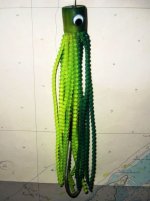
Back in 2005 I found this chap in a tackle store in Germany, totally dusty and the cardboard yellowed beyong being legible. I recon its an early MOLDCRAFT. What does your intel produce? The skirt is of a pearl shape... looks really sexy apparently to all kind of gamefish out here and retains the air bubbles smoke trail longer than straight skirts.

'tell you why it's of interest: This thing is 23,5cm of shear Marlin terror! I had bought two and only one survived till today. It catches anything from dorado, yfintuna, sails and the odd marlin. It best worked with a 10/0 mustad northern tuna decoraded a horse ballyhoo on...

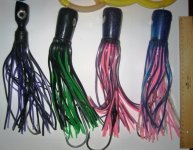
Other than that the 30,5cm super chuggers are a must in Angola. Red/black, green/black, blue/pink and purple/blue are safer as any bank!! They brought us spectacular fish into the spread trolled at speed 8 meters right behind the stern. We think the slurping sound it makes when cutting under I the signal for our seasonal marlin... myammyam.

Thanks in advance for your intel on the pearl green thingy.

Mui cordialmente,

Jan "Pargo MAN"


Attachments

  • MOLDCRAFT softhead yellowgreen.jpg
    MOLDCRAFT softhead yellowgreen.jpg
    37.1 KB · Views: 70

Pargo Man

Sealiner
... and here is the winning team of super chuggers 30,5cm.

The softknob we sometimes fish "shotgun" down the middle of the spread in early morning dusk, when it produces a better silouette than lighter colours and thanks to the angled head dives + surfaces even 30m behind the boat.


Attachments

  • Marlin Lures MOLDCRAFT 30cm 11,5inch SuperChugger und Softknob.jpg
    Marlin Lures MOLDCRAFT 30cm 11,5inch SuperChugger und Softknob.jpg
    55.2 KB · Views: 69

shagnrelease

Sealiner
ola,

I think i have one or two of those skirts somewhere, i will have a look for you!

I will send you the complete range when I get home later I have that info at the house.

send me your email address.

cheers


Top