You are using an out of date browser. It may not display this or other websites correctly.
You should upgrade or use an alternative browser.
You should upgrade or use an alternative browser.
http://www.news24.com/#1
- Thread starter Mouldz
- Start date
The correct link is: http://www.news24.com/SouthAfrica/News/Fishing-trawler-runs-aground-at-Clifton-beach-20120512
I would like to know what the Japanese trawler's purpose was. Why was it in our waters?
While fishing the Strand in the early hours of Friday morning I saw two ships' lights somewhere between Cape Point and Hangklip. It actually made me wonder again about the trawlers operating just outside False Bay...
boepens wrote:
Heard that story too. IMO they looking for coppers there!U should hear the stories of how the buggers come inshore in the transkie at night.
Makes me spit nails. Even heard how some guys have shot at them they so close.

bambooskollie
Sealiner
Just got in from watching the first attempt at pulling the long-liner free.
Didnt budge - Cable popped , was quite a vicious noise when it failed.
Epic to hear all that power from the tugs acceleration.
Next attempt will be 9ish tomorrow morning and with a swell predicted it could be interesting.
The long-liner does look well vas in the sand ....
Didnt budge - Cable popped , was quite a vicious noise when it failed.
Epic to hear all that power from the tugs acceleration.
Next attempt will be 9ish tomorrow morning and with a swell predicted it could be interesting.
The long-liner does look well vas in the sand ....
bambooskollie
Sealiner
Thanks for the heads up seeker .
Apparently there IS tuna onboard , no attempt was made to free the vessel today. Not sure why. The tow tug has been parked of Sea Point since last night .
Swell is up , position of vessel has changed slightly and it looks to be a touch closer to the beach.
Apparently there IS tuna onboard , no attempt was made to free the vessel today. Not sure why. The tow tug has been parked of Sea Point since last night .
Swell is up , position of vessel has changed slightly and it looks to be a touch closer to the beach.
subaruseun
Sealiner
ag nee
jaccil wrote:
Cargo ship stranded in False Bay
2012-05-09 09:04
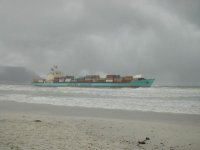
Cape Town - A Chilean cargo ship has been stranded in False Bay for seven weeks as engineers attempt to fix its engines, the Cape Times reported on Wednesday.
The Panos Earth was given permission by the SA Maritime Safety Authority (Samsa) to dock in the environmentally-sensitive bay after she experienced engine failure while sailing from Venezuela to China.
Repairs have taken so long that bills are racking up and creditors are lining up to be paid. The cost of a Smit Amandla tug and its staff, who have been ferrying supplies to the boat, is about R235 000 a day.
Samsa regional manager Dave Colly told the newspaper that if the owner could no longer pay the tug and the salvage company decided to pull out, Samsa would have to tow the ship out the bay to leave it at the mercy of salvors.
"Several creditors have put arrests on it, but at some point Samsa may have to go against the sheriff of the court. In choosing between the sheriff and a problem in False Bay, I would rather choose no problem in the bay.
"At the moment there is no direct risk, but the longer it's there, the greater the risk of something going wrong - fire, pollution."
- SAPA
The correct link is: http://www.news24.com/SouthAfrica/News/Fishing-trawler-runs-aground-at-Clifton-beach-20120512
I would like to know what the Japanese trawler's purpose was. Why was it in our waters?
While fishing the Strand in the early hours of Friday morning I saw two ships' lights somewhere between Cape Point and Hangklip. It actually made me wonder again about the trawlers operating just outside False Bay...
Cargo ship stranded in False Bay
2012-05-09 09:04
Cape Town - A Chilean cargo ship has been stranded in False Bay for seven weeks as engineers attempt to fix its engines, the Cape Times reported on Wednesday.
The Panos Earth was given permission by the SA Maritime Safety Authority (Samsa) to dock in the environmentally-sensitive bay after she experienced engine failure while sailing from Venezuela to China.
Repairs have taken so long that bills are racking up and creditors are lining up to be paid. The cost of a Smit Amandla tug and its staff, who have been ferrying supplies to the boat, is about R235 000 a day.
Samsa regional manager Dave Colly told the newspaper that if the owner could no longer pay the tug and the salvage company decided to pull out, Samsa would have to tow the ship out the bay to leave it at the mercy of salvors.
"Several creditors have put arrests on it, but at some point Samsa may have to go against the sheriff of the court. In choosing between the sheriff and a problem in False Bay, I would rather choose no problem in the bay.
"At the moment there is no direct risk, but the longer it's there, the greater the risk of something going wrong - fire, pollution."
- SAPA
Cape Town - The insurers of a cargo ship stranded in False Bay, Cape Town, intend to pull their cover for wreck removal and oil pollution at the end of May, it was reported on Friday.
The Cape Times reported that without the insurer Swedish Club's protection and indemnity cover, it was unclear who would foot the bill if something happened to the ship, Panos Earth.
The SA Maritime Safety Authority (Samsa) gave the ship permission to dock in the environmentally-sensitive bay after she experienced engine failure while sailing from Venezuela to China with a cargo of iron ore.
The permission was given on condition the ship was insured and that a Smit Amandla tug was on standby.
Samsa regional manager Dave Colly told the newspaper: "We've been caught out. They [insurers] came to us saying: 'Please can the ship come in to be repaired'. The owner never approached us. Now their risk has been taken care of. Now they're going to be on Samsa's blacklist."
The insurance company's John Owen said underwriters were not in a position to fund commercial operations, and many of the owner's problems were of a "commercial nature".
- SAPA
http://www.timeslive.co.za/local/2012/05/11/insurers-bailing-out-on-ship-stranded-in-false-bay
http://www.sealine.co.za/view_topic.php?id=72328&forum_id=1&highlight=false+bay+ship
jaccil wrote:
Hi Jaccil
Most of these boats come in to Cape Town for supplies.
They have to apply to Fisheries for a permit to traverse the EEZ. Part of the permit application is a description of the catch on board.
If they try to bull @!#$% about the catch on board then they get into trouble. I have posted a good example below.
If their catch does not accord with the requirements of international conventions then that too is noted at international conventions.
So Fisheries would be well aware of the presence of the vessel in South African waters.
Keep in mind that many of the boats fishing as far north as Angola or Mozambique come into SA for their repairs and drydocks etc.
Below is an article from a while back:
=================================
Two tons of Shark fin
March 15 2009 at 02:40pm
By Helen Bamford
[line]
A Taiwanese fishing vessel with nearly two tons of dried shark fins on board was seized at Cape Town harbour on Saturday.
The fins were confiscated by Department of Environmental Affairs inspectors and the skipper and crew of 26 face criminal charges for providing false information about their catch.
Carol Moses, spokesperson for Marine and Coastal Management (MCM), said it was clear the foreign-flagged vessel, the Chien Jui 102, had been finning. This practice involves hacking fins off live sharks and throwing them back into the sea where they either bleed to death or become prey for other sharks.
The organisation World Conservation estimates that finning causes the death of tens of millions of sharks worldwide each year.
The demand for shark fins is mostly to supply the East with shark fin soup, where it is regarded as a delicacy. Blacktip, silky and blue sharks are among those targeted.
Moses said that in terms of international regulations, the number of shark fins landed must correspond with the number of shark trunks on board.
She said that both the Indian Ocean Tuna Commission and the International Commission for the Conservation of Atlantic Tunas prescribed that the weight of the fins should not be more than 5% of the shark trunk.
Moses said the Chien Jui 102's permit had indicated they had 100kg of shark fin, 2,2 tons of shark trunk and 2 945kg of tuna on board.
But what they, in fact, had was nearly two tons of dried shark fins, which meant they should have had about 30 tons of shark trunk.
Moses said the vessel would be blacklisted for illegal, unreported and unregulated fishing and would remain in the harbour until the case had been finalised.
She said the Marine Living Resources Act made provision for a fine of up to R2 million and up to five years' imprisonment. She said the charges were still being formulated.
Moses said the vessel had been at sea since December, fishing off-shore on the high seas but had applied for an exclusive economic zone permit to enter South African waters.
"If they want to come into our waters to offload or do repairs they have to apply for a permit and provide details of their catch and the type of fishing gear they have on board."
The vessel was granted a permit on March 4 and two days later MCM inspectors boarded it at the harbour to do a spot check.
She said that should the skipper and crew be found guilty, MCM would sell the fish and the proceeds would go into the Marine Living Resources fund.
The correct link is: http://www.news24.com/SouthAfrica/News/Fishing-trawler-runs-aground-at-Clifton-beach-20120512
I would like to know what the Japanese trawler's purpose was. Why was it in our waters?
While fishing the Strand in the early hours of Friday morning I saw two ships' lights somewhere between Cape Point and Hangklip. It actually made me wonder again about the trawlers operating just outside False Bay...
Hi Jaccil
Most of these boats come in to Cape Town for supplies.
They have to apply to Fisheries for a permit to traverse the EEZ. Part of the permit application is a description of the catch on board.
If they try to bull @!#$% about the catch on board then they get into trouble. I have posted a good example below.
If their catch does not accord with the requirements of international conventions then that too is noted at international conventions.
So Fisheries would be well aware of the presence of the vessel in South African waters.
Keep in mind that many of the boats fishing as far north as Angola or Mozambique come into SA for their repairs and drydocks etc.
Below is an article from a while back:
=================================
Two tons of Shark fin
March 15 2009 at 02:40pm
By Helen Bamford
[line]
A Taiwanese fishing vessel with nearly two tons of dried shark fins on board was seized at Cape Town harbour on Saturday.
The fins were confiscated by Department of Environmental Affairs inspectors and the skipper and crew of 26 face criminal charges for providing false information about their catch.
Carol Moses, spokesperson for Marine and Coastal Management (MCM), said it was clear the foreign-flagged vessel, the Chien Jui 102, had been finning. This practice involves hacking fins off live sharks and throwing them back into the sea where they either bleed to death or become prey for other sharks.
The organisation World Conservation estimates that finning causes the death of tens of millions of sharks worldwide each year.
The demand for shark fins is mostly to supply the East with shark fin soup, where it is regarded as a delicacy. Blacktip, silky and blue sharks are among those targeted.
Moses said that in terms of international regulations, the number of shark fins landed must correspond with the number of shark trunks on board.
She said that both the Indian Ocean Tuna Commission and the International Commission for the Conservation of Atlantic Tunas prescribed that the weight of the fins should not be more than 5% of the shark trunk.
Moses said the Chien Jui 102's permit had indicated they had 100kg of shark fin, 2,2 tons of shark trunk and 2 945kg of tuna on board.
But what they, in fact, had was nearly two tons of dried shark fins, which meant they should have had about 30 tons of shark trunk.
Moses said the vessel would be blacklisted for illegal, unreported and unregulated fishing and would remain in the harbour until the case had been finalised.
She said the Marine Living Resources Act made provision for a fine of up to R2 million and up to five years' imprisonment. She said the charges were still being formulated.
Moses said the vessel had been at sea since December, fishing off-shore on the high seas but had applied for an exclusive economic zone permit to enter South African waters.
"If they want to come into our waters to offload or do repairs they have to apply for a permit and provide details of their catch and the type of fishing gear they have on board."
The vessel was granted a permit on March 4 and two days later MCM inspectors boarded it at the harbour to do a spot check.
She said that should the skipper and crew be found guilty, MCM would sell the fish and the proceeds would go into the Marine Living Resources fund.
Thanks JB, that makes sense. Hope they get the ship out of the area...
Thanks hndray, I'm became aware of the cargo ship in the bay after seeing those lights. Still made me think about the trawlers operating outside the bay though. How many tons of undersize kob and other inshore species get decimated as bycatch... While we're standing on the beach/reefs trying to catch a nice fish for the braai!
Thanks hndray, I'm became aware of the cargo ship in the bay after seeing those lights. Still made me think about the trawlers operating outside the bay though. How many tons of undersize kob and other inshore species get decimated as bycatch... While we're standing on the beach/reefs trying to catch a nice fish for the braai!
Mike Smith
Sealiner
marine69 wrote:
I can answer that question - Imagine the captain and the navigator stumbling to the bows after the ship ran aground, pitching an empty wine bottle overboard and shouting to the people on the beach: "WHERE DOUGLAS GREEN"?I'd love to know how they landed up there with a working radar system????????
http://news.howzit.msn.com/fishing-trawler-runs-aground-in-clifton
marine69 wrote:
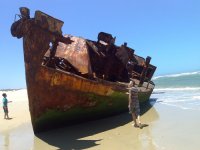
Half the time they drunk as skunks,I worked in the fire dept years ago and a Taiwanese crayfish boat ran aground at Boknes,when we got there at about 8 that night in pitch black ,the boat was about 50m off shore,we found the crew in a life raft drifting about 10m parallel to the beach,they were all so dronk they could not even see the beach,the skipper on watch fell asleep and only woke up when the ship "bumped" into Africa,whats left of the wreck is still there
I'd love to know how they landed up there with a working radar system????????
http://news.howzit.msn.com/fishing-trawler-runs-aground-in-clifton
Half the time they drunk as skunks,I worked in the fire dept years ago and a Taiwanese crayfish boat ran aground at Boknes,when we got there at about 8 that night in pitch black ,the boat was about 50m off shore,we found the crew in a life raft drifting about 10m parallel to the beach,they were all so dronk they could not even see the beach,the skipper on watch fell asleep and only woke up when the ship "bumped" into Africa,whats left of the wreck is still there