
You are using an out of date browser. It may not display this or other websites correctly.
You should upgrade or use an alternative browser.
You should upgrade or use an alternative browser.
How is the test curve of a fishing rod determined
- Thread starter Otto
- Start date
Rod actions and test curves
In the main there are three different types of rod action: Tip action (sometimes called Fast Action, or FA), tip-to-middle action and through action.
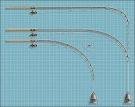
You can clearly see the different action styles in the diagram, showing how each rod bends when placed under pressure.
Fast action rods are the best for picking line up quickly on the strike because the middle and the butt sections remain fairly straight while the tip section will bend quickly to absorb the shock of setting the hook into a fish. They are also the best for casting as the main section of rod offers tremendous power, while the ‘whippy’ tip will help flick the rig out.
Most rods on the market have tip-to-middle actions, meaning that the rod will bend easily from the tip to the middle section of the rod to absorb any lunges of hooked fish, then when this area of the rod reaches full compression the middle to butt section will begin to release its power and start to bend.
Through action rods bend from the tip right through to the butt. There aren’t that many through action rods available nowadays. Avon rods tend to have through actions though, in keeping with their traditional roots. These actions don’t lend themselves to long distance casts, but then again most Avon rods are intended for use on rivers anyway, where short casts are the norm.
You may well have heard the phrase ‘progressive action’. This means that the power comes into the rod progressively as the rod bends from the tip. A true progressive blank will increase the power equally as the tip is pulled round. Some even bend in the handle, when placed under extreme pressure.
The top-most rod has a tip action (or fast action) which means that the middle and butt sections remain absolutely rigid while the tip bends through the 90 degree curve.
The rod in the middle has a tip-to-middle action – the butt section remains rigid while the other two sections bend through 90 degrees as the weight pulls down on the rod.
The bottom-most rod has a through action – like most Avon rods. It bends right through the blank as the weight pulls down on the tip.
Attachments
a Pound test curve rating has nothing to do with the rod action
It is determined by clamping a rod parallel to the ground and then determining what weight is needed to pull the tip around 90 degrees, ie till it points to the ground if it takes 3lbs then the Test curve is 3lbs
The dipping rod is not rated on test curve, only carp rods are rated by test curve
It is determined by clamping a rod parallel to the ground and then determining what weight is needed to pull the tip around 90 degrees, ie till it points to the ground if it takes 3lbs then the Test curve is 3lbs
The dipping rod is not rated on test curve, only carp rods are rated by test curve
A Test Curve of a fishing rod is the standard way to determine the power and strength of a carp or a specialist fishing rod.
Test Curves are measured in pounds and ounces.
To calculate the test curve of a rod, the rod is placed horizontally and weights are added to the tip of the rod until the tip has bent through 90 degrees (until the tip points directly to the ground).
If a carp rod takes 2.5lb of weight to bend it through 90 degrees, then it will subsequently have a test curve of 2.5lb.
Most carp rods sold have 2.75lb test curves, but rods from 1lb through to 5lb test curve are available.
Got it ZP, just I had a bit more background on the question which didn't come out because it was answered almost at the same time you did.
Your second part of the answer answered the context of the question but the rod he's referring to is a 14'6" T60 2-5oz Surfcasting blank so test curves become irrelevant there
Your second part of the answer answered the context of the question but the rod he's referring to is a 14'6" T60 2-5oz Surfcasting blank so test curves become irrelevant there