
Cuban Cigar
Sealiner
Ever since the Trini A series was launched in South Africa, I really wanted one, BUT every time I casted one owned by one of my fishing buddies, I found the reel to be simply too fast for my own casting abilities.
I (and the reel's owners) mostly had to put a lot of pressure on the cast control knob, to prevent the superfast spool (without any help from a centrifugal brake), from running the sinker and bait in from behind when attempting to make a powerful cast.
If you look at the spool of the Trini A from above, you will also notice that it doesn't have a pronounced shoulder like e.g. the original non- centrifugal Grandwaves and this make controlling the spool with a educated thumb not all that easy. This was probably to gain line capacity in these compact reels.
If you look at my original old Grandwave 40, the gold anodising is completely worn from the left shoulder of the spool due to all the "riding the thumb" that was needed to control that old reel that was rather fast and tricky before it was magged as well.
After lots of test-casting to figure out a range of magbrakes for different other popular model reels, I thought that it was the right time to also tackle the Trini A series, as I still wanted one for myself rather badly, so I bought a 16A and my buddy pulled the trigger on a 14A, even before I had the first prototype on my own reel sorted.
After we magged a couple of his other reels, he was so confident that we will be able to sort it, that he stuck his neck out by swiping his card to cash in on the last old stock 14A he could find !
Now the biggest difference between the older gold generation Trinis and the A Series, is that the A makes use of a one-piece frame and does not have a removable leftside sideplate. This allows that compact lefside, so that you can grip the reel very securely when casting, without having large hands, but means that you have to take the reel apart completely to get to the inside of the frame and then the spool.
You even have to break down the dragstack and lift off the anti reverse gear from the driveshaft, as the last two retaining screws that attach the black inner chassis to the frame, is situated underneath this !
All that said and done, the Trini A's responded very nicely to the magbrake treatment and most owners of the bunch of 14/16/20/30A's we have done sice, reported back that they can now cast their reels with real power and distance, with the spool set to have a small amount of sideplay when the clutch lever is pulled back and without having to control the spool by thumb during the flight part of the cast, obviously you still stop the spool by thumb when the sinker/bait lands - and this with the factory grease removed from the spool bearings and then relubed with ReelX or similar. In this way, the spool is controlled only by the magforce which supply a smooth, silent control and not by means of any mechanical bridge between spool and frame, like what would be the case with control by spool tension knob, centrifugal brakes or educated thumb.
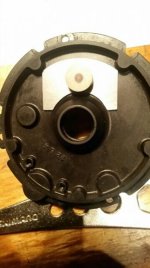
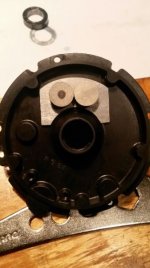
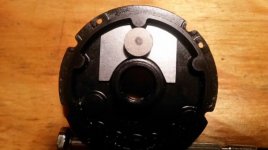
I will tell a bit about the adjustability, once I posted a few photos.....
Cheers !
I (and the reel's owners) mostly had to put a lot of pressure on the cast control knob, to prevent the superfast spool (without any help from a centrifugal brake), from running the sinker and bait in from behind when attempting to make a powerful cast.
If you look at the spool of the Trini A from above, you will also notice that it doesn't have a pronounced shoulder like e.g. the original non- centrifugal Grandwaves and this make controlling the spool with a educated thumb not all that easy. This was probably to gain line capacity in these compact reels.
If you look at my original old Grandwave 40, the gold anodising is completely worn from the left shoulder of the spool due to all the "riding the thumb" that was needed to control that old reel that was rather fast and tricky before it was magged as well.
After lots of test-casting to figure out a range of magbrakes for different other popular model reels, I thought that it was the right time to also tackle the Trini A series, as I still wanted one for myself rather badly, so I bought a 16A and my buddy pulled the trigger on a 14A, even before I had the first prototype on my own reel sorted.
After we magged a couple of his other reels, he was so confident that we will be able to sort it, that he stuck his neck out by swiping his card to cash in on the last old stock 14A he could find !
Now the biggest difference between the older gold generation Trinis and the A Series, is that the A makes use of a one-piece frame and does not have a removable leftside sideplate. This allows that compact lefside, so that you can grip the reel very securely when casting, without having large hands, but means that you have to take the reel apart completely to get to the inside of the frame and then the spool.
You even have to break down the dragstack and lift off the anti reverse gear from the driveshaft, as the last two retaining screws that attach the black inner chassis to the frame, is situated underneath this !
All that said and done, the Trini A's responded very nicely to the magbrake treatment and most owners of the bunch of 14/16/20/30A's we have done sice, reported back that they can now cast their reels with real power and distance, with the spool set to have a small amount of sideplay when the clutch lever is pulled back and without having to control the spool by thumb during the flight part of the cast, obviously you still stop the spool by thumb when the sinker/bait lands - and this with the factory grease removed from the spool bearings and then relubed with ReelX or similar. In this way, the spool is controlled only by the magforce which supply a smooth, silent control and not by means of any mechanical bridge between spool and frame, like what would be the case with control by spool tension knob, centrifugal brakes or educated thumb.
I will tell a bit about the adjustability, once I posted a few photos.....
Cheers !





 ... holistically we fish way harder than them and an uncontrolable reel for them is putty in our hands. I think that exact sentiment sums up reel usage. Some people can do without certain qualities in a reel as their muscle memory in terms of their casting style favours the way their reel is set up to achieve maximum distance and smoothness in casting. Be it mag or centrifugal.