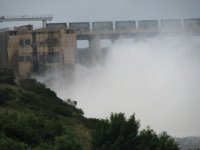
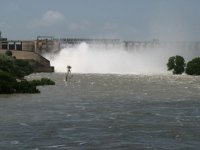
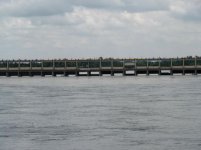
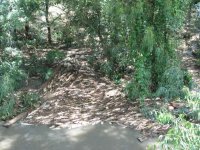
Hi Guys fourth time trying to post this. I went to Barrage yesterday to check out the level of the Vaal river because most of the Vaal dam sluices are open. Was met with quite a stench because of 1000's of dead fish. These photos are of one spot not more than 30 meters long. I was told that it looks the same in all of the bays and coves and any obsticle, where fish the dead fish can be pushed to, for kilometers down river. I am having difficulty in posting pic because of my 3G reception. If I don't come right now I will post tomorrow.

You are using an out of date browser. It may not display this or other websites correctly.
You should upgrade or use an alternative browser.
You should upgrade or use an alternative browser.
Dead fish at Barrage, Vaal triangle
- Thread starter ChrisBoon
- Start date
ChrisBoon wrote:
 ) starts to settle on the bottom. As soon as the river really pumps, this muck/sludge gets churned up and effectively poisons the fish. So instead of clean water rushing down, its more like toxic waste. A friend of mine went to a venue just befor Parys last week, and its the same there. Frightening stuff.

Hi Chris. This unfortunately happens when the vaal gets heavily flooded as is currently happening. Basically, the rotting plant matter, and all the other muck that eventually ends in the Vaal (all those sewage spills as wellHi Guys fourth time trying to post this. I went to Barrage yesterday to check out the level of the Vaal river because most of the Vaal dam sluices are open. Was met with quite a stench because of 1000's of dead fish. These photos are of one spot not more than 30 meters long. I was told that it looks the same in all of the bays and coves and any obsticle, where fish the dead fish can be pushed to, for kilometers down river. I am having difficulty in posting pic because of my 3G reception. If I don't come right now I will post tomorrow.
) starts to settle on the bottom. As soon as the river really pumps, this muck/sludge gets churned up and effectively poisons the fish. So instead of clean water rushing down, its more like toxic waste. A friend of mine went to a venue just befor Parys last week, and its the same there. Frightening stuff.Andre Laas
Sealiner
This can be due to a number of things and most likely due to the synergistic effects of multiple factors.
As Rory said, with this type of flooding, everything that have settled to the bottom over time will be churned up back into suspension. Added to this is all the muck resulting from surface run-off caused by the high rainfall. This will also include a variety substances that can be toxic to fish.
The number of suspended particles in the water is another big problem for any gill-breathing organism in the water. These particles will get caught up in the fine mesh that makes up gills, thereby significantly reducing the surface area available for gas exchange and thus breathing. under normal conditions this also happens, but fish can generally clear the gills with a "coughing" motion that forces more water the gills at a higher rate, dislodging particles stuck in the gills. One of the theories of why fish jump is that they may use the jump to force water and bubbles through the gills to get rid of irritants.
Another possible factor is that with the water movement, sediment upwelling and run-off, the concentration of dissolved substances in the water will increase. Basic water chemistry will tell you that the more dissolved substances you have in the water, the less oxygen will dissolve in the water. Thus, the oxygen concentration in the water will be less than under normal conditions, even with heavy aeration of the water, the dissolved substances will prevent more oxygen from dissolving into the water.
Now for the synergistic effects on the fish....... Imagine a fish in the flooded river.... you must swim much harder than normal due to the speed of the current, and you are constantly bombarded with all kinds of hard and nasty objects coming at you at high speed, and you cant see them coming because of the dirty water and your general poor eyesight. Thus you are working much harder to just keep your position in the water, never mind getting out of trouble, so you are breathing much harder. Apart from your muscles screaming for more oxygen, and you breathing as fast as you can, you suddenly find that there is too little oxygen in the water, and there are also a number of substances in the water that makes you feel sick and weak. On top of that your gills are being packed full of fine particles, and a cough only helps for a second or two.... You finally manage to get into a quite patch out of the main stream, where you can try and re-recuperate, but you find that millions of others have the same idea and soon the "save-haven" is over crowded and with every breath you breath in more and more waste products produced by the same bunch around you that are sucking up the last bit of oxygen in the pool.............and then you pass out, never to awaken again...
Thanks for that fish-eye view critter!
I see you in Westville too, the Palmiet river has been flooding a bit lately and there were some nice fish in the water... I am assuming they have all been fushed out or are dead by now too due to what you mention above.
Any idea on the water quality in the Palmiet?
Thanks in advance...
Den
I see you in Westville too, the Palmiet river has been flooding a bit lately and there were some nice fish in the water... I am assuming they have all been fushed out or are dead by now too due to what you mention above.
Any idea on the water quality in the Palmiet?
Thanks in advance...
Den
Andre Laas
Sealiner
Denfish wrote:
It seems that the Palmiet floods fairly regularly. The fish seem to somehow find a way to either remain in some areas, or find their way back after flooding. The big difference is however that the Palmiet is probably much healthier than the Vaal, and the flooding usually don't last long. But I must admit that I do not know too much about this system.
Based purely on visual observations, the water quality of the Palmiet is rather good. The water is mostly very clear, and there is a lot of aquatic insects amongst the rocks and submerged plant matter. It would however be really interesting to investigate that little river in more detail, especially as to the species and numbers of fish. So far I have only seen tillapia's (I think it is "bloukurpers").
Hi DenThanks for that fish-eye view critter!
I see you in Westville too, the Palmiet river has been flooding a bit lately and there were some nice fish in the water... I am assuming they have all been fushed out or are dead by now too due to what you mention above.
Any idea on the water quality in the Palmiet?
Thanks in advance...
Den
It seems that the Palmiet floods fairly regularly. The fish seem to somehow find a way to either remain in some areas, or find their way back after flooding. The big difference is however that the Palmiet is probably much healthier than the Vaal, and the flooding usually don't last long. But I must admit that I do not know too much about this system.
Based purely on visual observations, the water quality of the Palmiet is rather good. The water is mostly very clear, and there is a lot of aquatic insects amongst the rocks and submerged plant matter. It would however be really interesting to investigate that little river in more detail, especially as to the species and numbers of fish. So far I have only seen tillapia's (I think it is "bloukurpers").
Sorry for hijacking your post Chris...
Thanks Critter...
So lots of aquatic insects in the water are a good indication of water quality? There are also shrimps in the water...
Fish species I have seen are blue tilapia, scalies and plenty green swordtails. Recently (before the first major storm in December) I spotted my first Vlei kurpers, before the storm there were also lots of schools of what I can only assume were young scalies, or perhaps some sort of minnow. Small silver fish with three dark spots on the sides.
Thanks again!

Andre Laas
Sealiner
Sorry for the semi-high-jack Chris.
Denfish, a variety and high numbers of aquatic insects is a good indication of good water quality. Large numbers of a single insect family may indicate that there is some sort of problem. There is a system called the South African Scoring System (SASS) that uses the presence and abundance of aquatic invertebrate families to assess the water quality of the river or stream. Each family has a "sensitivity score" which basically means that a highly sensitive family (like some dragonflies) will have a high score (5) and a family that can handle poor water quality like the "aquatic earthworms" will score low (1). Based on the tally of scores of families present, you get a total score that gives a fairly accurate indication of water and habitat quality.
Denfish, a variety and high numbers of aquatic insects is a good indication of good water quality. Large numbers of a single insect family may indicate that there is some sort of problem. There is a system called the South African Scoring System (SASS) that uses the presence and abundance of aquatic invertebrate families to assess the water quality of the river or stream. Each family has a "sensitivity score" which basically means that a highly sensitive family (like some dragonflies) will have a high score (5) and a family that can handle poor water quality like the "aquatic earthworms" will score low (1). Based on the tally of scores of families present, you get a total score that gives a fairly accurate indication of water and habitat quality.
Andre Laas
Sealiner
The Power of water is incredible!!! The same substance that makes life on earth possible, can just as easily take lives!