Controling bleeding after shark attack

jmalan

New member
It is always sad to loose a fellow spearo. The most common cause of death after shark attacks is bloodloss, especially with upperleg wounds. I urge everybody to watch this link(my abilities did not allow me to post the clip directly). This is the best equipment you can have to save you buddy's life.

www.youtube.com/watch?v=_XSiwYZ-Vvs
 

landshark

Senior Member
Hi jmalan,

Very good to know. Many thanks for this.

I have embedded the movie for easier access.

[flash=425,344]http://www.youtube.com/v/_XSiwYZ-Vvs&hl=en&fs=1[/flash]
 
Nice link.

One thing to remember, that as spearos' we have ample equipment on the boat to make a tourniquet...Float lines, speargun bungies etc. That should help in controlling the bleeding of an injured person.
 

jmalan

New member
Tourniquetes can work on fore-arms and lowerlegs, but they can cause a lot of tissue damage, even lead to gangrene, if not managed correctly.

An upper-arm and upperleg injury will only respond to direct pressure over the big arteries. Even the tightest tourniquete will not controle the bleeding sufficiently.
 

landshark

Senior Member
Another question.

Let's say my dive buddy got chowed on the leg (seems like one of the favourite spots). Would it be better to remove (cut away) his wetsuit or leave it on.

My thinking is:

Cutting away the suit would potentially have the benefit of removing the pressure of the suit which is possibly forcing more blood to the area which has been damaged.

OR

Not removing the suit will help with keeping the person warm.
 
I would say leave the wetsuit on untill you with quailified medical personall, surely having the neoprene around the wound will help in controlling the bleeding by creating a clot of some sort?
 
I would say leave the wetsuit on untill you with quailified medical personall, surely having the neoprene around the wound will help in controlling the bleeding by creating a clot of some sort?
 

jace

Senior Member
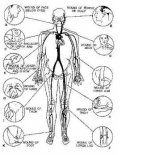
Here are pressure points for the rest of the body
 

Attachments

  • pressure points.JPG
    pressure points.JPG
    27.6 KB · Views: 384

jace

Senior Member
landshark wrote:
Another question.

Let's say my dive buddy got chowed on the leg (seems like one of the favourite spots). Would it be better to remove (cut away) his wetsuit or leave it on.

My thinking is:

Cutting away the suit would potentially have the benefit of removing the pressure of the suit which is possibly forcing more blood to the area which has been damaged.

OR

Not removing the suit will help with keeping the person warm.


Direct Pressure on the wound and pressure on pressure points will help

Note we have about 5.5 lites of blood. A femoral artery bleed will leave you unconscious within 30 secs and dead within 3 to 5 minutes.Speed is necessary. Do not be shy about putting your hand into the wound to stop the bleeding.
 

Fluffy

Senior Member
jace wrote:
landshark wrote:
Another question.

Let's say my dive buddy got chowed on the leg (seems like one of the favourite spots). Would it be better to remove (cut away) his wetsuit or leave it on.

My thinking is:

Cutting away the suit would potentially have the benefit of removing the pressure of the suit which is possibly forcing more blood to the area which has been damaged.

OR

Not removing the suit will help with keeping the person warm.


Direct Pressure on the wound and pressure on pressure points will help

Note we have about 5.5 lites of blood. A femoral artery bleed will leave you unconscious within 30 secs and dead within 3 to 5 minutes.Speed is necessary. Do not be shy about putting your hand into the wound to stop the bleeding.
Willer as die wildtuin!!
 

christob

New member
Leave the wetsuit on, apply direct pressure to the wound and if you can get to the pressure point then that is great as well. The big thing with shark attacks is to keep the person in one position on the beach and not to try and move them. The paramedics will not move the person until they are stabilised as it has been found that moving them without being stable has bad outcomes!
Get medical assistance ASAP so that they can control the bleed and get drips up and then move for a surgical intervention!
 

Corry

New member
While tourniquets will help for small artery bleeds they won't for large arteries like the femoral.

For a partially severed artery some direct pressure on the cut on the artery will stem blood loss as the blood will still carry on through the rest of the leg into the veins and back to the heart.

However, only a clamp or a finger plugged directly into the artery will be sufficient for a completely severed artery. Then one still has to be aware of the pressure, it is unbelievable and not merely a trickle. In a case such as this the person will probably lose the affected limb as bloodflow is completely cut off but the only alternative is death.

What "worsens" the situation is that the body goes into shock and it responds by causing all the peripheral vessels to contract and the heart rate and force of contraction to increase leading to an increase in BP and quickening blood loss.

It is sad that incidents such as these force us to take stock and realise we are not invincible.

Have you and/or your buddies done a first aid course?
Does your or your mate's boat have a adequate first aid kit?
Do you and your dive buddies know how to handle a diver who had a SWB? e.g. like blowing on the person's face to re-initiate the breathing reflex if the diver was eihter on or brought to the surface immediately after blacking out.

Strangely most folk would probably answer "No" to all of the above yet make no bones about it, this is a very dangerous sport.
 

braailegend

Senior Member
When we did first aid course, and you have major bleeding like that, you must grab the artery and pinch it close. Meaning if it retracted, you must stick your finger in to find it and close it.
Tourniquetes are not as effective as people might think and on smaller wounds you may causes alot more damage than good, may even cost a limb or life, where it may not have been nesesary. Main thing is pressure on wound and for big losses, get the artery.
 

Sandmann

New member
The other thing to remember is that once you start applying dressings, bandages or any other pressure pads onto the wound, never take it off.
Keep adding onto it, or over it.
There are two major reasons for this.
1- if you are lucky and the blood starts to clot, then by removing the dressings will only cause the wound to bleed all over again.
2- the medics and doctors need to estimate the loss of blood to ensure that sufficient replacements are added back into the body. They can use the rags, pads and dressing to judge the amount.

Remember in an attack it will be life over limb.
It is better to loose a leg than a life!! do what you have to on scene to try and help.

To get the full effect of a tourniquets on the femoral artery, place an object under the tourniquet like a pen or any other small hard thing you can find on a boat to increase the downward pressure into the leg.
I would even use a big cable tie if it will stop the bleeding in time.

And remember to panic slowly yourself!!!

Gangrene can be cured- to an extent, but not death.

It is not a nice topic, but one that is valuable in all accidents.
 
There are two courses of action that work best for massive haemorrhage.

Traumatic amputation of limb - apply a tourniquet above the injury site. A lot of people tend to under tighten a tourniquet and it therefore is ineffective. In order for a torniquet to be applied properly , it generally needs to cause the victim pain. That's how tight it needs to be applied.

For all other bites - apply combination of pressure point (brachial artery for arm lacerations) and (femoral for leg lacerations) and direct pressure over wound by any means available. Hand or pressure dressing.

In most cases the water temperature plays a big role too, as in colder conditions, your body's blood vessels naturally constrict to keep warmth in the core of your body (where heart and lungs are located). Constriction of blood vessels = less bleeding and better blood pressure. Do not over warm these victims, because the response to excessive heat production is vasodilation (dilation of blood vessels causing rush of blood to injury site and more bleeding).

I know from personal experience that treating a shark attack victim is stressful. Add in the stress and bereavement of it being a friend and you multiply the stress levels by 100. Fortunately the people I have treated were strangers to me (although being a surfer myself certainly added to the emotional factor).

The most important thing is to keep a clear head and to make sure you are prepared. Personally, I think that the onus is on the individual dive team to ensure that they have an adequate emergency kit  onboard. To be realistic, one's required for vessel COF are totally inadequate for a serious injury. 

Adding a few items to these kits could make such a huge difference. I am more than happy to discuss further.
 
Top