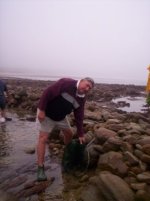
BEACHCOMBERS have been subsistence fishing in ancient semi-circle stonewall fish traps, known locally as vywers, along the Stilbaai coast for generations, although without official sanction.
The fishermen and their predecessors have been keeping the structures, which are made of rocks, packed tightly in a specific design, in working order for more than 100 years, thereby maintaining one of only two working vywers in the country.
The Stilbaai vywers and a fish trap in Arniston are the only two remaining stone technology traps in South Africa.
Since the proclamation of the Stilbaai Marine Protected Area last November, however, the fishermen have not been allowed to take fish home.
They have abandoned their task, leaving the archaeological heritage in danger of being pummeled by the ocean into a pile of rocks.
Roodt Cronje and his team of fishermen, who for years made sure the half-moon rock formations remained in tact after the rough spring high tides, would net whatever fish remained in the traps, harvesting them before dawn on the low spring tide.
Earlier this month, roleplayers met to find a compromise between conserving the coastline, fish stocks and the archaeological heritage of the fish traps.
Cape Nature spokesman Jean du Plessis said the roleplayers wanted to conserve the fish traps, but this would have to be done within the framework of the Stilbaai MPA, which contained specific regulations.
“For Cape Nature and Marine and Coastal Management, it is important marine resources and cultural heritage be managed and conserved in a sustainable manner,†he said.
Du Plessis said during the meeting it was decided it would be acceptable if the fishermen caught only mullet and returned other fish to the sea.
A permit would have to be issued for this purpose and a monitor would have to accompany the fisherman to capture scientific data.
Other suggestions included that only fish nets up to 10m should be allowed, and that maintenance of the fish traps needed to be managed by Marine and Coastal Management and the South-African Heritage Resource Agency.
Working fish traps would have to include a sluice structure to allow fish to escape back to the ocean.
Cronje said he was not happy with the state of the fish traps, where the ocean had knocked down some of the stone walls.
“The ocean has knoBEACHCOMBERS have been subsistence fishing in ancient semi-circle stonewall fish traps, known locally as vywers, along the Stilbaai coast for generations, although without official sanction.
The fishermen and their predecessors have been keeping the structures, which are made of rocks, packed tightly in a specific design, in working order for more than 100 years, thereby maintaining one of only two working vywers in the country.
The Stilbaai vywers and a fish trap in Arniston are the only two remaining stone technology traps in South Africa.
Since the proclamation of the Stilbaai Marine Protected Area last November, however, the fishermen have not been allowed to take fish home.
They have abandoned their task, leaving the archaeological heritage in danger of being pummeled by the ocean into a pile of rocks.
Roodt Cronje and his team of fishermen, who for years made sure the half-moon rock formations remained in tact after the rough spring high tides, would net whatever fish remained in the traps, harvesting them before dawn on the low spring tide.
Earlier this month, roleplayers met to find a compromise between conserving the coastline, fish stocks and the archaeological heritage of the fish traps.
Cape Nature spokesman Jean du Plessis said the roleplayers wanted to conserve the fish traps, but this would have to be done within the framework of the Stilbaai MPA, which contained specific regulations.
“For Cape Nature and Marine and Coastal Management, it is important marine resources and cultural heritage be managed and conserved in a sustainable manner,†he said.
Du Plessis said during the meeting it was decided it would be acceptable if the fishermen caught only mullet and returned other fish to the sea.
A permit would have to be issued for this purpose and a monitor would have to accompany the fisherman to capture scientific data.
Other suggestions included that only fish nets up to 10m should be allowed, and that maintenance of the fish traps needed to be managed by Marine and Coastal Management and the South-African Heritage Resource Agency.
Working fish traps would have to include a sluice structure to allow fish to escape back to the ocean.
Cronje said he was not happy with the state of the fish traps, where the ocean had knocked down some of the stone walls.
“The ocean has knocked down our hard work and the proclamation of the marine protected area has contributed to that. We have been chased away by the laws and are being watched like hawks,†he said.
He dismissed claims fish were getting hurt and that certain stocks could be eradicated.
“We don‘t catch every time, and the mullet only run from May to October,†he said, adding the nets did not harm the fish as the weave was big enough to allow the undersized fish to escape.
“To compare what we catch in the vywers to what is caught in the deep sea is like comparing a grain of sand to the Sahara desert,†he said.
cked down our hard work and the proclamation of the marine protected area has contributed to that. We have been chased away by the laws and are being watched like hawks,†he said.
He dismissed claims fish were getting hurt and that certain stocks could be eradicated.
“We don‘t catch every time, and the mullet only run from May to October,†he said, adding the nets did not harm the fish as the weave was big enough to allow the undersized fish to escape.
“To compare what we catch in the vywers to what is caught in the deep sea is like comparing a grain of sand to the Sahara desert,†he said.
The fishermen and their predecessors have been keeping the structures, which are made of rocks, packed tightly in a specific design, in working order for more than 100 years, thereby maintaining one of only two working vywers in the country.
The Stilbaai vywers and a fish trap in Arniston are the only two remaining stone technology traps in South Africa.
Since the proclamation of the Stilbaai Marine Protected Area last November, however, the fishermen have not been allowed to take fish home.
They have abandoned their task, leaving the archaeological heritage in danger of being pummeled by the ocean into a pile of rocks.
Roodt Cronje and his team of fishermen, who for years made sure the half-moon rock formations remained in tact after the rough spring high tides, would net whatever fish remained in the traps, harvesting them before dawn on the low spring tide.
Earlier this month, roleplayers met to find a compromise between conserving the coastline, fish stocks and the archaeological heritage of the fish traps.
Cape Nature spokesman Jean du Plessis said the roleplayers wanted to conserve the fish traps, but this would have to be done within the framework of the Stilbaai MPA, which contained specific regulations.
“For Cape Nature and Marine and Coastal Management, it is important marine resources and cultural heritage be managed and conserved in a sustainable manner,†he said.
Du Plessis said during the meeting it was decided it would be acceptable if the fishermen caught only mullet and returned other fish to the sea.
A permit would have to be issued for this purpose and a monitor would have to accompany the fisherman to capture scientific data.
Other suggestions included that only fish nets up to 10m should be allowed, and that maintenance of the fish traps needed to be managed by Marine and Coastal Management and the South-African Heritage Resource Agency.
Working fish traps would have to include a sluice structure to allow fish to escape back to the ocean.
Cronje said he was not happy with the state of the fish traps, where the ocean had knocked down some of the stone walls.
“The ocean has knoBEACHCOMBERS have been subsistence fishing in ancient semi-circle stonewall fish traps, known locally as vywers, along the Stilbaai coast for generations, although without official sanction.
The fishermen and their predecessors have been keeping the structures, which are made of rocks, packed tightly in a specific design, in working order for more than 100 years, thereby maintaining one of only two working vywers in the country.
The Stilbaai vywers and a fish trap in Arniston are the only two remaining stone technology traps in South Africa.
Since the proclamation of the Stilbaai Marine Protected Area last November, however, the fishermen have not been allowed to take fish home.
They have abandoned their task, leaving the archaeological heritage in danger of being pummeled by the ocean into a pile of rocks.
Roodt Cronje and his team of fishermen, who for years made sure the half-moon rock formations remained in tact after the rough spring high tides, would net whatever fish remained in the traps, harvesting them before dawn on the low spring tide.
Earlier this month, roleplayers met to find a compromise between conserving the coastline, fish stocks and the archaeological heritage of the fish traps.
Cape Nature spokesman Jean du Plessis said the roleplayers wanted to conserve the fish traps, but this would have to be done within the framework of the Stilbaai MPA, which contained specific regulations.
“For Cape Nature and Marine and Coastal Management, it is important marine resources and cultural heritage be managed and conserved in a sustainable manner,†he said.
Du Plessis said during the meeting it was decided it would be acceptable if the fishermen caught only mullet and returned other fish to the sea.
A permit would have to be issued for this purpose and a monitor would have to accompany the fisherman to capture scientific data.
Other suggestions included that only fish nets up to 10m should be allowed, and that maintenance of the fish traps needed to be managed by Marine and Coastal Management and the South-African Heritage Resource Agency.
Working fish traps would have to include a sluice structure to allow fish to escape back to the ocean.
Cronje said he was not happy with the state of the fish traps, where the ocean had knocked down some of the stone walls.
“The ocean has knocked down our hard work and the proclamation of the marine protected area has contributed to that. We have been chased away by the laws and are being watched like hawks,†he said.
He dismissed claims fish were getting hurt and that certain stocks could be eradicated.
“We don‘t catch every time, and the mullet only run from May to October,†he said, adding the nets did not harm the fish as the weave was big enough to allow the undersized fish to escape.
“To compare what we catch in the vywers to what is caught in the deep sea is like comparing a grain of sand to the Sahara desert,†he said.
cked down our hard work and the proclamation of the marine protected area has contributed to that. We have been chased away by the laws and are being watched like hawks,†he said.
He dismissed claims fish were getting hurt and that certain stocks could be eradicated.
“We don‘t catch every time, and the mullet only run from May to October,†he said, adding the nets did not harm the fish as the weave was big enough to allow the undersized fish to escape.
“To compare what we catch in the vywers to what is caught in the deep sea is like comparing a grain of sand to the Sahara desert,†he said.