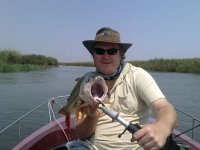
Okavango fishing report

svrooyen

New member
We recently had an extended trip to the Okavango panhandle, a trip I get to do about 4 times a year as it is the closest body of water.

We arrived at Sepopa swamp stop late on the 20th of September, for this time of the year it was pleasantly cool. Setup camp, and checked in. The following day we got a late start due to having to launch the boat. We launched fueled up, tackled up and off we went. With it being cool we were not expecting too much, this time of year the delta is known for a phenomenon we locals call the barble run.

We were practically guaranteed to find fish, traveling upstream about 10km we found our first run, and its a spectacular site, water boiling with fish and most predatory fish tacking part in the frenzy.

There are two major targets on these runs, one being the barble or catfish the other being the mighty tigerfish, which we were targeting.

First cast fish on 2.5km tiger...second cast 2.7kg tiger and so it went with a few breaking the 3kg barrier, but non under 2kg. The run eventually moved into a lagoon and then on under the lapirus. This forced us on to looking for another run, which we found not far ahead, moving two bends upstream. Again we were onto big ones, nailing fish after fish on practically every cast.

With it being close to midday we decided to head back to camp and take a break off the water since we would be there some time, and didnt want to burn.

Day2

Headed out to find the same runs again with some success, both the runs moved under the papyrus, forcing us to move on, luckily Sepopa has a loop system and one can travel a full circle and end up back at camp, so we decided to do the trip which takes us upstream for about 20min then into a channel known as the philipa. Once entering the philipa we headed down stream and found a run about 15km from the last run. Again hookups on every cast, but the fish on this run seemed to be larger, averaging 3kg. After landing a couple, I hooked up on a monster, reel screeching and with only having 4kg line on I prayed that it would hold which it did but to my dismay the wire trace did not.

I dont know how but the tiger managed to chew through the wire, and took off with my prized lure. I figured that since the lure I had on was working so well, I'd put another on. Put it on, cast again landed more in the 3kilo range. Then again another monster hit, and this time my prayers did not work...zzzz zzzz zzzz tik...the line snapped. Now highly pissed at loosing another of my prized lures, decided to switch to two bladed copper effzet.

These worked just as good, but with the line being too weak I was loosing too many, and we decided to move on to camp which is another 15 minutes down stream, then another 30min back up another channel.

Back at camp, we we enjoyed a sundowner on the deck overlooking the river taking in the splendor that is the delta.

To be continued.
 

svrooyen

New member
When preparing for the following days trip I noticed that we were running low on fuel, so only decided to go half day.  We headed back up to the runs near camp, and enjoyed hookup after hookup.

Even though it was now starting to heat up, we were still catching, the sun started to peer through the dust and layer of high altitude clouds. We were going to be in for a scorcher, luckily we decided on only half day, because by mid day the mercury was tipping at 41degrees.

We headed back to camp, when I decided I'd do a fuel run.  Knowing the closest source of fuel was dry for the past 3+ months decided to make a run to Gumare, a trek of about 100km.  Loaded up tanks and off we went.  Arrived in Gumare after traveling the worst road imaginable sections only wide enough for 1 vehicle and on top of that pot holes that could peel a tire right of the rim.

I did not have many containers so looked in the local "supermarket" found a couple, filled em up, and now we were in search of fresh bread which the local "supermarket" did not have.  We were directed to a residential area, which had a "bakery" with freshly baked buns, no bread though. 

The buns were delicious straight up.

We now had our fuel and bread, we headed back to camp, to enjoy another sunset on the Okavango.

The following day we went out for a full day, doing what we call the philipa again, we skipped the first runs, as they were not yielding fish anymore, and went on to the large run on the philipa channel. Fishing on this run was still good, but not nearly as productive as the previous days.  This I could attribute to the increased air temperature and the decreased water temperature which had dropped by 2 deg.

On this day trip we decided to explore islands and possibly investigate options of camping on them in the future.

We headed on to the next run, and these were also no longer yielding any tigers, however if one wanted to catch barble then casting a lure in the bubbling water would most certainly land you a fish varying in size from 1kg to 15kg+
 

Attachments

  • 10112012355.jpg
    10112012355.jpg
    72.5 KB · Views: 171

svrooyen

New member
The following day we decided to steer clear of the water, as the temperature in the shade was again in the 40's.

The next day we went out half day, and fishing by this time had almost come to a standstill, and we were traveling great distances in search of runs that produce.  We headed up to paradise island towards Nxamaseri, which is a good 25+km from camp.

While heading up we found a small run, which already had a boat, and out of courtesy we steared clear of this run.  I personally don't like it when on a small run you now have to jossel for position with someone the has come late to the party.

Further up there was absolutely no runs, so we decided to head back to camp to await the arrival of an addition to our party. 

We had only arrived at camp and showered (not to get clean but to cool down) when our +1 arrived.  I decided since he did not have much time to spend out on the water, that I would take him out.  We headed upstream, not even 500m and we found a newly formed run, it yielded a couple of smaller tiger, we then decided to head up to the larger run that was nearby.  Again we were able land a few smaller tigers, but nothing to write home about.

The sun was now starting to set, and we decided to try a lagoon which we normally have great success on during our December trips.  When arriving at the lagoon we saw the water boiling with barble, and found myself thinking there goes our chance at catching bream (tilapia) We fished a short while, only hooking up with a few barble, when we were forced in due to light.

Back at camp other members of our party arrived and we helped setup camp, then headed over to the bar and deck to take in another stunning sunset.

The following day was a full day out on the water, We did the Philipa again, headed up to the runs that had formed near camp, there were already two boats in the narrow channel, and josseling for position would have been disrespectful, so we headed up to the next run, again a boat already on it, but it was anchored such that we too were able to fish this run.  This one yielded a few fish, and with my cousin the first +1 landing his personal best of 3.22kg (his trip made worthwhile he says) The run then suddenly disappeared, did not head into the papyrus just plain disappeared.

So we decided to head up to the next one, which we found but it too was not fishable, as they were too far in on a lagoon that was lined on each side with floating papyrus, and the fish were mainly under the papyrus, not only was the papyrus a problem but the lagoon is known for some large hippos and evidence of their presence was all over the papyrus, as they were flattened and marked.

We headed downstream on the Philipa could not find a run, the runs that had previously been there had disappeared completely, no birds no nothing.

We headed back up to camp and when we rounded the bend joining up with the channel leading up to camp, just past a sand bank we were greeted by a heard of elephants drinking and grazing on the banks. We spent about 30minutes just watching them.  Unfortunately no photo's of this as the camera was left at camp.

We have been lucky enough on our last two trips to have been graced by these giant beasts.  It's one thing to be in a car watching them in a park, but being out on the water, these animals seem to not even acknowledge your presence and one can get up close, sometimes within two meters if not closer drifting past with the current.

The time spent watching the elephants forced us to make a move, and we pushed for camp, we still had a little time to kill before sunset, so we headed up to a lagoon to try a spot of bream fishing.  We were again unlucky with bream, so we decided to head back to camp.

The following morning we were minus 1 and we again headed up to the runs, and were able to land more fish in the 3 kilo range, but nothing compared to the first two days.  Lunch time we headed for an island where we braai'd.  Later we went back to one of the runs, and fished a little more, and during this fishing I had an experience that would possible alter the way I handle fish when taking them off the line.

My wife had hooked up a on papyrus, and was trying to get the hooked dislodged, when a cheeky barble decided he would assist, and jumped clean out the water(when I say clean out the water I mean 3 times it's own length) to grab this moving lure on the papyrus.  Great it's dislodged, so we land the thing, and I go to remove the lure, as per usual I grab the trace and hold the trace whilst using long nose pliers to remove the hook.  During this the barble decides to shake the hook and the rod tip being bent over pulls through my fingers and as the lure releases from the lips, now it's moving a speed, and embeds itself on my left ring finder tip.

Now you can imagine there were some choice words, and a hell of a lot of anger on the boat.  Fishing was still good so didn't want to head back to camp, I'm now sitting with a lure in my finger, and trying to remove it.  Everytime the lure moves I have excruciating pain, I  get out my long nose pliers, and try and cut the hook to manage it easier.  I clamp the hook and start pressing...the cutting section of my pliers are long gone past their best, and couldn't cut through the hook.  Luckily as chance has it I have my leatherman out on the water with us, it's cutters never been used before, so clip through.  No I'm sitting there attempting to remove the hook, trying to push it through then trying to pull it back. 

You can't imagine how tuff skin really is.  I tried pushing the hook through, and just couldn't get it past the skin.  I then tried pulling it back out, but the barb just made a dimple in the finder, and caused more pain.  I finally decided that we would head back to camp, to find out if there is a clinic or if no clinic then some whiskey.

We arrived at camp, and was glad to hear there is a clinic, headed out to the clinic.  It was not busy at all only one other person needing possibly headache pills or something.  It did not seem as if there was a nurse on duty, as the person there looked like they were admin, then I see no he's got the job of admin, nurse, cleaner etc.

I decided that there is no way in hell that I was going to allow anyone to work on this, so just asked if I could get a syringe with the necessary local anesthetic, which he gladly obliged after seeing the finger.  He too did not see chance of taking it out, and possibly being on the receiving end of a klap for hurting me :)

After drawing up some local anesthetic he hands it to me, and I decide I will use the entry wound to inject, pain was manageable, though it would have been worse.  Once the needle was in I no longer felt any pain.  The finger now felt as if it was a balloon with the added liquid from the anesthetic, I waited a few minutes to completely deaden, then tried to push through, it was just not going to happen, I just did not have sufficient power to break the skin, the skin just rose to a spike, but the hook was having nothing of it, on top of it I could feel the pressure on the tendon so decided against any further pressure to prevent damage to it.  I then decided that I would pull it out, this was practically impossible too, I had to use the barb to slice it's way back out twisting and turning back out.

Eventually got it out, and back at camp the feeling never returned, and to this day I don't have feeling in the tip of the finger, although it is slowly returning.(thankfully)

The following day was to be our last on the water, and we head out, spent half the day out on the water with not even a single tiger landed.  Later that afternoon I decided that I would try fishing for bream.

As we drifted down stream back to camp, I lobbed a rubber creature bait (Mix of lizzard, craw and worm) at the papyrus edge, trying to entice a bream hiding in them to bite.  I have never had success using this method of fishing, and it's known to produce some big fish, but I have never had one take on my line.

I cast a couple of times and no success, continued to cast since we were not catching anything anyways, and after about half an hour I have a take. Now I have a fish on and it's tripping line, and I am now smiling from ear to ear, as I have never even had a nibble using soft plastic.  I get the fish closer but still can't see what it is, it's zipping left zipping right, under the boat, eventually work it close enough only to be disappointed by the fact that it's not a bream, but a decent sized barble.  I am not a fan of these ugly fish, so yes I was really disappointed but catching something is better than catching nothing.

We headed back to camp short time later, and then headed back home 5 hour journey, which had us traveling the last section at night.

It was really an enjoyable trip, and even the bad days were good.
 

Attachments

  • 21092013449-1.jpg
    21092013449-1.jpg
    3.5 KB · Views: 164

svrooyen

New member
On our return home we heard of a tragic incident that took place in Shakawe.

Apparently a woman was cooling off in the water when a very large croc took her.

A warning to all future visitors, do NOT and I mean do not spend any time in the water.  This was tragic event that could have been avoided.

If you want to cool off take of your shirt and wet it in the water.

These animals are programmed to ambush, and the areas that look safe like sand banks are in actual fact their hunting grounds.

Also when fishing from the banks make sure you move, as a static target is easier than a moving target.
 

svrooyen

New member
Hi the owner.

Largest barble was about 8kilos...not a target species for me.

When I see them on my line ... a few choice words start flowing...but when nothings biting I will go out and target them.

On the panhandle I have had very little success for nembwe, but I dont seem to get away at the right time each year. Apparently best time to target nembwe is June. I have not had success even in June.

I have had a great deal of success in the lower reaches of the okavango river system. Mainly near Lake Ngami which started recieving water after being dry for 30+ years. The first year it recieved water was in 2004 and has had water ever since.

Netting started to become an issue, but government implemented a ban...not that it helps much as they dont police it.

Attached is a pic of a Nebwe caught at a bridge in Toteng.

Also barble in the delta are very active compared to their counterparts is SA rivers. I have fished the Vaal system for many years and never seen a barble leap clean out the water like a tiger...this happens quite often on the barble runs leaping like tiger fish. The first time I saw this, I was flabergasted. Didnt think they ever jumped during a fight.
 

Attachments

  • 25092010027.jpg
    25092010027.jpg
    39 KB · Views: 112

fanuse

New member
Best way to remove a hook, just rip it out QUICkLY...

Taken from: http://www.aafp.org/afp/2001/0601/p2231.html

String-Yank Technique
The string-yank technique is a highly effective modification of the retrograde technique and is also referred to as the “stream” technique. It is commonly performed in the field and is believed to be the least traumatic because it creates no new wounds and rarely requires anesthesia.8 It may be used to remove any size fishhook but generally works best when removing fishhooks of small and medium size. This technique also works well for deeply embedded fishhooks, but cannot be performed on parts of the body that are not fixed (e.g., earlobe).9 Physicians should be familiar with the concepts of this method because improper technique could cause further tissue damage.

A string, such as fishing line, umbilical tape or silk suture, should be wrapped around the midpoint of the bend in the fishhook with the free ends of the string held tightly (Figure 3). A better grip on the string can be achieved by wrapping the ends around a tongue depressor.1 The involved skin area should be well stabilized against a flat surface as the shank of the fishhook is depressed against the skin. Continue to depress the eye and/or distal portion of the shank of the hook, taking care to keep the shank parallel to the underlying skin. A firm, quick jerk is then applied parallel to the shank while continuing to exert pressure on the eye of the fishhook. The fishhook may come out with significant velocity so the physician and bystanders should remain out of the line of flight. A commercial fishhook removal device, based on this technique, is available. (Minto Research and Development In Redding, Calif.)10


FIGURE 3.
String-yank method. (A) Wrap a string around the midpoint of the bend in the fishhook. (B) Depress the shank of the fishhook against the skin. (C) Firmly and quickly pull on the string while continuing to apply pressure to the shank.
 
Top