I'm new to this site and this is the only site tha

STB

Member
I'm new to this site and this is the only site that I'll be sharing what I know as I'll be retiring from fishing soon. Firstly accept that your fishfinder won't show you Bottom fish 70% of the time, as fish have a body mass of say 500g when the fish stomach is full its swim bladder will be empty making him sink to the ocean floor. There he will sit and work water though his gills producing air to fill the bladder as the fish digest the food the bladder takes up the space of the stomach so it rises of the floor. When this happen you will see the fish on the finder. understanding this we can go further. when they start eating the food replace the air taken by the bladder.this is when you will see bubbles on the surface of the water.its hard to see but if the conditions is flat this is when you find your new waypoints with untouched reefs. Theres two tipes of skippers the pirate and the skipper.the pirate fish on others waypoints. the skipper finds his own reefs.

3 ways of finding reefs.

1) look at the swells were the swell is bigger than the rest of the places there's a pin .
2) Were theirs bubbles there's reef and the best is to look at your map.I work on the old navionic maps not the platinum as I found the platinum maps is off some time with miles.start off with the first 50 m contour line.where it makes a bend in the contour line there's reef nearby.so if the bend is out to sea work on the inside of it.

3) do a drift in 20 m lines parallel to the coast, feel the bottom for rocks with your sinker wile fishing.when you find it mark the distance to the bend in the contour line.that will be the norm all over the world.on 50 m depth its about 130 m distance from the bend.every depth has its own value.like 200 m will been about 1800 m from the bend.you have to do this yourself. Once you have these values you can fish any place in the world. Remember how a contour line is formed by water hitting a rock replacing the sand so a build up of sand will form around rock like a dune for many of years so the contour line don't mean its rock on it but a distance away.

This method has made me find rock on 500 m depth on my first outing in deep water I found a specie of fish there no one knew we had in Durban. See article on bluenose off Durban, it works and works very good
 

BigLes

New member
Hi there

Thank you for sharing.

I have been fishing for many years but I am new to being a skipper. I love learning from experience fisherman. I will soon be fishing a new area that is rather unexplored and very little public knowledge available.

Would love it if you could share some more of your knowledge!!!

Many thanks

Big Les
 

STB

Member
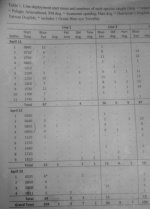
Morning.I Can only tell you what help me .keep a dairy with you.every day write down the pressure wind direction current and most in portend the time that each spesie eats.lots of time you will be on a good reef but they won't eat.learn the habit of each spesie.by us now there's Dorado snoek cuta and bek.Dorado and cuta like the same conditions norteast and sunny.bek and snoek cloudy so on.here by us I'll target first bek 05h00 to 07h00 then rocord and soldier 07h00 to 10h00 then slinger 10h00 to 13h00 and so on.I'll post a PIC of a survey done in Brisban on the bluenose that helped me target them.here you can see there's a definite pattern on the time and tide as each day they eat 1 hour later and its only the tide that moves on every day by about an hour.
 

Attachments

  • IMG_20160311_083131.jpg
    IMG_20160311_083131.jpg
    28.8 KB · Views: 301

STB

Member
Sorry but I'm a fishermen not a computer guy iv asked some one to post the survey on.But to continue nature have a way to tell us when to do what.like if you see the first guy selling leachys on the street your fist fad must go in for Dorado .if you see the first wale its dagga time.when you see the first dragonfly on the pool its GT and bluenose time .That's the way the older guys work.
 

STB

Member
On the bubble story remember that you will only see them when the fish is eating on a frency look for it at an hour before the turn of the tide to an hour after the turn.its very difficult to get the hang of it
 

STB

Member
Once you see these bubbles you found fish but its still a distance from where its found.put you GPS track on and point the boat out to sea do a drift so you can see the direction of the drift.now go back and do the same pointing the boat towards land. You'll see Its two different directions.take a centre line between your two track lines that would be your direction to search for fish.now check your current speed and depth.you need to know the speed of that size bubble I time it in a pool.with the time a bubble travels depth and speed of current and direction you can more or less work out where to find them.it takes time but this is a total new reef that you found.
 

STB

Member
Placing your bait and sinker on the fish is also an art iv seen experience skipper making this mistake especially in deep water.same principal apply to find your true drift line.now mark the fish with your curser one in front one at the back and a few on the side of the showing.set your lines down mark when you start to go down and when you reach the floor with a different icon.that's your run up distance.you want to place your trace at the biggining of the fish.not to far in front because the small sand soldiers will clean your bait off.now pay attention to you line.if its 90 degrees to the boat its a strait drift according to your drift line .that will happen if the wind and current is in the same direction.every one gets good fish then.but when its wind against current or a beastly eastly strait east the boys gets separate from the men.look at your depth say 50 m.now the distance from the tip of your rod to the water say 2 m then where that imaganary line from tip to water touch the water to where your line actuly touch the water say 4 m.now the direction of your line to the drift line.so your line angel is 2m to 4m its 1 to 2 so your boat have to be 100 m from the mark in the lines direction for your bait to be on the fish .mark all of this on the GPS plus the run up distance and you will be pritty accurate.imagine this on 500 m depth with 1 to 2 angle it means you will be with the boat 1000 m of the fish.so if some one give you a mark you need to know the drift of that day and the angle of the line when he found fish.if given a mark sound around properly.
 

kitefisher

Sealiner
STB. Kudos to you for sharing this wealth of information thus far(I am sure there is way more to come). I don't even fish off a boat and yet it is arguable the most interesting information that I have read in a long long time.

Admin ,this should be documented for posterity.

Thanks again STB,great stuff. _seal1_
 

STB

Member
Get use to your fish finder you should be able to tel more or less how many fish is down there if the fish go off the bite sound over the showing to see if all the fish isn't on your boat already so you don't waste time.pre cut your bait.time is fish.shorten your drifts with accuracy. And target your spesie on the time they fead.soos in Afrikaans n goeie skipper kan sy sinker op n tiekie neer sit.
 

Emperor

Administrator
Staff member
kitefisher wrote:
STB. Kudos to you for sharing this wealth of information thus far(I am sure there is way more to come). I don't even fish off a boat and yet it is arguable the most interesting information that I have read in a long long time.

Admin ,this should be documented for posterity.

Thanks again STB,great stuff. _seal1_
agreed. will do.

Thank you . STB
 

STB

Member
On the survey done in Brisbane on the bluenose the bite is 6 hours apart and 1 hour later every day so its clear this spesie depend on the tide for its feeding times.Thanks Shaun
 

IWyk

Sealiner
STB wrote:
On the survey done in Brisbane on the bluenose the bite is 6 hours apart and 1 hour later every day so its clear this spesie depend on the tide for its feeding times.Thanks Shaun

Very interesting to note that the tides influence fishing even so far out.
 

STB

Member
Personally I swear by it .that why I write down when each spesie bites.games fish and bottems it makes a big difference.Remember that every 10 m is 1 newton pressure so on 500 m its 50 newton so every m make a big difference .the tide GOS. Up or down by more than 2 m between high and low.
 

STB

Member
When it change from a high pressure to a low and visa versa it makes s big difference in the way the fish eats as well as full moon and neep tide courter moon.I prefer counter moon for bottems hates full moon..3 day before courter to 3 days after courter is nice on a constant pressure.the two go hand in hand
 

STB

Member
On the servey it was a constant pesure.so the tide makes a difrence if the pressure is constant. Remember 1 newton is 0.01 hpa and the surface pressure is measured in hpa normally between 980 hpa and about 1027 hpa a low pressure and high pressure.so the change in pressure from n low pressure to a high and vise versa make a huge difference in feeding times.Mutch bigger than the tide.Dus its important to put in your dairy time pressure rise of pressure and tide as well as decline in both.So in short if the pressure is constant for more than 6 hours focus on the tide but if the pressure is rising or dropping focus more on the pressure. You will soon see the pattern and will be able to target fish more effective.
 

BigLes

New member
I'm hear to learn... My experience to deep sea bottom fishing is limited to about 15 trips on charter and commercial boats.

This was all off the eastern cape between pe and port Alfred.

Can I ask, many of the skippers I fished with bottom fishing, I noticed that we would start at 30m depth and as it got later in the day we would keep going deeper, as the fish slow down on one reef then they would go to a 50m reef then 60m then 80m. And each time the fish would be feeding very well. Have you noticed that before? Any reason for that?
 

STB

Member
True its better to start shallow and close and work deeper its more to see if the current allows you to fish deep.If the current is to strong and you went strait to the deep you would have wasted a lot of time and fuel.we are fortunate in Durban to have 2 weather bouys that gives you all the info to make the wright choice.see www.cfoo.co.za click on bouy then amamzimtoti or umkomaas.I would go on the hill at gateway to look at the way the ships is facing then compare that with the info on cfoo.this would tell if you have the same current all over or two current facing each other.if the two face each other the current will go out to sea or to land between the port and isipingo making good conditions to fish for trollsoldiers on the drop off.
.if the turn of the tide is urly in the morning I start fishing close but if it is later the day I'll travel then fish.also there reefs is totally different to Durban.theres very good fish close where our reef is more to the deep side.look at the mountains around your area of fishing.like the Drakensberg the bluff here by us don't stop by the water it runs all the way to Richards bay.some places its covered with sand but if you put all your waypoints on the chart you can see a defennate pattern.
 

STB

Member
Also you need to see who you have on the boat if at 30 m they all tangle it would be a total nightmare deeper.so you give the guys time to setle in and get use to the water gear and boat .
 
Top